What are the key points of large red radish planting techniques?
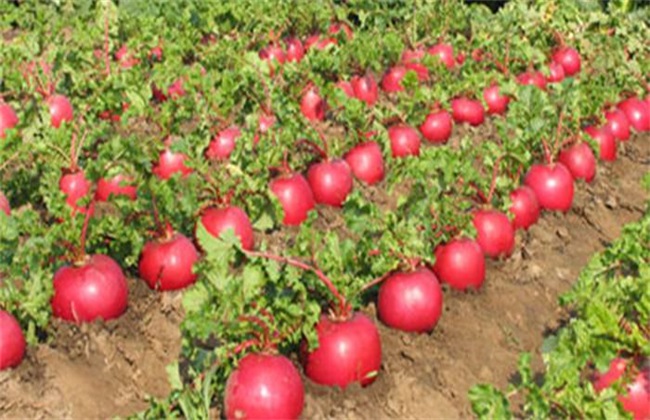
The large red radish is a variety of radish and a vegetable of the Brassicaceae family. It has various effects such as clearing heat and dissipating blood stasis, nourishing the heart and purifying the blood, and strengthening the stomach and relieving cough. It is welcomed by many people and has relatively large market demand. Therefore, the planting area of large red radish is now relatively large. So how should you go about planting large red radish? Today, the editor brings you the planting techniques for large red radish. Let's take a look below!
1. Site selection and land preparation
Before planting large red radish, we first need to choose a suitable planting plot. The planting plot must ensure good permeability, high terrain, dryness, and a sufficient supply of pollution-free water nearby. The soil should mainly be sandy soil; clay-heavy soil has poor permeability and will affect the growth of large red radish. The previous crop in the planting soil should not be a Brassicaceae crop, and crop rotation should be carried out for at least three years. Then carry out land preparation work: deeply plow the soil, break up and level the soil, make high beds, keep the bed surface level, and then apply about 2000 kg of farmyard manure per mu as base fertilizer.
2. Timely sowing
The sowing time for large red radish is generally from June to July each year, and the sowing methods are mainly hole sowing and broadcast sowing. Control the sowing rate well and scatter the seeds evenly over the soil. If using hole sowing, then place 6 seeds in each sowing hole. After sowing, cover with an appropriate amount of soil, and control the sowing depth according to the looseness of the soil. Loose soil can be sown somewhat deeper; otherwise, it should be sown somewhat shallowly. If sowing in summer, then cover the soil with rice straw or plastic film to improve the soil's moisture-retention capacity. This promotes uniform emergence of seedlings and avoids soil compaction caused by rainwater washing, which reduces the emergence rate.
3. Seedling stage management
After the large red radish emerges, we should appropriately extend the thinning time and delay final thinning to ensure a high rate of complete and strong seedlings of large red radish. Adjust the thinning time reasonably according to the sowing method. For example, if using broadcast sowing, then carry out the first thinning when the seedlings have two true leaves. Adjust the spacing between strong seedlings to about 8 cm, and then carry out the second thinning after about 11 days. If using hole sowing, thinning can be done about 7 days after emergence. After the first thinning, carry out one intertillage and weeding operation to promote the growth of the seedlings.
4. Water and fertilizer management
If sufficient base fertilizer has been applied, then the amount of topdressing can be appropriately reduced during planting. Generally, between the stage when large red radish roots begin to turn white and the expansion stage, apply one light fertilizer solution as topdressing. Be careful to control the concentration and the fertilization position to avoid root burn. Large red radish has a relatively large demand for water during growth, so it must be supplied regularly and in fixed amounts. If the soil lacks water, then it will have a great impact on the growth of the large red radish roots. Undesirable phenomena such as spiciness and hollowing are likely to occur. However, water should not be excessive either, as it can easily cause diseases. We should water reasonably according to the growth stage. After emergence, water once a day, and just keep the soil moist.
The above is a brief introduction to large red radish planting techniques. We should also pay attention to doing drainage work well, especially after rain, to avoid affecting the growth of large red radish. Finally, do a good job in pest and disease control to ensure the normal growth of large red radish. That is all for today's introduction. This article is for reference only, and I hope it can help everyone!