What are the environmental requirements for the growth of Panax notoginseng?
Panax notoginseng is a perennial herbaceous plant in the Araliaceae family, and the plant can generally grow to about 60 cm tall. Its distribution is mainly concentrated in the south. Panax notoginseng is mainly used medicinally for its root, and it has various effects such as reducing swelling and resolving blood stasis, and promoting blood circulation to relieve pain. Although the planting area of Panax notoginseng is now large, it cannot be grown just anywhere, because Panax notoginseng has certain requirements for its growing environment. So below, the editor will briefly introduce this to everyone. Let's take a look together!
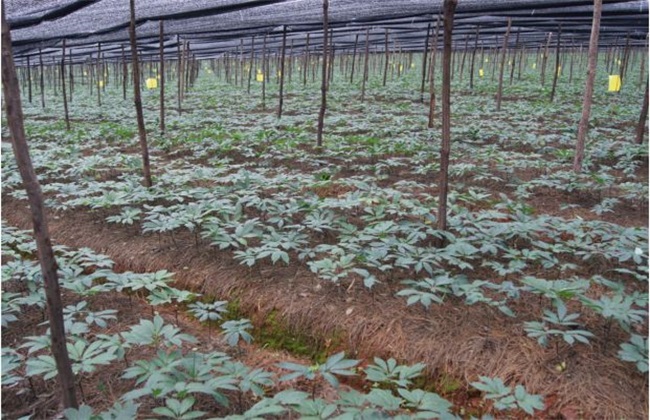
1. Soil
Panax notoginseng's requirements for soil are actually not very strict. Generally, apart from overly acidic soil and heavy clay soil, other types of soil can be used to grow Panax notoginseng normally. However, in order to ensure the normal growth of Panax notoginseng and improve its yield and quality, the soil must be loose and rich in humus. It is best to use sandy soil as the main type, maintain a certain slope, and the land should not have been planted with Panax notoginseng within eight years, with the pH controlled at around 6-6.5.
2. Temperature
Temperature is very important for the growth of Panax notoginseng, and its temperature requirements differ at different growth stages. When the Panax notoginseng seedlings break through the soil, the temperature should be controlled at around 22 degrees, and the soil temperature should remain at 12 degrees. If the temperature is below zero degrees, it will cause frost damage to the seedlings. Then, during the growth period of Panax notoginseng, the temperature should remain at 24 degrees, while the soil temperature needs to be controlled at around 18 degrees. If the temperature is higher than 32 degrees for a long time, it will also affect the growth of Panax notoginseng seedlings.
3. Light
Light is also a planting condition that cannot be ignored when growing Panax notoginseng. When growing Panax notoginseng, a certain degree of shade must be ensured, and the sun must not shine directly on Panax notoginseng for a long time, otherwise it is easy to cause sunburn on the leaves. The light requirement for one-year-old Panax notoginseng is generally about 10% of natural light each year, while for two-year-old Panax notoginseng it is about 14%, and finally the light requirement for three-year-old Panax notoginseng is about 18%.
4. Moisture
Panax notoginseng also has a very high demand for moisture during its growth process. When growing Panax notoginseng, the moisture in the seedbed soil should be maintained at around 28%, and the water content must not be lower than 20% at minimum, otherwise the Panax notoginseng plants will show wilting and water deficiency, seriously affecting the growth of Panax notoginseng. If it is lower than 15%, then the Panax notoginseng seeds will stop germinating, greatly affecting the yield and reducing planting benefits.
5. Altitude
In addition to the above four points, altitude is also something we need to pay attention to. We should reasonably control the planting altitude according to the growth years and variety of Panax notoginseng. If planting a one-year-old variety of Panax notoginseng, then the altitude of the planting site should be controlled at around 1300-1500 m. If it is two-year-old, then the altitude should be controlled at around 1400-1900 m, to ensure the normal growth of Panax notoginseng.
The above is a brief introduction to the environmental requirements for the growth of Panax notoginseng. The growing environment requirements of Panax notoginseng mean that it cannot be planted in many places, so everyone must pay close attention before planting. That is all for today's introduction. This article is for reference only, and I hope it can help everyone!