What kind of growing environment is suitable for Houttuynia cordata?
Houttuynia cordata is a famously controversial wild vegetable: those who like it absolutely love it, and those who do not cannot stand it. In the southwestern region, people are very fond of this wild vegetable, most commonly eaten in cold dressed salads, and it has always been mostly harvested from the wild, but now the wild supply can no longer meet market demand, so artificial cultivation has begun. For artificial cultivation to grow well, it is inevitable to study what the wild environment of Houttuynia cordata is like, and artificial planting should meet those growing needs according to its growth characteristics.
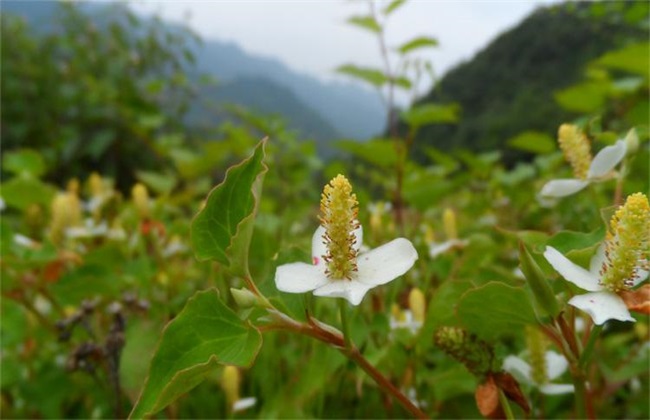
1. Climate
It grows in a subtropical climate; areas like Yunnan are especially suitable for Houttuynia cordata growth, and it is mainly distributed in Hunan, Hubei, Guizhou, Sichuan, Chongqing, Yunnan and other places. It likes a moist, shady growing environment. It often grows in valleys, beside fields, and along earthen ridges.
2. Temperature
It has strong adaptability to temperature; the rhizome can sprout above 12 degrees, grows poorly below 12 degrees and above 25 degrees, and at a high temperature of 35 degrees growth stops but it will not die, and it can endure it briefly. It can overwinter below zero degrees. Aboveground tissues can grow at 13 degrees, but it is best between 13 degrees and 18 degrees.
3. Humidity
Its root system is distributed rather shallowly and not widely, and it has few root hairs, so its water requirements are quite strict; the soil must be kept moist and must not lack water, preferably at 70% to 80%, and air humidity at roughly 60% to 80%. Lack of water and drought easily cause seedling death. Although wild plants are sometimes seen still surviving in extreme drought, that is wild; artificial cultivation should provide as good an environment as possible.
4. Light
It is not strict about light requirements, but it rather likes weak light and is also fairly shade-tolerant, because under strong light the corresponding temperature rises, affecting growth, and water evaporates easily, making the soil dry and the roots lose water, so it does not grow very well.
5. Soil
It is best grown in loose soil; compaction is not good for rhizome growth. If the soil is clayey and heavy, when there is a lot of rain water it easily turns black and rots, but sandy soil is also no good, as it loses water very quickly and growth is poor. It is best grown in sandy loam, which has good fertilizer and water retention. It grows in neutral soil, and the main nutrient supplements are nitrogen fertilizer and potassium fertilizer.
Houttuynia cordata grows well mainly in moist, shady, weakly lit, neutral sandy loam, so in actual cultivation the suitable growing environment should be provided as much as possible, which is also very beneficial for yield.