Detailed Explanation of Key Management Techniques for Celery Greenhouse Cultivation
Celery has a relatively long cultivation history. The plant itself is not very tall and grows relatively fast, making it quite suitable for greenhouse planting and also very suitable for insulated hydroponic cultivation in greenhouses. Greenhouse cultivation creates an artificial microclimate environment that can retain heat and moisture for off-season cultivation, but humidity control inside the greenhouse is difficult, and the air environment is not as good as outside. There are some drawbacks, and these drawbacks are also the key points in managing celery greenhouse cultivation.
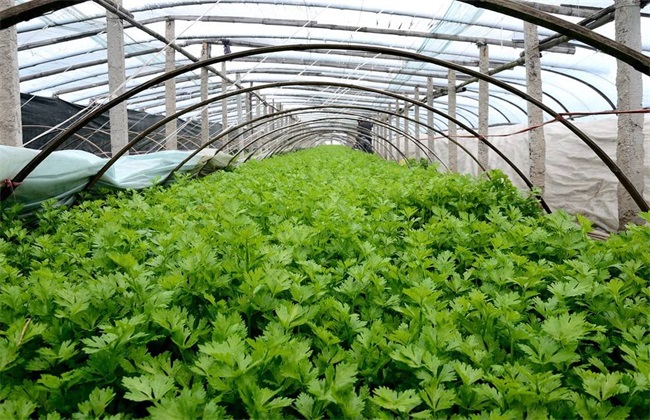
I. Seedling Stage Management
Seeds do not need soaking before sowing because the seeds are relatively small; sow directly, and it is best to use seedling trays for raising seedlings, which reduces seedling-stage diseases and latent pathogens. Seedling trays can save on seed usage, have a high emergence rate, and are convenient to manage and can be moved freely. They can be used for direct hydroponic seedling cultivation in the greenhouse. The nutrient soil must be sterilized. After roots grow, the seedling trays float in water for seedling cultivation. The light transmittance of the greenhouse film should not be too high, and light and temperature should not be too strong. Nutrient solution can be directly prepared and applied.
II. Transplanting Management
Transplant directly into the bed surface. When transplanting, the seedlings can be gently lifted and transplanted with nutrient soil, basically without damaging the root system. After planting, keep moist until new leaves grow, then reduce watering. After the seedlings recover, as the root system begins to grow, water multiple times, but do not water thoroughly; guide the roots to grow downward. After that comes seedling hardening; during seedling hardening, apply less fertilizer and water, and in the late stage of seedling hardening, apply dilute fertilizer water.
III. Growth Management
1. Fertilization
Once seedling hardening ends, the rapid growth stage begins. At this time, a large supply of fertilizer and water is needed. Celery is tolerant of fertilizer, mainly requiring nitrogen fertilizer, followed by phosphorus and potassium fertilizers. Nitrogen fertilizer mainly supports leaf growth. Phosphorus fertilizer has poor mobility, so it is mainly applied concentratedly in the early stage. Celery stems need potassium fertilizer to remain upright and glossy, but not too much, as it easily causes hardening. It requires relatively more trace elements boron and calcium. Calcium deficiency causes dry heart disease, boron deficiency causes black heart disease, and potassium fertilizer inhibits the absorption of calcium and boron.
2. Temperature and Humidity
It can grow even at low temperatures of minus 10 degrees, but the best temperature is 15 to 20 degrees. Under high temperatures, growth is slow or even stops. However, greenhouse film with higher opacity can be used to lower the temperature somewhat. In the greenhouse, the temperature should be reduced at night. On sunny days, ventilate; 20 to 22 degrees is sufficient. Watering inside the greenhouse should be less frequent than in open fields. Do not flood irrigate; drip irrigation is best. The water vapor produced will condense and drip down, causing diseases, and the humidity will also be too high. Water only when the soil looks dry.
Celery greenhouse cultivation is intended to create an environment suitable for celery growth, but I think greenhouse cultivation is mainly most applicable in severely cold winter regions. Management differs somewhat, caused by the limitations of the micro-environment. To learn more about agriculture, please continue to follow.