Key Field Management Techniques for Cowpea After Transplanting
Cowpea is what we commonly call long beans in daily life. It is rich in nutritional value and has a very large market demand in China. Cowpea cultivation is mainly done through seedling raising and transplanting, which can effectively increase yield and expand planting benefits. Therefore, management work after transplanting cowpea is very important. So how exactly should it be managed? Below, the editor brings you management tips for cowpea after transplanting. Let's take a look!
1. Reasonable Watering
After transplanting, water well to stabilize the seedlings and improve the survival rate of the young plants. Then, after the seedlings enter the slow seedling stage in autumn and winter, water once more, and water again after the slow seedling stage ends. Then do a good job of intertillage and hoeing to promote seedling squatting and improve the soil's moisture retention capacity. Be sure to control the amount of watering well; do not water too much, otherwise water accumulation can easily lead to seedling death. Afterward, water reasonably according to the growth stage of the cowpea seedlings. For example, during the bud stage, drip irrigate appropriately with a small amount of water, and do not water during the early flowering stage. A reasonable watering method can effectively improve the survival rate of cowpea seedlings after transplanting.
2. Scientific Fertilization
Before transplanting, we must first apply sufficient base fertilizer. Then, during the cowpea seedling stage, apply phosphorus cake fertilizer once in the holes, with the amount of cake fertilizer per mu controlled at about 60 kg. When topdressing, we should follow the principle of applying less fertilizer before flowering and more fertilizer after flowering. After transplanting and survival, apply one topdressing of decomposed farmyard manure, with the amount per mu controlled at about 1000 kg. Then, after flowering, increase the amount of fertilization and reduce the frequency of fertilization. When topdressing, we should reasonably adjust the nutrient ratio of the fertilizer according to the growth condition of the cowpea, soil fertility, and other factors, so as to ensure normal growth of the seedlings.
3. Building Supports in Time
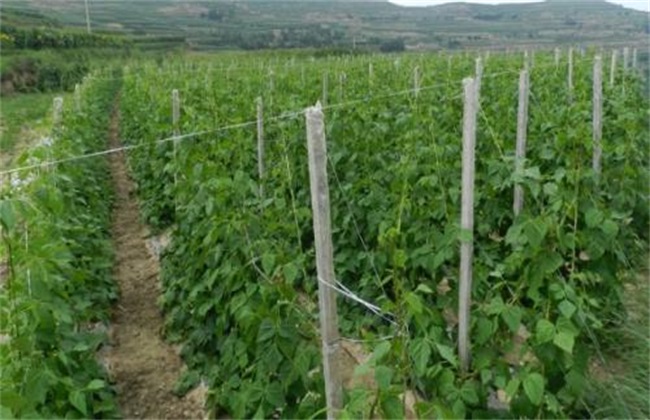
Cowpea is a vining vegetable, so after transplanting we should also pay attention to doing a good job of building supports. After transplanting, when the seedlings begin to send out vines, supports should be set up in time to avoid them tangling with each other, affecting growth, causing flower and pod drop, and reducing yield. The cowpea supports should be inserted at a position about 12 cm from the base of the seedlings, with the support depth maintained at about 18 cm. Then, at about 4/5 of the support's height, horizontally tie another bamboo pole to guide the vines well, letting the cowpea grow along the supports. Building supports in time can effectively increase cowpea yield, so everyone must pay close attention to this.
4. Pest and Disease Control
Pest and disease control is not only something to pay attention to after cowpea transplanting; it is something we must not relax our vigilance on throughout the entire growth period of cowpea cultivation. Different pests and diseases appear at different growth stages of cowpea, and some pests and diseases may even occur throughout the entire growth period of cowpea. Therefore, after transplanting, we must strengthen management, spray and disinfect regularly, and do a good job of intertillage and weeding. Common pests and diseases include anthracnose, gray mold, and bean pod borer, among others. After transplanting, we should frequently observe the growth of the seedlings, and when disease occurrence is found, promptly take corresponding measures to control it.
The above is a brief introduction to how to manage cowpea after transplanting. After transplanting, we should also do a good job of replanting. For some weak seedlings, diseased seedlings, and dead seedlings, promptly remove them, then replant healthy seedlings of the same growth to improve the rate of uniform seedlings and yield. That is all for today's introduction. This article is for reference only, and we hope it can help everyone!