What kind of environmental conditions does garland chrysanthemum cultivation require?
Garland chrysanthemum, also called chrysanthemum greens, is an annual to biennial vegetable whose leaves and flowers closely resemble those of chrysanthemums. Mainly its tender stems and leaves are harvested for eating, and it can also be used as a medicinal herb. As a medicine it helps reduce phlegm and nourish the stomach. At present there are wild varieties in the Hebei region, and it is widely cultivated nationwide. However, garland chrysanthemum also has certain restrictions on its growing environment and climate, and it cannot be planted just anywhere. Even in some environments where it can survive, it will not necessarily grow well. To achieve high yields, the best possible growing conditions must be provided to the greatest extent. The specific requirements are listed and introduced below.
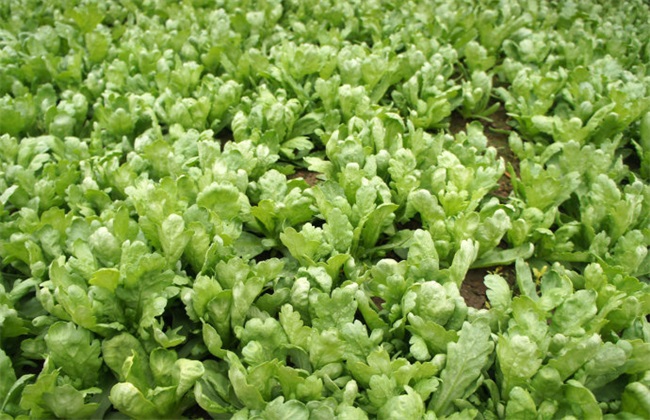
1. Climate
Garland chrysanthemum is a semi-cold-hardy vegetable, mainly grown in semi-cold temperate to subtropical regions. It is well suited to cultivation in regions where the cold is not too severe and the heat is not too high. As long as the four conditions are met and there is a suitable temperature and climate, it can be planted. In temperate regions it can be planted year-round. In other areas, spring and autumn planting may need to be chosen.
2. Light
Garland chrysanthemum is a short-day vegetable. It grows well under short-day conditions and grows best under weak light. If planted in a long-day environment, its growth is relatively slow, its vegetative growth and development are incomplete, and it easily enters the reproductive growth stage rapidly, then begins to age, mature and set seed. Long days easily cause premature maturity.
3. Temperature
Because it likes a cool environment, its growth is afraid of high temperatures and it cannot grow under high temperatures. The best temperature for growth is 17 to 20 degrees, and growth stops above 29 degrees. However, below 12 degrees it grows poorly. Sudden low temperatures or short periods of low temperature can be tolerated, but it cannot remain at low temperature continuously. Seed germination requires a temperature above 10 degrees per day, but for uniform emergence it needs to be between 15 degrees and 20 degrees.
4. Humidity
The soil moisture for growth should be around 75% to 80% for good growth. The soil must always be kept moist, neither dry nor waterlogged. Waterlogging affects development and reduces yield. Water less during the emergence stage, as damping-off disease easily occurs. In addition, under normal circumstances you can water once a week, or you can water according to the soil moisture, watering when it is dry.
5. Soil and nutrients
Slightly acidic soil is required, as this kind of soil is suitable for growth. Then, deep soil with good fertility is required. About 100 jin of compound fertilizer must be applied to the soil, and in addition a large amount of farmyard manure must be applied to supplement the elements lacking in the soil that garland chrysanthemum needs. The compound fertilizer should be roughly 30 jin of nitrogen fertilizer, 50 jin of phosphorus and 20 jin of potassium fertilizer. This application rate can be adjusted appropriately.
For the five environmental factors above, garland chrysanthemum cultivation has its own growth limits. As long as you grasp the growth principles of garland chrysanthemum and adjust accordingly, it will be fine. Friends who want to learn more can refer to this for reference. Thank you for reading and supporting; for more cultivation content, please follow for future updates.