What are the precautions for growing watercress?
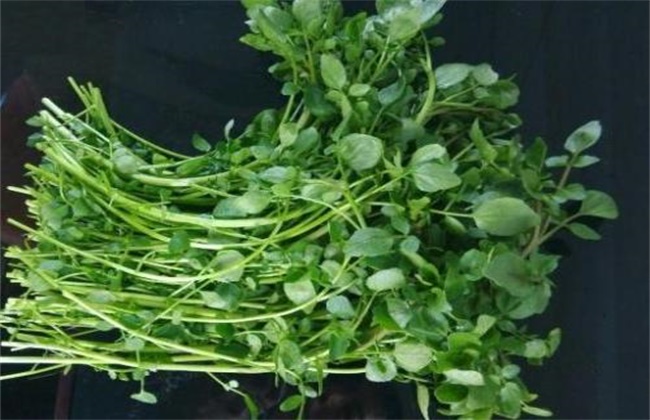
Watercress, also known as douban cai, is a perennial aquatic herb in the genus Nasturtium of the Brassicaceae family. It is a health-promoting vegetable that is not only very good for health but also tastes excellent. So what should be noted when cultivating watercress artificially? Let's take a look.
1. Temperature
The most suitable growing temperature for watercress is between 15-25 degrees; it grows rapidly at around 20 degrees, and the stems and leaves are of good quality. When the temperature exceeds 30 degrees, growth is inhibited and diseases are prone to occur. Below 10 degrees, the stems and leaves turn red and the quality is poor. In addition, during planting, care should be taken to maintain a water depth of about 5-7 cm. If the water level is too deep, it will cause excessive vegetative growth, too many adventitious roots, and yellowing stems and leaves; this is caused by the soil oxygen content at sowing and the excessive nutrient consumption by adventitious roots. If the water is shallow, the stems tend to age; this is caused by the water temperature easily becoming too high and the air humidity being relatively too low.
2. Light
Watercress is a light-loving crop. Insufficient light or overly dense planting will make the stems and leaves grow weak, accumulate fewer nutrients in the stems and leaves, and reduce yield and quality. Therefore, when planting, be sure to choose a plot with sufficient light, and the planting density should not be too dense, so as to avoid field closure, which leads to thin and weak stems and leaves, low nutrient accumulation, and a relatively large impact on returns.
3. Fertilizer
Watercress is a fertilizer-loving crop, especially fond of nitrogen, and it has certain requirements for base fertilizer, so generally 1500 kg of decomposed farmyard manure or 3500 kg of manure is applied in the base fertilizer. In addition, topdressing should be done promptly once after each harvest, such as drenching with decomposed human excrement and urine or diluted urea solution. During the growing period, in the evening when sunlight is relatively weak, spray foliar fertilizer 2-3 times, adding 0.5 urea solution, which will make it grow quickly, have good quality, and produce high yields.
4. Disease prevention
Watercress shows relatively strong resistance throughout its entire process, but it is inevitable that some pests will damage its leaves. Common pests include diamondback moth, aphids, or striped flea beetles, etc., which will cause certain damage to the leaves. At this time, growers are required to treat it promptly, observe the patterns of pest occurrence, and spray pesticides for control.
The above is an introduction to the precautions for growing watercress. We hope it can help you. If you want to learn more related knowledge, please stay tuned to us.