How to fertilize Atractylodes macrocephala? A detailed guide to practical fertilization methods
Atractylodes macrocephala is a perennial herbaceous plant whose main economic value comes from its rhizome used as medicine, and it generally grows in the Jiangnan region. It has high medicinal value and is a medicinal material that has always been in great demand on the market. It is widely cultivated artificially, but to achieve abundant harvests and high-yield, high-quality rhizomes, fertilization is needed to support growth and achieve this goal. What fertilizer requirements does Atractylodes macrocephala have, how should it be applied, where should it be applied, what should be applied, and how much should be applied? Read the following content with these questions and find the answers.
I. Fertilization requirements
Atractylodes macrocephala mainly relies on its swollen roots to stabilize the plant, and on its fibrous root system to absorb water, nutrients, and other organic matter. Therefore, the root system's absorption capacity is not strong, and the swollen roots need protection, so fertilizer can only be applied in small amounts multiple times. Do not apply highly concentrated fertilizer, and do not apply fertilizer with high heat-generating properties. Composting fertilizer can reduce some of its heat and sterilize it, making it easier to absorb. The root system is not extensive, with depth within 20 cm, so fertilizer should not be broadcast over the whole field; concentrating it is beneficial for absorption.
II. Fertilization methods
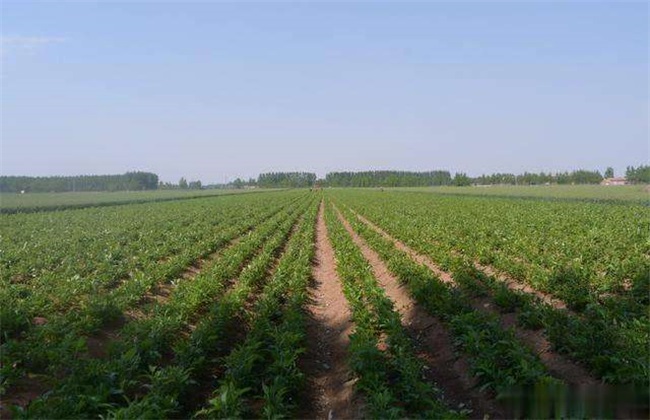
Concentrated fertilization is more beneficial for root absorption and utilization. You can open a furrow 10 cm deep and 10 cm wide in the middle of the planting row for band application, so it is neither too far nor too close to the roots, will not damage the roots, and can be well absorbed. Alternatively, use the ring-shaped furrow application method, that is, dig a ring-shaped furrow around each plant's root system at a distance of 10 cm from the roots and apply fertilizer there, with the furrow depth at about within 10 cm, so fertilization absorption is the most complete and the least wasteful.
III. Fertilization
1. Base fertilizer
First, select the land before planting. If the selected site is relatively poor, then fertilization is needed to improve the soil, applied together with the base fertilizer, increasing the amount used somewhat. Apply about 1500 jin of farmyard manure per mu. If the land is relatively fertile, then the amount can be reduced somewhat, to about 1000 jin per mu. Bury it into the soil when deep plowing, and rotary tillage to break up the soil helps mix it together thoroughly and evenly.
2. Seedling recovery fertilizer
The first topdressing is after the seedlings are planted and the seedling recovery period has passed; then water and fertilizer should be applied together promptly once. During the seedling recovery period, do not fertilize or water. This time, watering is the main focus, providing the water for the plant to stand upright and transport the products of photosynthesis. But fertilizer should be added to promote leaf and root growth, produce more nutritional products, and speed up growth.
3. Flowering and root-strengthening fertilizer
After flowering, the main shift is to the reproductive growth of the underground rhizome, and topdressing at this time is for the later growth of the rhizome. Flowering consumes a lot of nutrients, so generally more phosphorus fertilizer should be applied to meet the needs of flower growth, and less nitrogen fertilizer to avoid excessive aboveground growth. When the rhizome enters its main growth period, more potassium fertilizer is needed to strengthen the rhizome, and nitrogen fertilizer use only needs to meet the needs of photosynthesis.
4. Post-harvest fertilizer
Atractylodes macrocephala is a perennial plant, so after harvesting the rhizome, the plant still grows and will continue to grow roots the next year. Therefore, farmyard manure must be applied well within one week after harvest, which can actually be counted as part of the base fertilizer for the second year. In winter, these fertilizers are also needed to maintain normal growth. Apply about 500 jin per mu.
Atractylodes macrocephala needs a good continuous supply of fertilizer to maintain good growth at all times and not be affected by external conditions. Therefore, attention should be paid to fertilization, targeted fertilization, and no shortage of fertilizer, which provides a certain guarantee for both yield and quality.