A Detailed Guide to Black Skin Wax Gourd Planting Techniques and Management Methods
Black skin wax gourd is a common vegetable and a gourd vegetable variety that farmers have actively grown in recent years. It has the advantages of high yield, good quality, and tolerance for storage and transport, with very good prospects for development. So how should black skin wax gourd be planted? Let's find out together.
1. Sowing and Seedling Raising
Choose a plot with convenient drainage and irrigation and fertile soil, apply 1000-1500 kg of decomposed farmyard manure per mu, rake it fine and level, mix it evenly with the soil, and then make beds. Before sowing, first soak the seeds in 40 degree warm water for 4 hours, then disinfect them with a low-concentration potassium permanganate solution for 3 minutes. After removing the seeds, wrap them in clean white cloth, and of course place them in a suitable temperature environment for germination. When the seeds begin to show white, they can be sown. When sowing, use double-row sowing, requiring a plant spacing of 85-90 cm, sowing about 900 holes per mu, generally sowing 3 seeds per hole. When the seedlings grow two leaves, they can be transplanted, leaving one seedling per hole.
2. Fertilizer and Water Management
Black skin wax gourd has a large fertilizer requirement, so sufficient base fertilizer should be applied. After transplanting and setting, apply a light nitrogen fertilizer every 7-10Ian, or apply 40-50 kg of compound fertilizer per mu, and 60-80 jin of raw bran. In winter, fertilizer should be applied frequently and lightly, light first and heavy later, with a reasonable combination of nitrogen, phosphorus, and potassium fertilizers. After the vines are on the trellis, the water requirement increases, so watering should be done frequently. Keep the soil supplied to meet the needs of gourd growth. In the rainy season, pay attention to drainage to avoid water accumulation that causes root rot.
3. Vine Training and Vine Pressing
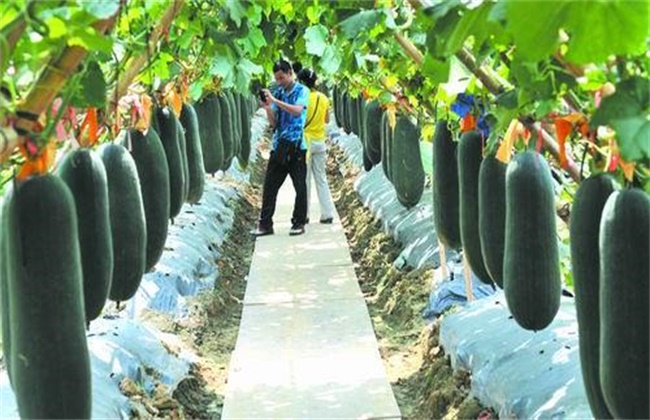
Black skin wax gourd generally sets fruit on the main vine. When setting fruit, remove side vines in time. Before fruit set, remove all side vines. Before going on the trellis, coil the main vine within the range of the plant spacing, pressing the vine once every 3*4 nodes, for a total of 3-4 times, to promote the formation of adventitious roots. When it reaches 16-18 nodes, guide the vine onto the trellis. Use 3 or 4 bamboo poles to build a drum frame, with one bamboo pole placed horizontally on top as the dragon root. When the wax gourd grows to 3-4 jin, use a rope to loop around the fruit stalk and tie it to the dragon root of the drum frame. After fruit set, top the plant at around the 15th node. At the same time, reasonably retain fruits according to the plant's growth state. Generally, retaining fruit at the 3rd-4th female flower on the main vine is ideal. Artificial pollination can be used to increase the fruit-setting rate.
4. Pest and Disease Control
The main diseases of black skin gourd are fusarium wilt, phytophthora blight, and anthracnose, which can be controlled with pesticides such as chlorothalonil and thiophanate-methyl. The main pest is thrips. At 25-30 degrees, July-September is when the disease is most severe. For control, promptly spray pesticides such as bisultap and acetamiprid EC. Pesticides should be used alternately to avoid developing resistance.
The above is an introduction to the planting techniques for black skin wax gourd. I hope it can help you. If you want to learn more related knowledge, please follow us.