Detailed Explanation of Key Management Techniques for Greenhouse Cucumbers
After cucumber planting, the most important and longest-lasting work is nitrogen fertilizer planting management in the cucumber field. Open-field planting has its own key points and methods for open-field management, as well as some precautions. The management techniques for greenhouse planting are different again. For the warm microclimate conditions, growth management methods and so on must also be adjusted to a certain extent, and the key management points must be grasped well. You can take a look at some of my views on cucumber greenhouse management.
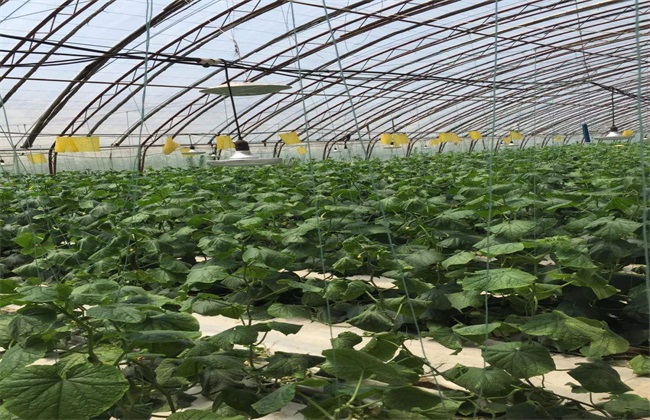
I. Water and Fertilizer Control
When cucumbers are planted in greenhouses with plastic film mulching, because of the mulching, water vapor is not easily discharged out of the greenhouse, and doors or windows must be opened for it to evaporate out. Therefore, irrigation should preferably be set up with drip irrigation facilities, so that the water slowly drips into the soil. Do not use large-volume flooding irrigation, as it easily breeds diseases. Alternatively, irrigate in small amounts multiple times. At the seedling transplanting stage, use about 30 jin of nitrogen fertilizer per mu, such as urea. During the flowering and fruiting stage, apply a topdressing once, applying about 45 jin of phosphorus and potassium fertilizer per mu, then spray a 0.2% potassium dihydrogen phosphate solution. Fertilization should be combined with watering. During the fruiting stage, a large amount of water is needed, and irrigation can be done about once every five days, but do not apply excessive amounts, as the flavor easily becomes bland.
II. Temperature Control
After transplanting, the seedlings need to recover, which requires heat preservation, so the greenhouse needs to be closed, and the temperature can rise slightly without ventilation. Only after the seedling recovery period is over and normal growth begins can ventilation be gradually introduced, maintaining a daytime temperature of 20 to 28 degrees and a nighttime temperature above 12 degrees. When the outside nighttime temperature can remain stable above 12 degrees, ventilation can be kept open throughout the night.
III. Plant Adjustment
When cucumbers begin to send out vines, trellises should be set up in time so the vines can climb smoothly. When branch vine growth shifts to reproductive growth and the branch vines almost stop growing, vine tying should begin, tying the branch vines with rope at intervals of about 20 cm. During the vigorous growth period, remove old leaves at the bottom in time to improve ventilation and reduce humidity, and remove excess branches in time, leaving healthy main branches. Remove the tops of all retained branch vines to concentrate nutrients for the fruit.
IV. Disease and Pest Control
The main diseases to control are downy mildew and Phytophthora blight. To prevent disease occurrence, broad-spectrum fungicides are mainly used, spraying once every one week or more than one week, with two consecutive sprays. After disease onset, in the early stage of the disease, use agents such as 58% metalaxyl for spraying, and continuous spraying is possible, generally spraying once every three days, and three or four consecutive sprays are enough. The main pests to control are aphids and red spider mites, both of which are piercing-sucking pest insects. You can use 3% acetamiprid emulsifiable concentrate at 2000-2500 times dilution or 10% imidacloprid wettable powder at 2000 times dilution.
Greenhouse cucumber cultivation management consists of the above major aspects, but in actual production management, attention should be paid to refining these major points for detailed management. It is also necessary to take into account the actual environmental conditions, climate and some other practical factors, and one can adapt flexibly in practice.