How to manage peas during the podding stage? Detailed explanation of key technical points
The peak growth period of pea cultivation is the podding stage. At this time, sufficient fertilizer and water are needed, along with measures such as pruning and training to regulate pea growth. So what measures are generally used to assist regulation, and how should fertilizer and water be managed? Please pay attention to the following content.
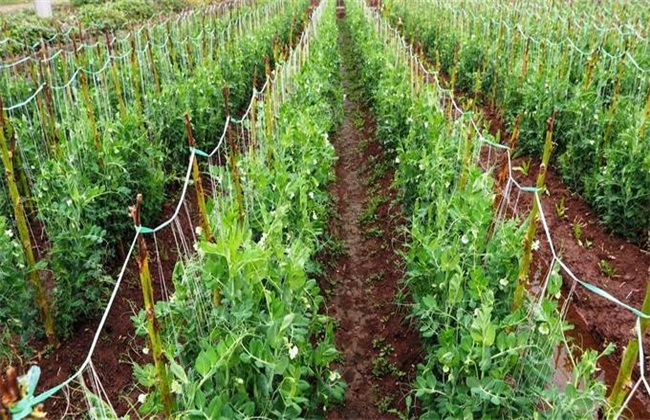
I. Pruning and training
1. Removing buds
The lateral buds at the base can be removed to improve ventilation and light penetration, increase photosynthesis, reduce crowding, lower humidity, and prevent diseases caused by lower branches and tips touching the ground. It can also avoid unnecessary nutrient consumption, direct nutrients to the main stem, and then promote thickening of the main stem and pod formation.
2. Pinching
Keep the main vine and a few lateral vines, then remove the excess parts and remove the terminal buds on both the main vine and lateral vines. Eliminate apical dominance, preserve nutrients so the vines thicken, and avoid excessive vegetative growth, so as not to consume too many nutrients and reduce the quality of the retained pods.
II. Light
When growing peas in greenhouses, the duration of light exposure can be adjusted. Generally, peas are not very strict about light duration during podding, and they can grow well in open fields without adjustment. However, pea pods are afraid of strong light and need sunlight; strong light will cause peas to lose water, so shading can be provided during strong-light weather.
III. Fertilizer and water
Pea roots are not strong and need water, but waterlogging must be avoided. Generally, keep the soil alternately dry and moist, and apply more fertilizer and water during the podding stage. However, do not flood-irrigate, and do not apply too much fertilizer at one time; it can be applied multiple times during this period. Podding fertilizer is the main topdressing at this stage. After the young pods have set, apply fertilizer and water together, about 100 jin of compound fertilizer per mu, then water one week after application to promote dissolution and absorption. Water once a week and fertilize once every 1.5 months until podding stops, but topdressing can prolong the pea growth period.
IV. Pest and disease control
The main pea disease is brown spot, which mainly damages leaves, stems, and pods, showing brown concentric-ring spots, and the leaves wither and die. It is generally triggered by low temperatures. Use a 70% thiophanate-methyl wettable powder 500-fold solution sprayed at the early stage of disease onset, once a week, for several consecutive weeks. The main pest is the black leafminer, whose larvae mainly bore into and feed on the xylem inside stems, mainly damaging legumes. Use 45% phoxim emulsifiable concentrate diluted 1000-fold with water for spraying.
The main work during the pea podding stage is to accomplish the above tasks, and these key points must be paid attention to. Through the above brief introduction, everyone should have learned some content. For more other content, please pay attention to subsequent updates.