How should carrots be grown to increase yield?
Carrots are a common vegetable in people's daily lives, rich in their unique carotene, and are a staple vegetable consumed every day. To achieve greater economic benefits from growing them, it is necessary to increase yield and ensure quality, so what follows is how to increase yield through specific measures in production.
1. Site selection and variety selection
When planting, choose land that is relatively flat, rich in organic matter, convenient for drainage and irrigation, and free from continuous cropping, and carry out crop rotation. Control the source of pathogens and improve growth quality. Choose varieties suited to the local climate and ecology, with strong disease resistance and not prone to forking, such as Hongxin No. 6 from the National Vegetable Engineering Technology Research Center; for autumn planting, improved variety series of the Japanese Kuroda type can be chosen; for greenhouse planting, Dutch carrots such as Newton can be chosen.
2. Sowing methods
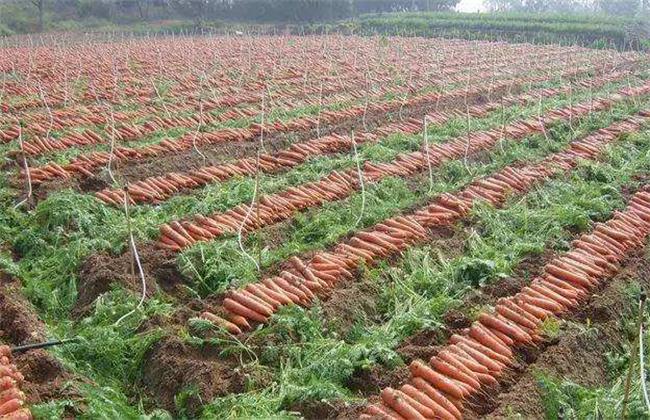
Spring planting is done from November to early December, and autumn planting from June to July. Before planting, plow the soil deeply, then rotary till twice, and sun the soil for three days or spray pesticide to kill underground pests. After leveling the land, manually form ridges about 20 to 30 cm wide and 30 cm high, leaving sowing furrows 20 cm wide and 30 cm deep. This helps with drainage and aeration, and meets nutritional needs. Sow shallowly in fine soil, or cover with edible mushroom residue, and gently press the covering soil to prevent rain from washing it away. For autumn-sown carrots, emergence and growth are slow, so before emergence spray pendimethalin to prevent weeds from growing.
3. Field management
Spring-sown carrots emerge about 10 hours after sowing, and when grown in a greenhouse the temperature must be controlled below 30°C. Autumn sowing uses pre-germinated seed, and emergence occurs about 6 hours after sowing. When there are three true leaves, irrigation is needed to maintain moisture. Thin the seedlings 3 times during one growing period. When the seedlings are about 4 cm tall and have 2 true leaves, thin once with a plant spacing of about 4 cm; when the seedlings are about 10 cm tall and have 4 true leaves, thin again with a plant spacing of 5 cm; when 6 true leaves appear, thin a third time with a plant spacing of 14 cm.
Before planting, decomposed farmyard organic fertilizer is needed, and depending on the soil's fertilizer tolerance, oil cake can also be added, or a nitrogen-phosphorus-potassium compound fertilizer can be applied. Two months after sowing, the fleshy root enters a rapid growth and swelling stage, requiring a large supply of water and fertilizer, and compound fertilizer can be applied as a top dressing, about 40 jin per mu. Control water in the early stage to make the roots grow downward, use drip irrigation or overhead spraying in the middle stage, and in the late stage decide based on the weather. The main diseases and pests of carrots include bacterial soft rot, black rot, as well as fennel swallowtail butterflies and cotton bollworms. They need to be controlled with emphasis. For bacterial soft rot, copper hydroxide can be used at the early stage of the disease; for black rot, copper ammonia complex water agent can be sprayed at the early stage of the disease; and for cotton bollworms and fennel swallowtail butterflies, fipronil can be used for control.
The growth of carrots can be adjusted through the above methods to achieve the desired high yield. By learning the above theory and then combining it with your own actual situation for specific operations, I believe a substantial increase in carrot yield can certainly be achieved.