Cultivation and Management Techniques for the Netherlands-Introduced Specialty Vegetable Buli Tower Eggplant
Cultivation and Management of the Netherlands-Introduced Specialty Vegetable Buli Tower Eggplant
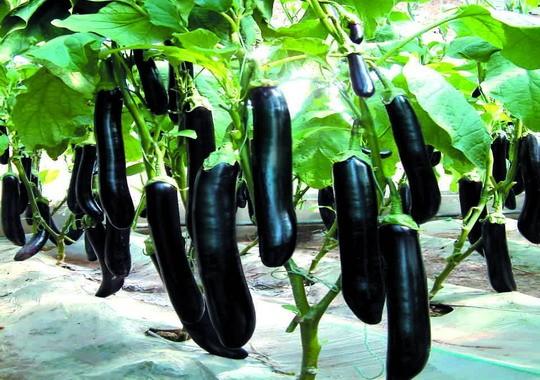
Buli Tower eggplant is a new variety introduced from the Netherlands. The plant grows 2 to 3 m tall, resembling an "eggplant tree," and can climb, branch and bear fruit like a cucumber. Its leaves are medium-sized, the flowers are purple, and the calyx is small. The fruit is elongated, with a purple-black surface that is smooth and glossy, 22 to 35 cm long and 4 to 7 cm in diameter. This eggplant has good disease resistance, high yield potential, good storage tolerance and excellent market quality.
Buli Tower eggplant is suitable for overwintering cultivation in solar greenhouses with multi-layer covering. The seedling-raising process is the same as for other eggplants, or you can buy young seedlings from a certified seedling nursery and plant them directly.
1 Site selection
Eggplant is most averse to continuous cropping. Choose a loam or sandy loam plot with deep soil, convenient irrigation and drainage, and where no solanaceous crop has been grown in the previous season. Generally, apply more than 5000 kg of decomposed organic fertilizer per mu, along with about 60 kg of compound fertilizer with a total NPK nutrient content of 45% or more. Apply the fertilizer 15 to 20 days before land preparation and planting. After fertilizing, plow deeply to 30 cm, level and harrow finely, and form small raised ridges 15 to 20 cm high with a ridge spacing of 80 cm.
2 Planting
The planting time is September 10 to 15, chosen on a cloudy day or the evening of a sunny day. The plant spacing is 30 to 45 cm, with about 1800 seedlings planted per mu. After planting, drip irrigation is best, watering thoroughly to help the seedlings recover and improve the survival rate.
3 Management after planting
3.1 Temperature management
After planting, if the temperature inside the greenhouse is too high, open the greenhouse film for ventilation; if the temperature inside the greenhouse is too low, close the greenhouse film vents. Keep the daytime temperature at 25 to 30°C and the nighttime temperature at 17 to 20°C.
3.2 Fertilizer and water management
After planting, eggplant growth is mainly in stems and leaves. Water to promote plant growth 15 to 18 days after planting, and apply topdressing together with watering, applying 10 to 15 kg of ammonium sulfate or urea per mu.
3.3 Cultivation
After watering to help the seedlings recover, when the soil moisture is suitable, carry out cultivation and earthing up to a depth of about 5 cm. Cultivation loosens the soil surface, increases aeration, helps conserve moisture, raises soil temperature and promotes deeper root development.
3.4 Pest control
The main pest is aphids. Aphids attack the plant leaves, causing slow growth, leaf curling and even death. To control aphids, spray 50% pirimicarb wettable powder at 2000 to 3000 times dilution per mu, spraying once every 7 to 10 days for 2 to 3 consecutive sprays, which gives good control results.
4 Management during the flowering period
About 20 days after planting, eggplant enters the flowering period of the first fruit, which is the fruit set on the inflorescence of the first branch on the main stem. In terms of management, appropriately control water to prevent excessive plant growth that could affect fruit set.
4.1 Pruning and sucker removal
During the bud emergence and flowering period of the first fruit, prune the eggplant once, that is, after the first branches emerge from the main stem, keep only two stems growing and remove excess side branches and the growing tip. During this period, tillers are likely to sprout from the base of the plant and should be removed promptly. In addition, remove the latent buds in the leaf axils to reduce nutrient consumption and improve ventilation and light penetration for the plant.
4.2 Hanging vines
Buli Tower eggplant plants are tall and need external support to climb, branch and bear fruit. When the plant grows to 70 to 80 cm, vines must be hung, which both makes reasonable use of space and prevents the eggplant from lodging and causing fruit rot. Commonly, polypropylene tape or rope is used, tied around the eggplant stem and wrapped twice around it, with the other end fixed to a prepared wire frame.
4.3 Flower smearing
To prevent flower and fruit drop caused by poor pollination due to low nighttime temperatures, 2,4-D aqueous solution at a concentration of 0.002% to 0.003% is commonly used for flower smearing. One to two days before flowering or just as flowering begins, dip the solution and apply it to the flower stalk. If you want Buli Tower eggplant to reach the market earlier, you can add another layer of plastic film after the eggplant flowers, which helps increase soil temperature, improve fertilizer use efficiency and improve management efficiency during the early fruiting period.
5 Management during the early fruiting period
5.1 Leaf removal
When the first fruit reaches 3 to 4 cm in diameter, remove leaves once, removing the yellowed old leaves and diseased leaves in the lower part of the plant to improve ventilation and light penetration, reduce flower drop and nutrient consumption, and promote fruit coloring and rapid growth of the first fruit. If the plant is growing vigorously, a few more leaves can be appropriately removed.
5.2 Topdressing
When the first fruit begins to swell, topdress and water, applying about 15 kg of potassium sulfate compound fertilizer per mu, with topdressing and watering once every 10 to 15 days.
5.3 Early harvest of the first fruit
The first fruit can generally be harvested 20 to 25 days after flowering. At this time, the first fruit is not yet fully mature, but it should be harvested early. This allows it to reach the market earlier, promotes healthy plant growth and the development of upper fruits, and increases overall yield.
5.4 Temperature management
During the early fruiting period, the weather turns colder and temperatures drop, so ventilation should be gradually reduced. Keep the daytime temperature at 20 to 28°C and the nighttime temperature no lower than 12°C.
6 Management during the harvest period
As the eggplant plant continues to grow taller, flower and bear fruit, it generally enters the peak fruiting period in November. With proper management, the eggplant harvest period can last as long as 6 to 8 months.
6.1 Fertilizer and water management
To achieve a long harvest period and high yield for Buli Tower eggplant, topdress and water in a timely manner. Generally, water once every 7 to 10 days, fertilize once every 10 to 15 days, and apply about 15 kg of potassium sulfate compound fertilizer per mu. This can delay plant aging, promote fruit growth and ensure yield during the harvest period.
6.2 Temperature management
During the harvest period, Buli Tower eggplant goes through the winter low-temperature season, so temperature must be strictly controlled. Make full use of the midday temperature to raise the greenhouse temperature, keeping the temperature inside the greenhouse at 25 to 30°C during the day and 15 to 18°C at night. After mid-March of the second year, the temperature gradually rises, and when the greenhouse temperature is above 32°C, ventilation should be used to lower the temperature.
6.3 Control of Phytophthora fruit rot
During the peak fruiting period, eggplant fruit Phytophthora rot often occurs. In the early stage, small water-soaked spots appear on the fruit, gradually expand, produce cottony mold, and finally cause the fruit to rot. To control it, spray 75% chlorothalonil wettable powder at 600 times dilution in the early stage of the disease, applying once every 5 to 7 days for 2 to 3 consecutive applications.
6.4 Harvest standards
Eggplant is mainly eaten as a tender fruit and should be harvested at the right time. Reference standards for harvesting eggplant: look at the width of the "eggplant eye," which refers to the band-shaped ring at the junction of the calyx and the fruit, with color ranging from white to green. If the band-shaped ring is relatively wide, it indicates the fruit is growing rapidly and the quality is tender, so it should not be harvested; if the band-shaped ring becomes less obvious or is disappearing, it indicates the fruit is growing slowly or the flesh has stopped growing, so it can be harvested.
 Cultivation and Management of the Netherlands-Introduced Specialty Vegetable Buli Tower Eggplant