Balcony vegetable cutting propagation methods for a bountiful harvest
These days, growing vegetables on the balcony is a method of vegetable gardening deeply admired and loved by the broad masses of people. The vegetables you grow yourself are green and pollution-free, and eating them is very healthy - this is what people call trustworthy vegetables. Getting a bunch of city dwellers to clear land and farm is impossible; even digging up the green space in a residential compound would probably mean a long legal battle with the property management. But for those interested in growing vegetables, there is really no need to pursue a large plot - just use flower pots, and you can eat all kinds of greens you grow yourself.
When it comes to cuttings, everyone probably thinks first of flowers. In fact, vegetables can be propagated from cuttings just the same - water spinach, Ceylon spinach, sweet potato, Gynura bicolor, sedum, and purslane can all be grown from cuttings. Below, let us introduce a few potted cutting-propagated vegetables - they are edible and also green up your space. Get started right away!
Water spinach
Water spinach has a long harvest period and is a leafy vegetable that grows in summer, breaking the pattern of the north's summer, which has few leafy vegetables and more pod and fruit vegetables, and it is not limited by high temperatures or heavy rain. For this reason, the north began introducing and cultivating it, and succeeded. It can clear heat and detoxify.

1. First choose water spinach just bought back; the stems must be fresh.
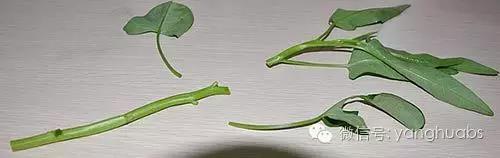
2. Then remove the leaves and the tips.
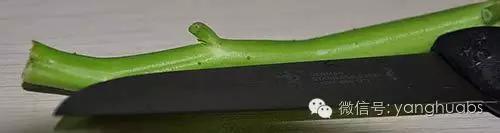
3. Note that when pinching off the leaves, you pinch them off rather than tear them, so a little leaf stalk is left; between the leaf stalk and the main stem there is a bud, which makes it easy to sprout new shoots.
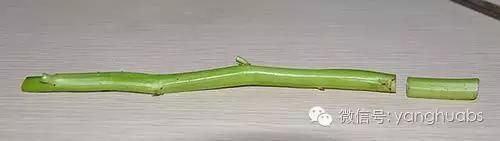
4. Cut at the bottom joint, removing the hollow part at the base of the water spinach stem. Doesn't water spinach have a partition at every node, like bamboo? Cut exactly to the point where the partition is visible, and then when you insert it into the soil it will not rot.
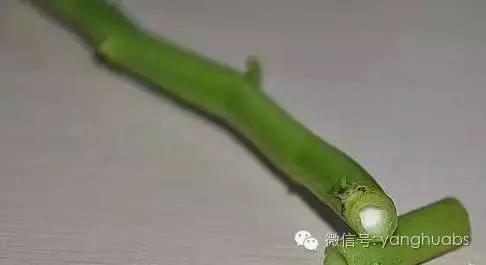
5. The picture above shows the cut position; this can avoid the problem of the base rotting when water spinach is propagated from cuttings.
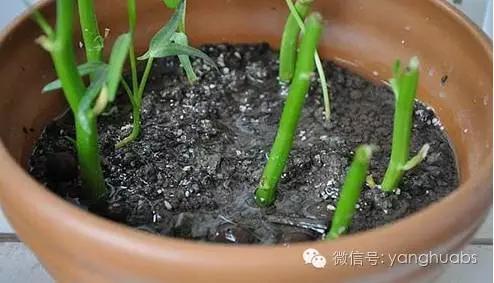
6. Then do the cutting, inserting 2-3 cm deep into the soil; it needs more water, which makes success easier. In the south, water spinach can be grown in water, so do not fear too much water. Generally, it will sprout in 7-10 days.
7. This is the sprouted water spinach; after a while you can eat delicious fresh water spinach. Doesn't it feel great~~
Sweet potato
Sweet potato, also called fan shu, is eaten for its enlarged fleshy root, the tuber. When young it is sweet and juicy, and can be eaten as a fruit, as a staple food, or used in dishes. Sweet potato leaves are rich in fiber, vitamin A, vitamin B, vitamin C, and iron, calcium, and so on.
1. Cut a section of vine about 10 cm long directly from the sweet potato vine; choose a seedling with a moderately thick stem.
2. Choose a flower pot with a diameter greater than 30 cm, because it will grow very fast later and needs enough nutrients. Sweet potato has strong adaptability to soil and suits deep, loose, sandy soil rich in organic matter. Use ordinary garden soil, or leaf mold, plus some sand to increase air permeability.
3. Insert the cut branches well, water thoroughly, and place in a cool, shaded spot for about three days; generally in 7-10 days roots begin to grow. (Remove two or three leaves from the bottom; this effectively reduces water loss and makes survival and rooting easier.)
4. During the growing period, apply more organic fertilizer; in summer, water more; in early autumn, control water appropriately. Sweet potato has strong adaptability to soil and suits deep, loose, sandy soil rich in organic matter.
5. When the sweet potato harvest season comes in autumn, dig open the soil surface and look - the treasure appears.
Ceylon spinach
Ceylon spinach is also called luo kui; it is seldom cultivated and has long been listed as a rare specialty vegetable. Luo kui is eaten for its seedlings, tender stems, and tender leaf shoots. The edible texture is fresh, tender, soft, and smooth. It can be stir-fried, blanched, or served cold. Its flavor is fragrant, crisp, and refreshing, like wood ear, with a distinctive taste. Note: people with a cold spleen should not eat it. Pregnant women should avoid it.
1. Buy fresh Ceylon spinach from the market; take the sturdier lower branches, about 10 cm long, and cut off excess leaves. Some leaves that are too large can be cut in half.
2. Cut the lower part of the branch at a slant; when cutting, you should first have a place with a vegetable bud, as this makes it easier to sprout new roots.
3. Good, the branches prepared for cuttings are ready.
4. The cutting medium can be coarse sand; it is best to choose loose peat + perlite. The soil must be kept moist, with regular misting of water; in about 10 days new roots will grow.
5. Before long, you can eat fresh, delicious Ceylon spinach with absolutely no pollution~~
Gynura bicolor
Gynura bicolor, also known as guanyin cai, danggui cai, hongfeng cai, guanyin xian, red-backed vegetable, and purple-backed vegetable. It is a plant of the Asteraceae family. It likes to grow in dark, damp places. The underside of the leaf is green and the back is purplish red, which is why it is called "red-backed vegetable." It helps lower blood lipids, aid digestion, and relieve intestinal gas. It is a wild vegetable that can be enjoyed all year round.
1. Select sturdy branches about 15-20 cm long for cuttings, and remove the excess leaves of hongfeng cai (leaving only 2 or 3 tender leaves at the top) to avoid water loss. It is best if the branch has side buds, which can speed up growth. Cut the lower part into a slant, and then it can be inserted.
2. Loose, well-draining, moist, and fertile sandy loam is best. Insert at a slant, firm the soil, and water thoroughly, shading and keeping moist. After 7 days, remove the shade.
3. About 10-15 days after cutting, the plant will grow fine roots. At this time, avoid fertilizer burn to the fine roots; wait until the plant has grown more roots (about 14-20 days) before starting topdressing, and afterward topdress once after each harvest to supplement nutrients.
Finally, here is a picture of the result of leaf cuttings of Gynura bicolor; I hear the survival rate is also very high!
Fruit Gang (WeChat ID: shuiguobangv)
Introducing all kinds of potted plant techniques for fruits, flowers, and more, as well as various home creative ideas. We advocate green, ecological, and environmentally friendly living, and being urban farmers!