Harvesting, Storage, Fresh-keeping and Processing Methods of Taro
Taro is a perennial herbaceous hygrophytic plant of the Araceae family, native to China, India, the Malay Peninsula and other places. At present, in China it is mainly distributed in South China, Southwest China and the Yangtze River Basin, with a small amount also grown on the North China Plain. The edible part of taro is the corm, which is rich in starch and protein; besides being used as a vegetable, it can also serve as a staple food.
I. Storage and Fresh-keeping
1. Pit burial method
Indoors or outdoors in a high, dry location away from water sources that could cause dampness, dig an elongated storage trench according to the quantity of taro, with a depth of 50-60 cm. First spread a 5-10 cm thick layer of wet sand on the bottom of the trench, then place the taro in the storage trench and store it piled together with the wet sand layer. Cover with soil in several batches according to temperature changes to keep warm and prevent freezing. During storage, take care to prevent rainwater seepage that could cause water to accumulate in the trench; if seepage and water accumulation occur, measures must be taken immediately, or the taro must be moved to a safe place, otherwise it will rot.
2. Cellar storage method
Choose a high, well-drained, wind-sheltered and sunny spot to dig the cellar. The cellar is about 1 m deep, 1-1.5 m wide and 2-3 m long, and each cellar can store 1500-2000 kg of taro. Before storing in the cellar, first remove injured, rotten and diseased taro, and dry them in the sun for 1-2 days before putting them in the cellar; alternatively, they can first be transported to a warmer, dry indoor place for temporary storage and stored after the Start of Winter (Lidong) solar term. Before putting them in the cellar, first burn straw inside the cellar once, or scatter sulfur powder to disinfect. When putting them in, line the bottom and sides of the cellar with dry wheat straw or rice straw, then place the taro into the cellar and pile it about 30 cm high with an arched top, cover it with a layer of wheat straw or rice straw about 10 cm thick, then cover with soil about 50 cm thick, and pat it firm into a steamed-bun shape. During storage, maintain the cellar temperature at 8-15°C and relative humidity at about 85%, and at the same time dig drainage ditches around the cellar (at a slightly greater distance) so that there is no water accumulation around it. As for regulating the temperature inside the cellar, this can be solved by artificially increasing the thickness and moisture content of the covering soil.
3. Outdoor storage method
Choose a house facing south, build up bricks about 30 cm high against the corner of the wall, lay a layer of thin bamboo poles on the ground, then spread a layer of dry grass crosswise, and then pile taro 24-27 cm thick. On both sides of the first layer, build up bricks another 30 cm high, place thin bamboo poles on top, spread dry grass, and then add the second layer of taro. Each subsequent layer is done the same way, and about 4 layers can be piled. According to temperature changes, promptly cover with grass to keep warm or ventilate to cool down; generally store the piled taro under well-ventilated conditions at 5-10°C and 85% relative humidity, and the storage period can last as long as 6 months. Long-term storage can also be carried out in a dry basement. In order to extend the storage period and ensure quality, before piling for storage, dry the taro in a well-ventilated place for 1-2 days, which can reduce fungal infection.
II. Simple Processing
1. Washing
Taro intended for sale and packaged without mud generally needs to be washed clean before being put on the market. Because washing easily causes wounds of various sizes, it should be disinfected after washing. A simple method is to dip the washed taro in a disinfectant solution, take it out and dry it in the air or blow it dry, then wrap each one in paper, and place them flat in a cardboard box so that they are pressed close to one another. Never transport them in the same compartment with other fruits and vegetables that tolerate low temperatures.
2. Packaging
The packaging of taro mainly involves the following process:
(1) Raw material selection. Select fresh taro with normal color, no damage and no rot or deterioration as processing raw material.
(2) Peeling. Place the taro in a peeling machine to peel it while flushing with water (peeled taro browns very easily when exposed to air, and flushing with water can appropriately isolate it from air). It can also be peeled by hand, which likewise requires flushing with water.
(3) Sulfur dipping. Promptly place the peeled taro into a soaking solution prepared from 0.2% vitamin C, 0.2% citric acid and 0.3%-0.5% sodium sulfite for 5-10 minutes, and ensure the liquid covers the taro, so as to achieve color protection, bleaching and preservation. However, the soaking time should not be too long, otherwise although the whitening effect after bleaching improves, the sulfur smell will be very strong and it will be inedible.
(4) Blanching. Take the taro out of the soaking solution and immediately put it into boiling water at 100°C to blanch for 30-40 seconds. Blanching is to deactivate enzyme activity and at the same time achieve the purpose of sterilization.
(5) Rinse-cooling. After blanching, the taro should be quickly put into cold water containing citric acid to rinse and cool.
(6) Washing. Put the rinse-cooled taro into clean water and stir thoroughly to wash off the residual chemicals on the surface of the taro; the washing time should be somewhat longer.
(7) Air-drying. Either natural air-drying or mechanical blow-drying is acceptable, as long as there are no longer water droplets on the surface of the taro.
(8) Trimming and grading. After natural air-drying or mechanical blow-drying, trim the taro slightly, then grade it by shape and size.
(9) Packaging and sales. Seal the graded taro in plastic bags or other packaging materials (a fill level of 90% is appropriate), and then it can enter the market for sale.
Taro grown by early-maturing cultivation can be harvested and marketed from June to July; early-maturing varieties grown by ordinary cultivation begin to be harvested in August; mid- and late-maturing varieties are harvested and marketed from October to November. In warm regions they can be left in the field and harvested for market after winter sets in. Taro can be stored for 6 months, and generally can be supplied to the market successively until before the Grain Rain (Guyu) solar term.
(I) Harvesting requirements
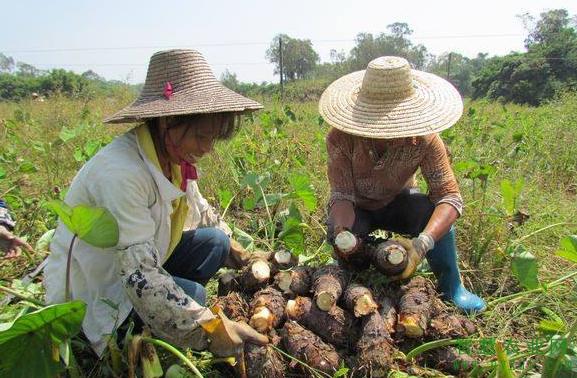
For water taro, the water must be drained after September. Before harvesting taro, keep the soil dry and loose; a few days before harvesting, first cut off the aboveground leaf stalks, and harvest only after the wounds have healed. When the taro leaves turn yellow and wilt and the fibrous roots wither, that is the optimal harvesting period.
After digging, remove diseased, injured and rotten taro, dry them in the sun for 1-2 days, and then put them in the cellar for storage. Those not going into the cellar for the time being can be kept temporarily in a warmer and dry indoor place.
(II) Storage and transportation methods
1. Trench storage: the trench is 2.3 m deep and 1.3 m wide, and the length is determined by the storage quantity. Taro is laid in the trench to a height of 1.3 m, then filled with soil covering up to the top of the trench. During storage it can be dug out at any time for supply to the market. When trench storage is used in the Yangtze River Basin, bamboo tubes or bamboo bundles need to be buried on both sides of the trench as ventilation devices.
2. Cellar storage: choose a high, well-drained, non-sunny spot to dig the cellar. The cellar is 1 m deep, 1-1.5 m wide and 2-3 m long. Store in the cellar around the Start of Winter (Lidong) solar term. Before putting them in the cellar, first scatter some sulfur powder inside the cellar to disinfect. When putting them in, line the bottom with dry wheat straw or rice straw, then place the taro into the cellar and pile it 30 cm high with an arched top, cover it with a 10 cm thick layer of wheat straw or rice straw, then cover with soil about 50 cm and pat it firm into a steamed-bun shape. Dig drainage ditches at a slightly greater distance around the cellar. Regulate the temperature and humidity inside the cellar by controlling the thickness and moisture content of the covering soil. Each cellar can store 1500-2000 kg.
3. Transportation and packaging: the main taro producing areas are in the south, supplying the northern market, so transportation plays an important role. Trains and automobiles are important means of transport. During transportation, pay attention to preventing freezing and rot, and take necessary precautionary measures so that the taro is kept under suitable temperature and humidity conditions.
During transportation, baskets and boxes should be used for packaging.
(IV) Market quality standards
The corm is dense and clean, free from rot, chilling injury, freezing injury, pests and diseases, and mechanical damage; packaged in baskets and boxes.
Article source [China Smart Agriculture Official Website]