What kind of medicinal herb is Angelica sinensis? A guide to understanding it
Herb name: Angelica sinensis
Harvesting and processing: Angelica sinensis is generally cultivated until late autumn of the second year, when it is dug up, the stems, leaves, fibrous roots and soil are removed, and it is left to stand until the moisture evaporates slightly and the roots become soft, then tied into small bundles, placed on racks, and slowly smoked dry over a fire.
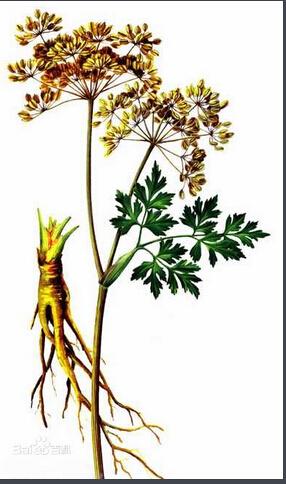
Angelica sinensis plant
Properties of Angelica sinensis decoction pieces: This product is slightly cylindrical, with 3 to 5 or more branch roots at the lower part, 15 to 25 cm long. The surface is yellow-brown to brownish-brown, with longitudinal wrinkles and transverse lenticels. The root head (gui tou) is 1.5 to 4 cm in diameter, with ring patterns, the upper end round and blunt, bearing remnants of purple or yellow-green stems and leaf sheaths; the main root (gui shen) has an uneven surface; the branch roots (gui wei) are 0.3 to 1 cm in diameter, thick at the top and thin at the bottom, mostly twisted, with a few fibrous root scars. The texture is soft and pliable, the cross-section yellow-white or pale yellow-brown, the bark thick, with fissures and numerous brown dot-like secretory cavities, the xylem lighter in color, and the cambium ring yellow-brown. It has a rich fragrance, and tastes sweet, pungent and slightly bitter.
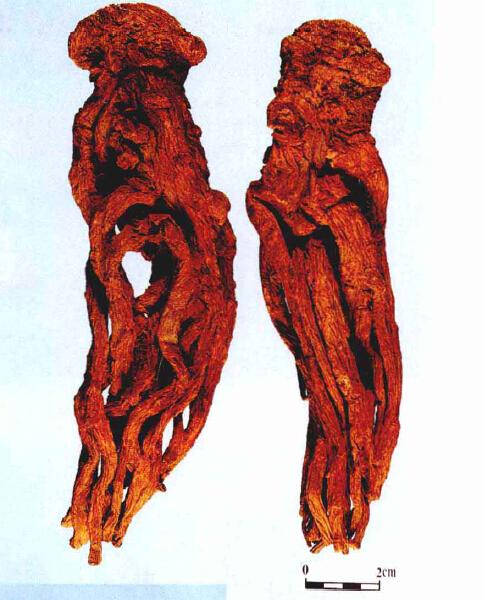
Dried Angelica sinensis
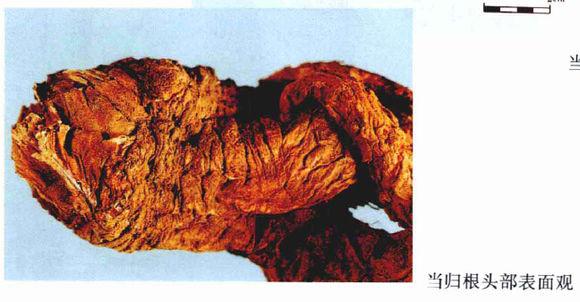
Angelica sinensis root head
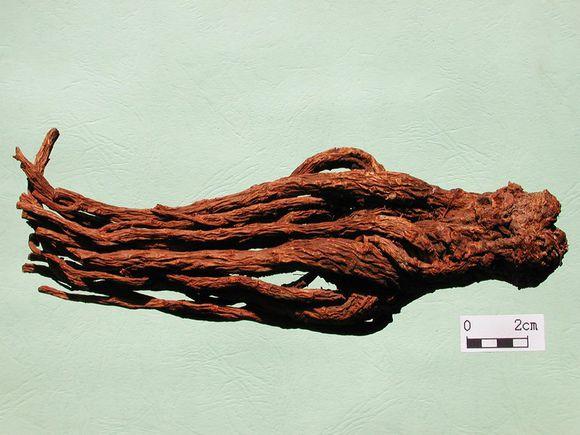
Dried Angelica sinensis
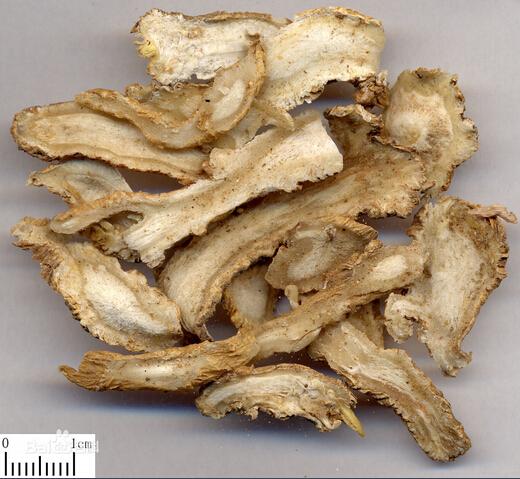
Sliced Angelica sinensis
Strong aroma, sweet taste, no sourness, sweet followed by slight bitterness. Those with a large main root with ring patterns, a long body, few branch roots, a yellow-white cross-section and a rich aroma and flavor are considered the best.
Those with a short, small main root, many branch roots, a weaker aroma and flavor, and a cross-section that has turned reddish-brown are of inferior quality.
Medicinal properties of Angelica sinensis: "[Shennong Bencao Jing, middle grade. Angelica sinensis, sweet in flavor, warm in nature. It mainly treats cough with counterflow qi, warm malaria with shivering chills on the skin, women's abnormal uterine bleeding and sterility, various malignant sores and ulcers, and metal wounds; decoct and drink it. Dried gui.]
Bitter and pungent in flavor, slightly warm in nature, it enters the foot jueyin liver meridian. It nourishes blood and enriches the liver, clears wind and moistens wood, revives the minute and subtle in the meridians, reverses the counterflow cold of the limbs and joints, relieves internal urgency and calms abdominal pain, regulates postpartum conditions and protects the fetus before birth, can free the urine of pregnancy, and is good at lubricating the large intestine of the parturient; it must be used for running piglet qi, should be added for vomiting roundworms, is very good for cold hernia, and is most effective for warming the meridians.
Fire is yang and water is yin; the qi within water is the root of yang. When the root of yang ascends on the left, it raises yi wood and transforms it into ding fire; when fire descends and yang becomes clear, the spirit is manifested. The spirit flourishes in fire, but tracing it to its origin, it is actually conceived in wood; when yang qi ascends fully, the spirit flourishes. Wood occupies the middle of yang ascent, at the initial conception of the spirit, when the spiritual mechanism is just beginning, and this is called the hun (ethereal soul); the hun is stored in the liver and housed in the blood. The liver, as jueyin wind-wood, is born from gui water; when gui water warms and ascends, it transforms into blood vessels. Blood is the essence and fluids of wood, and the body and substance of the hun. When wind is calm and blood is regulated, the branches and trunk flourish and are nourished, so wood reaches out and the hun is at peace. When warm qi is deficient, the root loses its nourishment, and pent-up anger generates wind-dryness, and essence and fluids are depleted and damaged. When the root is shaken and falls, the body and substance are injured and destroyed, and the hun also drifts and scatters; this is the origin of liver disease. From this arise cold limbs and thin pulse, abdominal pain and internal urgency, difficult defecation and scanty urine, amenorrhea and blood loss, running piglet qi, vomiting roundworms, cold hernia, and the like. All should be treated by nourishing blood to clear wind-dryness.
Angelica sinensis is nourishing, moistening and smooth, and is best at calming wind and nourishing blood, while its pungent and warm nature is also suited to the qi of wood. Sour causes stagnation while pungent causes reaching out; cold causes congealing while warm causes free flow; this is the natural principle. When blood flows freely and the pulse is replete, it can therefore reverse counterflow cold and revive the minute and subtle; when wood reaches out and earth revives, it can therefore relieve acute pain and calm pregnancy and childbirth. For all patterns of wood depression and wind stirring, there is none for which it is unsuitable. However, it rather assists earth dampness, damages the spleen and stomach, and loosens the stool; therefore, when Zhang Zhongjing used it, he often treated earth and wood together. Knowing only to assist yin and not knowing to reduce yang is the great error of later mediocre practitioners that misled the common people.
"
[Processing] Angelica sinensis: Remove impurities, wash clean, moisten thoroughly, cut into thin slices, and sun-dry or dry at low temperature.
Wine-processed Angelica sinensis: Take clean Angelica sinensis slices and stir-fry dry according to the wine-frying method (Appendix II D). This product consists of subrounded or irregular thin slices, with a light brown ring pattern on the cut surface, a soft and pliable texture, and a deep yellow color with slight scorch marks. Sweet and slightly bitter in taste, with a rich aroma and a wine fragrance.
[Nature and flavor] Sweet, pungent, warm.
[Meridian entry] Enters the liver, heart and spleen meridians.
[Functions and indications] Enriches blood and invigorates blood, regulates menstruation and relieves pain, moistens the intestines and frees the stool. Used for blood-deficiency sallow complexion, dizziness and palpitations, irregular menstruation, amenorrhea and dysmenorrhea, abdominal pain due to deficiency cold, dry intestines and constipation, wind-damp painful obstruction, traumatic injuries, and abscesses, boils, sores and ulcers. Wine-processed Angelica sinensis invigorates blood and frees the meridians. Used for amenorrhea and dysmenorrhea, wind-damp painful obstruction, and traumatic injuries.
[Usage and dosage] 6 to 12 g.
[Storage] Keep in a cool, dry place, and protect from moisture and insects."