Daily Grain and Oil: Don't believe that liquor is the essence of grain; your alcohol tolerance directly reveals your IQ
Around three thousand years ago, during the Shang and Zhou dynasties, the Chinese uniquely invented the multiple fermentation method using jiuqu (wine starter), and began large-scale brewing of huangjiu (yellow rice wine). Around one thousand years ago, during the Song dynasty, the Chinese invented the distillation method, and from then on baijiu (white liquor) became the main alcoholic drink consumed by the Chinese. Alcohol permeates the entire five-thousand-year history of Chinese civilization, occupying an important place in Chinese people's lives in everything from literary and artistic creation, cultural entertainment, to food and cooking, health preservation and more.
Along with the trend of promoting traditional culture, drinking-toast routines from various places have emerged endlessly. Sayings like "deep feelings, down in one gulp; shallow feelings, just a sip" are far too low-class. The hard-drinking "fighting nation" Russia has recently come up with a new scientific research finding that leaves people no choice but to drink:
According to a report on the website of Russia's Komsomolskaya Pravda, scholars from universities in the United States, the United Kingdom and elsewhere found through surveys that the smarter a person is, the more prone they are to alcohol addiction and the better their alcohol tolerance; the higher a person's IQ level, the more often and the more they want to drink.
Look at that - drinking is not only a culture, but also a display of IQ! So will you drink this liquor or not?
Appendix: A selection of ancient drinking-toast routines
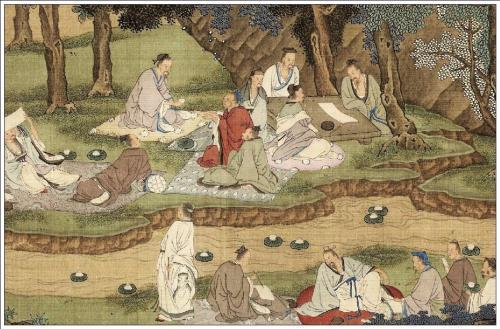
Curved water floating goblets: On the Shangsi day in the third month of the lunar calendar, after people held the fuxi purification ceremony, everyone sat on both sides of a river channel, and a wine cup was placed upstream; the cup floated downstream, and whoever it stopped in front of took the cup and drank, meaning to remove disaster and misfortune. This tradition is very ancient in history, traceable at the earliest to the early years of the Western Zhou. According to Wu Jun of the Liang dynasty in the Southern Dynasties, in Xu Qi Xie Ji: "In the past, the Duke of Zhou divined the city at Luoyi, and floated wine along the flowing water, so the lost Shi Jing says 'feather goblets follow the flowing waves.'"
Beating the drum and passing the flower:Use one flower, or other small objects such as a handkerchief may be used instead. The game leader blindfolds their eyes and passes the flower to one person beside them, who passes it on in turn, quickly passing it to the next person. When the game leader calls stop, the person still holding the flower that has not been passed on is penalized with a drink. This penalized drinker then has the right to act as the game leader for the next round. Sometimes drumming is used as accompaniment. This is called the "beating the drum and passing the flower game." The game leader holds a flower branch in hand, someone beats a drum behind a screen, the seated guests pass the flower branch in turn, and when the drumming stops, whoever holds the flower branch drinks.
Banquet archery and pitch-pot:A pot is set up at the drinking banquet, and guests in turn throw arrows into the pot; whoever throws in the most wins, and the loser is penalized with a drink.
Hiding the hook and shooting the cover:"Hiding the hook," also called "sending the hook," is simple and easy to do. That is, side A either hides the "hook" in their hand or conceals it outside the hand, forming a fist for side B to guess; a wrong guess is penalized with a drink. This is rather like today's "guess whether there is one or not." "Shooting the cover" first divides into teams, also called "dividing into groups"; first one side secretly covers an object under a vessel for the other side to guess. "Shooting" means guessing or measuring, and the Tang dynasty poet Li Shangyin was skilled at this; he wrote in a poem: "Passing the hook across seats, spring wine warm; dividing into groups to shoot the cover, wax lamp red."
Bamboo drinking counters:On bamboo drinking counters are inscribed lines from classics or poems, ci, and qu, or names of characters from Romance of the Western Chamber, Water Margin, and Dream of the Red Chamber, and from these are derived categories such as toasting, urging a drink, and penalizing a drink.
Leaf drinking cards: Originating from the leaf game of the Tang dynasty, it flourished greatly in the Ming and Qing dynasties, and was an excellent item for ancients to drink and play drinking games to add to the fun. It is somewhat like today's playing cards; on the card faces are figure prints, inscriptions, and drinking rules. Because the drawings are exquisite and contain deep meaning, when playing the game one draws a card and drinks according to the meaning illustrated, often gaining pleasure beyond the wine itself. For example, the "Laozi" suit says "the long-lived rejoice," meaning the oldest person at the table drinks; for example, the "Huang Shigong four" suit says "those with writings, a cup," meaning those present who have written works drink a cup of wine.
Guessing lantern riddles and drawing flower names: Those who fail to guess the lantern riddle are penalized with a drink. Drawing flower names is when several sticks are placed in a stick holder, each stick painted with a kind of flower or plant, inscribed with a line of old poetry, and attached with drinking rules; when playing the game one person draws a stick and drinks according to the rules on the stick.