How much longer can corn prices rise? Daily Grain and Oil Analysis

Daily Grain and Oil, December 1 news: today's corn purchase prices continued to decline slightly in North China, while Northeast China remained stable.
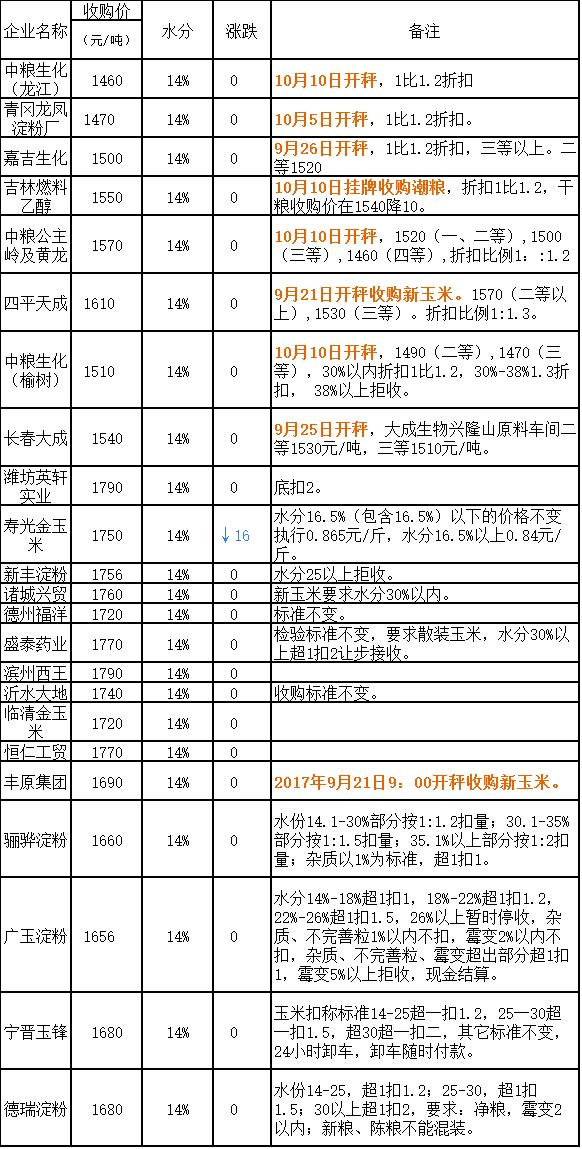
Shandong Fukuan Bioengineering adjusted its corn purchase price at 8 a.m., cutting it by 1 fen. For more than 12 tons, the price is 0.85 yuan/jin; for less than 12 tons, it is 0.84 yuan (converted to standard moisture).
Shandong Chengwu Dadi corn price fell by 2 li: 0.835 yuan for moisture below 17.0%, and 0.83 yuan for moisture above 17.0%.
Zhucheng Xingmao corn price fell by 5 li: 0.88 yuan/jin. Northeast dried corn. (New corn within 30 moisture.) Mold and scorch damage of 7 or less is not deducted; other purchase standards remain unchanged.
Changle Shengtai naturally dried corn fell by 3 li to 0.885, dried grain 0.86.
Shouguang Xinfeng fell by 5 li to 0.878, moisture 25, dried grain at the same price.
Shouguang Jin Corn fell by 5 li to 0.878, moisture 30, dried grain rejected.
Chenming Starch fell by 3 li to 0.875, rejected if moisture exceeds 25, dried grain rejected.
Although corn prices in North China have recently pulled back, corn quality issues still support local purchase prices at a high level. Yesterday, official news from Xinmi said that because continuous rainfall during the autumn grain purchase period caused mold and sprouting in corn in most areas, the local grain authorities are currently organizing state-owned grain enterprises to help farmers sort corn free of charge to reduce losses.
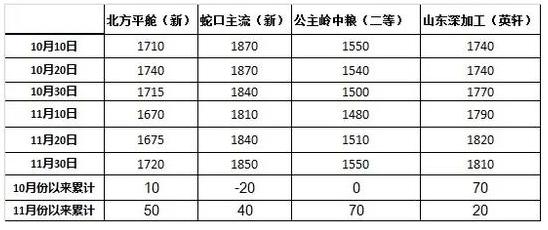
Overall, the mold situation of corn in North China still provides strong support for corn prices. According to market statistics, since October, Shandong Yingxuan's corn purchase price has cumulatively risen by about 70 yuan per ton, while COFCO Gongzhuling in Northeast China remained flat over the same period.
Afterward, as corn prices in North China broke above the high level of 0.9 yuan per jin, prices pulled back all the way, while the Northeast continued to maintain slight increases, catching up to North China prices. Since November, corn purchase prices in North China have cumulatively risen by 20 yuan, while the Northeast reached 70 yuan. However, in a horizontal comparison of corn prices, North China is still 200-300 yuan per ton higher than the Northeast.
In recent times, the rise in corn prices in North China has also promoted the outward shipment of Northeast corn. News from the Guangdong Corn Data Network shows that from January to November 2017, arrivals were 9.357 million tons, while from January to November 2016, arrivals were 5.596 million tons, an increase of 67.2% year on year.
According to another incomplete count, since November, the volume of corn shipped south from northern ports in China has basically concentrated between 700,000 and 1 million tons, nearly double the average level of 400,000 to 500,000 tons over the past two years.
However, such a huge volume of corn transportation still keeps the sales-area market tense. Because of concerns about the supply of high-quality corn next spring and summer, since November, enterprises in southern China have already bought imported U.S. corn as forward inventory, with the volume exceeding 10 vessels - it is said that the corn price level the market is worried about is 2,000 yuan per ton.
In the Northeast production area, concerns about this year's output and demand are even more obvious. On the one hand, because the overall quality of corn in Northeast China this year is relatively good, grain authorities are somewhat worried about the local grain purchase and sales market and have stepped up efforts to sell grain outside the region, avoiding price declines caused by farmers selling grain in a concentrated way, which would prevent good grain from fetching a good price. On the other hand, the volume of corn shipped out has increased considerably compared with the same period in previous years, and coupled with the absence of the overall production-demand gap this year, local deep-processing enterprises have also had to raise prices to buy grain.
It can be said that the current price increase in Northeast China is an increase under a form of grain grabbing, just as the southern market worries that high-quality corn supply will fall short of demand later. In previous years, everyone took the path of state policy purchasing, but this year everyone is feeling their way in the dark: although everyone knows the state has stockpiles, what if there is less grain next year?
It is worth noting that from November last year to January this year, Northeast corn purchase prices cumulatively fell by as much as 300 yuan per ton.