High returns from using the five-change planting method for overwintering cucumbers
Change dense planting of seedlings to rational sparse planting. In winter, temperatures are low and light is weak, so crop photosynthesis is relatively poor, and only rational sparse planting can achieve high yields. If plants are too dense, they will also grow tall and spindly as they compete for light, and the fruit-setting rate will decline. Poor ventilation also makes them prone to infection by multiple diseases, and dense leaves make spraying difficult. Once the disease spreads, it is very hard to cure completely. Flat beds...
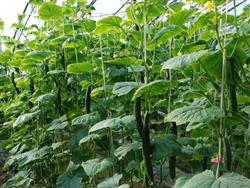
Change dense planting of seedlings to rational sparse planting. In winter, temperatures are low and light is weak, so crop photosynthesis is relatively poor, and only rational sparse planting can achieve high yields. If plants are too dense, they will also grow tall and spindly as they compete for light, and the fruit-setting rate will decline. Poor ventilation also makes them prone to infection by multiple diseases, and dense leaves make spraying difficult. Once the disease spreads, it is very hard to cure completely.
Change flat-bed planting to trench planting or ridge planting. Trench planting means digging trenches on flat ground and planting the seedlings on both sides of the trench, generally 30-35 cm deep. Ridge planting means planting on raised ridges and setting the seedlings on both sides of the ridge, generally 20-25 cm high. With ridge planting or trench planting, there is more exposed surface to light, which helps raise soil temperature; the soil around the roots has good aeration, which favors rooting and can greatly enhance the plant's disease resistance, stress resistance, and continuous fruiting ability; and it is easier to control fertilizer and water, so as to avoid root damage from excessive water and root burn from excessive fertilizer.
Change root drenching for disease prevention after seedling recovery to applying chemicals in the planting holes at transplanting for disease prevention. In view of severe soilborne diseases, especially the severe Phomopsis root rot of grafted cucumbers, many vegetable growers use the method of root drenching after transplanting and seedling recovery to prevent disease. Although this method has some effect, it is labor-intensive and time-consuming, and the efficacy is short-lived. Therefore, it can be changed to applying chemicals in the planting holes at transplanting for disease prevention.
Change planting on cloudy days to planting on sunny days. Planting on cloudy days means weak light and high humidity inside the greenhouse, which is not conducive to rooting; planting on sunny days, although the seedlings tend to wilt after transplanting, is conducive to rooting and seedling recovery. In addition, when transplanting, the seedlings should be graded by large, medium, and small, and carried to the planting trenches or beside the ridges. From the perspective of the whole greenhouse, large seedlings should be placed at the east and west ends and at the front part of the greenhouse, while small seedlings should be placed in the middle of the greenhouse. Within a row, large seedlings go in front, small seedlings behind, and generally medium seedlings in the middle. This helps the plants grow uniformly and consistently later on.
Change heavy fertilization to scientific fertilization. High yields of cucumber cannot be achieved without fertilization, but it is not the case that the more fertilizer applied, the higher the yield. The key is what fertilizer to apply and how to apply it. The amount of fertilizer applied cannot be determined only by the number of kilograms; the composition and content of the fertilizer must also be considered. Fertilizer is not about quantity; it must be strong and suitable. Fertilization should be scientific, not blind application based only on subjective experience. Only by scientifically and rationally selecting high-quality fertilizers according to the fertilizer requirements of cucumbers and the specific fertilizer supply conditions in each greenhouse, and applying balanced and comprehensive fertilization, can high-quality and high-yield cucumbers be achieved.