How to prevent and control yellow ring leaf in greenhouse cucumbers
In overwintering cultivation of cucumbers, "yellow ring leaf" commonly appears, severely affecting yield and economic returns. This phenomenon is not caused by an infectious disease; it is generally a physiological disorder. 1. Symptom expression: It occurs more often on the middle and lower leaves of cucumbers. At first, the edges of the leaves turn yellow, then it spreads from the leaf edges inward...
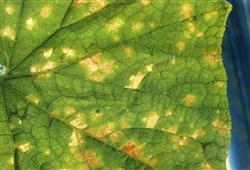
In overwintering cultivation of cucumbers, "yellow ring leaf" commonly appears, severely affecting yield and economic returns. This phenomenon is not caused by an infectious disease; it is generally a physiological disorder.
1. Symptom expression: It occurs more often on the middle and lower leaves of cucumbers. At first, the edges of the leaves turn yellow, then it spreads from the leaf edges inward, with a 2-3 cm wide band showing chlorosis, later turning yellow-green, encircling the leaf, hence the name "yellow ring leaf." When it occurs severely, the yellow ring becomes scorched and the leaves die.
2. Occurrence conditions and patterns: This disease is caused by a lack of potassium in the plant. It occurs severely at lower temperatures. This is because low soil temperature reduces the activity of soil microorganisms, causing an imbalance in the ratio of ammonium nitrogen to nitrate nitrogen in the soil, which inhibits the absorption of potassium. Therefore, although the soil is not lacking potassium, cucumbers still show potassium deficiency symptoms. When the soil is too sandy, organic fertilizer is insufficiently applied, and potassium fertilizer is lacking, it occurs more severely. Too low soil temperature in the greenhouse can also cause "yellow ring leaf" in cucumbers.
3. Control methods (1) Raise the soil temperature inside the solar greenhouse. Improve the structure of the solar greenhouse, such as thickening the walls, digging cold-proof trenches, increasing the height of the greenhouse, increasing the solar incidence angle, increasing the solar incidence rate, using plastic film and straw mats with good insulation performance for double-layer covering, and hanging reflective screens on the north side of the greenhouse. (2) Apply more organic fertilizer and an appropriate amount of ammonium nitrogen fertilizer. When applying chemical fertilizers, pay attention to a reasonable combination of nitrogen, phosphorus, and potassium. (3) During the cold winter growing period, spray Shuofeng 481 solution once, which can promote photosynthesis and the growth and development of the root system. (4) At lower temperatures, spray a 0.2% potassium dihydrogen phosphate solution once every 3-5 days to supplement the plant's potassium supply. At the same time, enhance the plant's cold resistance.