Detailed Explanation of Water and Fertilizer Management Techniques for Greenhouse Celery
I. Seedling Stage: When the sprouts push through the soil, water lightly once, and the seedlings will emerge completely in 1-2 days. After that, keep the soil moist, following the principle of frequent but light watering. When the seedlings are 10 cm tall, apply topdressing with irrigation 1-2 times. II. Transplanting and Seedling Restraint: From transplanting to seedling recovery, water frequently and lightly to keep the soil moist; after seedling recovery, control the water amount and carry out cultivation (to a depth of 1 cun) to restrain the seedlings, so that the roots grow downward and the differentiation of heart leaves accelerates. III. Vegetative Growth Stage: This period is the key stage for yield formation. After the seedling restraint period ends, concentrate fertilizer and water to promote vegetative growth of the plants. Generally, immediately after seedling restraint, apply quick-acting nitrogen fertilizer, then apply topdressing 2-3 times in stages. Pay special attention to applying a certain amount of potassium fertilizer, because celery is a potassium-loving vegetable. Water once every 3-4 days, but with a smaller amount of water, to avoid excessively low soil temperature, which is unfavorable for petiole thickening. About half a month before harvest, spray the whole plant with 30-50 ppm gibberellin 1-2 times for a better yield-increasing effect. Nitrogen deficiency in celery shows as small leaves and easy hollowing and aging of petioles. Phosphorus deficiency in the early stage and potassium deficiency in the later stage both have a relatively large impact on the yield and quality of celery, so phosphorus and potassium liquid fertilizers can be sprayed in the early and late stages respectively. In addition, celery is very sensitive to boron fertilizer. When boron is deficient, stem cracking occurs, and 0.5-0.75 kg of borax per mu can be applied for prevention and control.
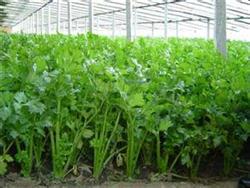
I. Seedling Stage: When the sprouts push through the soil, water lightly once, and the seedlings will emerge completely in 1-2 days. After that, keep the soil moist, following the principle of frequent but light watering. When the seedlings are 10 cm tall, apply topdressing with irrigation 1-2 times. II. Transplanting and Seedling Restraint: From transplanting to seedling recovery, water frequently and lightly to keep the soil moist; after seedling recovery, control the water amount and carry out cultivation (to a depth of 1 cun) to restrain the seedlings, so that the roots grow downward and the differentiation of heart leaves accelerates. III. Vegetative Growth Stage: This period is the key stage for yield formation. After the seedling restraint period ends, concentrate fertilizer and water to promote vegetative growth of the plants. Generally, immediately after seedling restraint, apply quick-acting nitrogen fertilizer, then apply topdressing 2-3 times in stages. Pay special attention to applying a certain amount of potassium fertilizer, because celery is a potassium-loving vegetable. Water once every 3-4 days, but with a smaller amount of water, to avoid excessively low soil temperature, which is unfavorable for petiole thickening. About half a month before harvest, spray the whole plant with 30-50 ppm gibberellin 1-2 times for a better yield-increasing effect. Nitrogen deficiency in celery shows as small leaves and easy hollowing and aging of petioles. Phosphorus deficiency in the early stage and potassium deficiency in the later stage both have a relatively large impact on the yield and quality of celery, so phosphorus and potassium liquid fertilizers can be sprayed in the early and late stages respectively. In addition, celery is very sensitive to boron fertilizer. When boron is deficient, stem cracking occurs, and 0.5-0.75 kg of borax per mu can be applied for prevention and control.