How to sow and raise seedlings for autumn delayed cultivation of celery?
(1) Seed treatment: The suitable seedling age for transplanting celery is 5 or 6 true leaves, the seedling raising period is 50-60d, and the sowing period is from June to August. At this time, the high temperature is not conducive to emergence, so low-temperature seed soaking and germination should be carried out before sowing. The method is: 6-7d before sowing, soak the seeds in cold water for 24h, rub and wash them several times and change the water during this period, and after taking them out, wrap them well in gauze or a gunny bag...
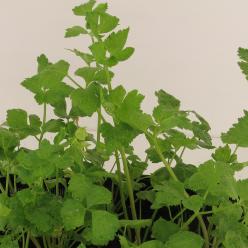 Autumn delayed cultivation of celery uses open-field seedling raising. The seedling age is 50-60 days, with 4-5 true leaves, seedling height 15-20 cm, and a well-developed root system, which is considered suitable-age strong seedlings. In various places, sowing and seedling raising are mostly done in early August, and planting in late September; harvest at New Year. Or sow in mid-to-late August, transplant in early October, and harvest around Spring Festival. To cultivate strong seedlings, attention should be paid to the following matters:
(1) Preparation of the seedling bed: Celery seeds are small, have weak soil-penetrating ability, and emerge slowly, so suitable seedling land should be selected and the soil should be finely prepared to make beds. For the celery seedling land, it is advisable to choose slightly higher terrain, loose soil, land that can be irrigated and drained, and fertile sandy loam soil for the seedling bed. Apply 5000 kg of decomposed barnyard manure per mu, plow deeply, rake level, and make flat beds about 1.2-1.5 m wide and about 20 m long. When making the beds, first take out part of the bed soil, sieve it, and use it as covering soil. After finely breaking up and raking level, spray 48% trifluralin mixed with 60-100 kg of water per mu on the bed surface, then immediately hoe to a depth of 5-10 cm so that the herbicide is evenly mixed with the surface soil layer to prevent trifluralin photolysis. The weeding effect of trifluralin lasts 2-3 months.
(2) Seed soaking and germination and sowing: Start soaking seeds to promote germination 7-10 days before sowing. Soak the seeds in clean water for 24 hours, then rub and wash the seeds until the water is clear, take the seeds out and dry them on a straw mat or the like so that excess surface moisture is lost from the seeds. After drying, put the seeds into an earthenware basin, cover with a wet cloth, and place at 15-20°C to promote germination. During germination, turn the seeds once a day with clean water so that temperature and humidity are uniform, and rinse the seeds with clean water once every 2 days to prevent mold. After about 7 days, when 80% of the seeds show white tips, they can be sown. Soaking the seeds in 1000 ppm gibberellin or 1% thiourea for 10 minutes, washing off the liquid, then soaking in clean water, and then promoting germination gives a better effect. Before sowing, water the bottom water, and use a rake to smooth the bed surface with the water. Let the germinated seeds dry slightly, then mix with a small amount of fine soil, and evenly broadcast the seeds after the water in the bed has seeped away. After sowing, cover with soil 0.5-1.0 cm. The sowing rate per mu of seedling land is 1-1.5 kg, and the seedlings raised can be planted on 3-4 mu.
(3) Management after sowing: After sowing, cover the seedling bed with straw curtains or wheat stalks with the leaves removed. It is best that the covering material does not directly touch the bed surface, but is placed on the bed ridges. The function of the covering material is to shade and lower temperature and to prevent raindrops from directly beating the bed surface when it rains. During the emergence period, when it is dry and there is no rain, water frequently with a small amount of water to keep the bed surface moist. After emergence, uncover the straw curtains every morning and evening to let the seedlings see light, and when the weather is hot at noon, cover the straw curtains again for shade. As the seedlings grow, the daily shading time becomes shorter and shorter, and after more than 10 days the curtains may no longer be covered. If wheat stalks are laid across the bed ridges and covered on the bed surface, after the seedlings emerge, remove part of the wheat stalks every 2-3 days, completing the removal in 3-4 batches. If no herbicide was applied before sowing, after sowing and covering with soil, spray the bed surface with 200 times 25% nitrofen solution, using 70-100 kg of liquid per mu. After the first true leaf unfolds, carry out the first thinning, with a seedling spacing of about 1.5 cm. At the second true leaf, carry out the second thinning, with a seedling spacing of 3 cm. While thinning, attention should also be paid to pulling weeds. During this period, pay attention to watering to keep the bed surface moist. When the seedlings have 4-5 leaves, apply 10-15 kg of ammonium sulfate per mu as a topdressing and water, after which the number of waterings should be appropriately reduced.
During the seedling raising period, pay attention to the prevention and control of diseases and insect pests. When there is aphid damage, use dimethoate for control. When leaf blight or leaf spot disease occurs, use chlorothalonil for control.