Detailed Explanation of Key Techniques for Blanching Cultivation of Celery
Overwintering celery is mainly grown in a single-slope solar greenhouse with covering conditions, with the supply period from New Year to the Spring Festival. Because of its good quality, it is well received by the market and has relatively high output value. Its cultivation techniques are introduced as follows: 1. Select good varieties. For solar greenhouse celery cultivation, choose varieties that do not tiller, grow fast, are high-yielding, ...
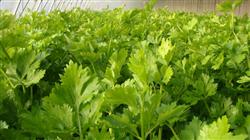 Celery is a vegetable whose leaf stalks are eaten. If cultivation and management are not meticulous, the fiber content often increases and it loses its edible value. Using the blanching method to cultivate celery can reduce the cellulose content, decompose the chlorophyll in the leaf stalks, and form xanthophyll, thereby improving edible value and increasing yield and income. The blanching cultivation methods are:
Soil-mounding blanching method. Soil-mounding blanching requires a celery row spacing of 33-40 cm. When the seedlings are 35-50 cm tall, first apply one heavy fertilizer and water thoroughly three times in succession. After 5-7 days, tie the base of each clump of plants with rice straw, then loosen the soil once to make the soil slightly dry, then mound soil on both sides of the plants and pat the soil firm so that the soil surface is smooth. The first mounding of soil is about 4 cm thick. After 2-3 days, mound soil again, and continue mounding soil 5-6 times in this way, to a height of about 20-25 cm, letting the heart leaves of the plants show and not injuring the buds. The best time for mounding soil is in the afternoon on a sunny day when the soil is not moist. After about 30 days, they can be harvested.
Board-enclosing blanching method. Board-enclosing blanching also requires a celery row spacing of 33-40 cm. When the seedlings are about 35 cm tall, first lift the plants up so that they stand upright and the soil between the rows is exposed. Then use two boards of wood or plastic, etc., 1.7-3.5 m long, 13-17 cm wide, and 2-3 cm thick, and place them on both sides of the celery plants, fixing the two ends of the boards with wooden stakes. Between the two boards, mound soil 13-17 cm thick so that the plants are not injured externally and soil does not fall into the heart of the celery, so as to avoid plant rot. Early-maturing celery only needs soil mounding 1-2 times, and can be harvested after about 30 days.
Bamboo-pole-clamping blanching method. The row spacing and seedling height requirements are the same as above. Use slender bamboo poles to clamp the leaf stalks of the plants along the planting rows, tie and bind the two ends of the slender bamboo with straw or nylon rope, then mound soil in stages according to the soil-mounding blanching method. Generally, they can be harvested after about 30 days.
Natural blanching method. This method belongs to blanching by close planting with semi-shade. Autumn-sown celery is planted in clumps at a plant and row spacing of 7 cm x 7 cm, with 3-4 plants per clump. Mound soil 20-28 cm around the edges of the bed, and use rice straw or reeds, thatch, etc., to make straw curtains and enclose the four sides. Before the plants close the rows, cultivate 2-3 times, and in combination with cultivation apply quick-acting nitrogen fertilizer 3-4 times, to promote plant tillering and luxuriant leaf growth, cover the top and close the rows as early as possible, and make the leaf stalks grow in a dark environment, so as to achieve the purpose of blanching the leaf stalks.