Detailed Guide to Identifying and Controlling Downy Mildew in Spinach
Downy mildew is a common disease of spinach, with severity varying from year to year. The spinach downy mildew pathogen is an obligate parasite that only infects spinach. I. Symptoms Spinach downy mildew can locally infect leaves and can also cause systemic infection. When leaves are locally infected, the affected areas first appear as pale green, water-soaked round spots, which then expand...
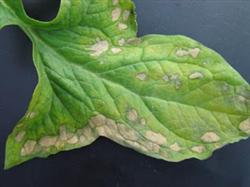
Downy mildew is a common disease of spinach, with severity varying from year to year. The spinach downy mildew pathogen is an obligate parasite that only infects spinach.
I. Symptoms
Spinach downy mildew can locally infect leaves and can also cause systemic infection. When leaves are locally infected, the affected areas first appear as pale green, water-soaked round spots, which then expand into irregular yellow lesions with indistinct edges; a grayish-white mold layer develops on the underside, later turning purplish-gray. Generally, the lower part of the plant becomes diseased first and the disease gradually spreads upward. In dry conditions, diseased leaves turn yellow and wither; in high humidity, they tend to rot. In systemic infection, the diseased plant becomes stunted, and large amounts of purplish-gray mold develop on the underside of the leaves. In severe cases, lesions cover the entire leaf, the leaf turns yellow and withers, and high humidity causes rotting.
II. Transmission Routes and Conditions for Disease Development
The pathogen overwinters as mycelium in overwintering spinach and on seeds, or as oospores in diseased plant residues. The following year it produces sporangia, which spread via airflow, rainwater, irrigation water, farm tools, insects and farming operations, becoming the primary infection source. Sporangia invade through stomata or the epidermis and cause repeated infections under conditions of 7-16°C and rainy, humid weather. The most susceptible growth stage for spinach downy mildew is when plants have more than 5 leaves; the peak disease periods are March to April in spring and September to December in autumn; generally, when there is less and lighter rain in spring, the disease is mild, while when there is more and heavier rain in autumn, the disease is severe. In fields with continuous cropping year after year, adjacent to or continuously cropped with other vegetables prone to downy mildew, in low-lying areas prone to waterlogging, with excessively high sowing density and a closed, poorly ventilated field, the disease is more severe.
III. Control Methods
1. Agricultural control In severely affected fields, implement a 2-3 year crop rotation; strengthen cultivation management by achieving moderate dense planting and reasonable irrigation; promptly remove infected plants when found; after harvest, clear away residual branches and fallen leaves.
2. Seed dressing with chemicals You can use 30% ridomil or 25% metalaxyl wettable powder for seed dressing, with the dosage being 0.3-0.4% of the seed weight.
3. Chemical control Spray at the early stage of disease onset, once every 7-10 days, for 2-3 consecutive sprays. You can use 58% metalaxyl-mancozeb wettable powder at 500 times dilution, 50% thiram wettable powder at 500 times dilution, 64% oxadixyl-mancozeb wettable powder at 500 times dilution, etc. If the disease occurs severely, you can use 72% cymoxanil wettable powder at 800 times dilution or 50% dimethomorph-mancozeb wettable powder at 500-600 times dilution for spray control.