Several Cultivation Methods for Achieving High Yields of Greenhouse Luffa
1. Variety selection. For greenhouse luffa, it is advisable to choose varieties with vigorous plant growth, cold tolerance and strong adaptability, such as the cylindrical luffa. 2. Land preparation and fertilization. Before sowing, in combination with plowing, apply more than 5000 kg of high-quality farmyard manure per mu; after leveling and harrowing evenly, open furrows along the planting rows, and apply another 50 kg of superphosphate and 25 kg of potassium sulfate per mu, ...
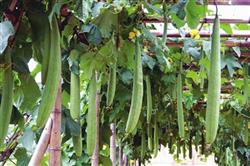
1. Variety selection. For greenhouse luffa, it is advisable to choose varieties with vigorous plant growth, cold tolerance and strong adaptability, such as the cylindrical luffa.
2. Land preparation and fertilization. Before sowing, in combination with plowing, apply more than 5000 kg of high-quality farmyard manure per mu; after leveling and harrowing evenly, open furrows along the planting rows, and apply another 50 kg of superphosphate and 25 kg of potassium sulfate per mu, or 100 kg of decomposed cake fertilizer; then close the furrows and form ridges, ready for planting.
3. Sowing time and cultivation method. Greenhouse luffa can be directly sown in mid-October, or raised as seedlings and transplanted. The cultivation method generally adopts ridge planting with large and small spacings: large row spacing 70 cm, small row spacing 60 cm, plant spacing 30 cm, 3400 plants per mu.
4. Sowing and seedling raising. Before sowing, soak the seeds in warm water at 50-60°C for 10 minutes, then soak for 24 hours after cooling; take them out, wrap them well in mixed cloth and place them at 28-32°C for germination acceleration, rinsing once a day with clean water; when most seeds have sprouted, they can be sown. Before sowing, water thoroughly to ensure sufficient bottom water; after sowing, cover with 1.5 cm of soil. In directly sown fields, furrows can be opened and seeds sown on both sides of the ridge back, and seedlings will emerge in 3-4 days. When the seedlings grow to 1-2 true leaves, thinning can be carried out in directly sown fields, and transplanting can be carried out in planting fields, keeping only one strong seedling per hole.
5. Management within the greenhouse.
1. Adjust temperature and light properly. Luffa requires relatively high temperatures throughout its growth period. The optimum temperature for growth is 20-24°C, and the optimum temperature for fruit development is 24-28°C; growth is slow at around 15°C, and is inhibited below 10°C. During management, keep the temperature inside the greenhouse at 25-30°C during the day and around 18°C at night. Before luffa vines begin to run, straw mats can be used to properly control the duration of sunlight to promote stem and leaf growth and female flower differentiation. During the flowering and fruiting period, open the straw mats in good time and make full use of sunlight to raise the temperature.
2. Water and topdress in good time. Luffa seedlings do not need much water; depending on soil moisture, lightly water 1-2 times. When the vine grows to about 5 cm, in combination with hilling again, apply 30 kg of monopotassium phosphate per mu as a topdressing and water heavily once. After flowering and fruiting, generally water once every 7-8 days, and at the same time apply 5 kg of urea per mu as a topdressing.
3. Set up trellises, tie vines, and adjust the plants. The stems and vines of luffa can reach up to 7-8 m in length. When the vine grows to about 25 cm, trellises need to be set up. To reduce the space occupied by trellis poles and shading, generally use iron wire or nylon rope, etc., tied directly to the greenhouse supports to form a single-row vertical trellis, with no crossing at the top, and guide the vines vertically upward according to the original planting row spacing and density. After the vines are on the trellis, tie them once every 4-5 leaves, and an "S"-shaped tying method can be used.
4. Preserve flowers and fruits. Applying 2.4-D to flowers can reduce flower drop and significantly increase the fruit-setting rate. When the temperature is high, the concentration is 20×10-6; when low, use 30×10-6. You can either use a brush to dip the liquid and apply it to the stigma of female flowers and the base of the corolla, or directly dip the flowers in the solution. The application time should be around 8 a.m.
5. Disease and pest control. The main diseases of luffa include anthracnose, phytophthora blight, and gray mold, which can be controlled with pesticides such as carbendazim, chlorothalonil, and dimethachlon. The main pests include melon aphids and whiteflies, etc., which can be controlled with rotenone and saoshiling, etc.