Dense-Planting Cultivation Techniques for Luffa (Sponge Gourd) in Winter-Warm Greenhouses during the Winter-Spring Season
Using winter-warm greenhouses for high-density off-season cultivation of luffa can greatly increase yields, with a per-mu yield of over 5000 kg and a per-mu income of 30,000-40,000 yuan. Variety selection: choose early-maturing varieties with strong cold tolerance, disease resistance and adaptability, such as Jiangshu No.1, Zaoza No.1, Cuilu Early Luffa, Yulu Early Luffa, and Wuye. Xiang...
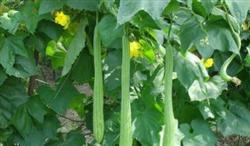
Using winter-warm greenhouses for high-density off-season cultivation of luffa can greatly increase yields, with a per-mu yield of over 5000 kg and a per-mu income of 30,000-40,000 yuan.
Variety selection: choose early-maturing varieties with strong cold tolerance, disease resistance and adaptability, such as Jiangshu No.1, Zaoza No.1, Cuilu Early Luffa, Yulu Early Luffa, Wuye. Xiang luffa, Yahua Zaojia luffa and other common luffa varieties; according to market demand, you may also choose angled luffa varieties such as Xiatang No.1, Lvwang, and Guangdong Angled Luffa.
Raising strong seedlings: sow in early to mid-October to ensure the crop reaches the market before Spring Festival. Soak the seeds to promote germination until two-thirds of the seeds have sprouted, then sow. Raise seedlings in the greenhouse in black nutrient pots with a side length of 10 cm. Each mu of field requires 30 sq m of seedbed and 600-754 g of seed. Mix barnyard manure and garden soil at a ratio of 7:3 or 6:4, and add 1 kg of potassium sulfate, 2 kg of superphosphate and 60-80 g of 50% carbendazim wettable powder per cubic meter of nutrient soil, mixing well to make the nutrient soil. After sowing, build a small arched tunnel over the seedbed and cover it with insect-proof netting and shade netting. Keep the seedbed moist and control the temperature at 25-30°C. Transplant the seedlings at the 2-3 leaf stage.
Land preparation and transplanting: choose a greenhouse where no cucurbit vegetables were previously grown for transplanting. During ploughing, apply 5000 kg of decomposed barnyard manure and 50 kg of potassium sulfate compound fertilizer per mu as a base dressing. After deep ploughing and leveling, make north-south oriented ridges 70 cm wide and 20 cm high, with 50 cm wide furrows. Plant 2 rows per ridge, with a row spacing of 40 cm and a plant spacing of 30 cm, giving 3700 plants per mu. Before transplanting, apply 5 g of decomposed soybean cake per hole; after transplanting, cover the ridge surface with plastic film and cut holes in the film to release the seedlings.
Temperature and light management: keep the greenhouse sealed for 1 week after transplanting to raise the internal temperature and promote seedling recovery. Maintain the daytime temperature at 30-35°C and not lower than 12-15°C at night. After seedling recovery, maintain the daytime greenhouse temperature at 25-30°C, ventilate from the top when it exceeds 30°C, and keep the night temperature at 14-16°C. During cold spells, provide temporary heating so that the night greenhouse temperature does not fall below 8°C. Before the vines begin to run, control the light duration by uncovering and covering the straw mats to promote stem and leaf growth and female flower differentiation. During the flowering and fruiting stage, uncover the straw mats in time to raise the greenhouse temperature.
Fertilizer and water management: water well at transplanting to settle the seedlings. Before fruiting, control fertilizer and water to promote steady and rapid seedling growth. When male flowers open, apply decomposed human manure or decomposed cake fertilizer once together with irrigation. After flowering and fruit set, apply a fruit-swelling fertilizer, and gradually increase the amount of fertilizer and water thereafter. After watering, ventilate to remove excess moisture. During the peak fruiting period, apply fertilizer with irrigation once every 8-10 days, each time applying 500-600 kg of decomposed chicken manure and human manure per mu or 10-15 kg of urea, alternating with 10-15 kg of NPK compound fertilizer. On sunny mornings, appropriately increase carbon dioxide gas fertilizer. From the early fruiting stage, spray sodium bisulfite once every 7-10 days, for a total of 3 sprays, with 5 g, 10 g and 15 g per mu respectively each time, diluted with water to make a 200 mg/L solution for spraying.
Plant adjustment: when the vines reach 30 cm long, tie them to the support, using the crossbeams at the north and south ends of the greenhouse for hanging the vines. After the vines are trained onto the trellis, tie them every 4-5 leaves. Generally keep the vines at a height of 1.5 m to prevent the top from touching the film and being scorched. Remove all side vines before the first female flower appears; side vines that appear later should be pinched after fruiting, leaving 1 leaf. When tying the vines, pinch off tendrils and male flowers, and pay attention to adjusting the position and direction of the vines. Promptly prune thin and weak vines or overly dense old and declining vines.
Flower and fruit retention: carry out artificial supplementary pollination in the evening or in the morning when there is no dew, taking care not to damage the stigma of the male flowers during pollination. Applying 2,4-D solution to the flowers can also reduce flower drop and increase the fruit-setting rate. Use a concentration of 20 mg/L when the temperature is high and 30 mg/L when the temperature is low, applying at 8 a.m.
Timely harvesting: harvest luffa 10-12 days after pollination, choosing the morning; during the peak fruiting period, harvest once a day.