Managing loofah this way in the late stage lets you both save seed and keep harvesting fruit
Vegetable growers often save their own loofah seed in the late fruiting stage. Generally speaking, once plants are kept for seed, they are no longer used for normal loofah production. However, it takes 80-90 days from fruit set to seed maturity, and over these nearly 3 months, growing seed alone is bound to hurt the returns from loofah production. If you manage the late stage of loofah skillfully...
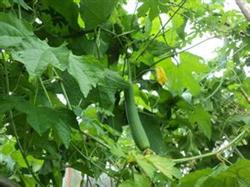
Vegetable growers often save their own loofah seed in the late fruiting stage. Generally speaking, once plants are kept for seed, they are no longer used for normal loofah production. However, it takes 80-90 days from fruit set to seed maturity, and over these nearly 3 months, growing seed alone is bound to hurt the returns from loofah production. If you manage the late stage of loofah skillfully, you can ensure both seed saving and fruit production.
When loofah enters the planned seed-saving period, at 1-2 nodes below the fruit intended for seed, keep a side vine in advance; after the main vine is pinched off, let this side vine take over from the main vine and continue to set fruit.
At least 5-6 leaves must be kept above the seed fruit on the main vine to ensure the nutrients needed for seed development.
The side vine should be trained up a trellis promptly, and no fruit should be kept on it for 15 days after the main vine's seed fruit is set, to prevent competition for nutrients from affecting normal seed development. This is because at around 15 days the loofah fruit has basically finished swelling and enters the seed maturation stage, so to avoid the seed fruit being too small or the fruit swelling too slowly, no fruit should be kept on the side vine. At the same time, the nutrients produced by the side vine's leaves can also be supplied in large amounts to the growth of the seed fruit, which helps increase the quantity and quality of the seed being grown.
In the early fruiting stage of the side vine, the concentration of the flower-setting agent should be low when pollinating. Formula: add to 2 kg of water 10 ml of Liangguosu, 6 ml of 2,4-D, 10 ml of naphthalene acetic acid, 10 ml of Hualeibao, 12 ml of loofah flower-preserving agent, 20 ml of Lvzhiyuan, and 1 g of Fuluning; the fruit-setting agent can be left out for now, to reduce competition for nutrients and avoid hormone poisoning that causes premature plant decline. After 80-90 days, once the seed fruit is harvested, the concentration of the flower-setting agent can be increased appropriately: 2,4-D can be raised to 8 ml, and 10 ml of fruit-setting agent can also be added.
Although loofah has a well-developed root system, after entering the seed-saving period it has already reached the late stage of production, and the plant will inevitably show decline, so to ensure both seed saving and fruit production, the amount of fertilizer must be increased. Topdressing can be done by flushing application and foliar spraying. Biological bacterial fertilizer and high-potassium chemical fertilizer can be applied together by flushing to promote roots, maintain the plant, and preserve flowers and fruit. Biological bacterial fertilizer: 20-25 kg per mu per application by flushing; high-potassium chemical fertilizer: 15-20 kg per mu per application by flushing. Potassium sulfate compound fertilizer can also be applied by flushing, 25-30 kg per mu per application. Foliar spraying is mainly to make up for the shortfall of root-zone topdressing, so as to meet the large nutrient demand of loofah for seed saving and fruit production; a full-nutrient foliar fertilizer can be sprayed.