How to manage green onions in early summer? Detailed explanation of key technical points
Green onions prefer a cool and humid environment. The optimum temperature for growth is 15-25°C. Above 26°C, growth becomes thin and slow, and above 30°C they enter a semi-dormant state. The first stage generally runs from planting to the start of the dog days, a period when the temperature rises from 15°C to 25°C, which is relatively suitable for green onion growth. Therefore, after planting and recovering from transplanting, they quickly enter...
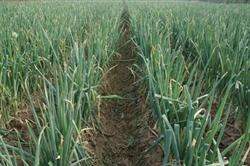
Green onions prefer a cool and humid environment. The optimum temperature for growth is 15-25°C. Above 26°C, growth becomes thin and slow, and above 30°C they enter a semi-dormant state. The first stage generally runs from planting to the start of the dog days, a period when the temperature rises from 15°C to 25°C, which is relatively suitable for green onion growth. Therefore, after planting and recovering from transplanting, they quickly enter the first growth peak, producing one leaf every 4-5 days. At this time, strong seedlings should be selected, planting should be done early, and fertilizer and water management should be strengthened. The second stage runs from mid-July, the start of the dog days, to early August, the end of the dog days, which is the hot summer season. At this time green onions grow slowly, producing only one leaf every 8-10 days, and their disease resistance weakens as they enter the semi-dormant period, so intertillage and weeding should be strengthened, with attention to drainage and pest and disease control. The third stage runs from mid-August, the end of the dog days, to mid-October. As temperatures drop and the temperature difference between day and night increases, green onion growth speeds up, producing one leaf every 3-4 days, and the white stalk elongates and thickens rapidly, entering the second growth peak. At this time, timely topdressing should be carried out, and intertillage and hilling should be strengthened to promote white stalk growth and increase yield.
The main diseases of green onions are purple blotch, downy mildew, and rust. For the control of purple blotch and downy mildew, the main method is foliar spraying with chlorothalonil, ridomil, and sandofan after rain. Rust appears as small brown raised spots on the surface of the leaves; spray triadimefon promptly after rain for control.
The main insect pests of green onions are root maggots, leafminers, and onion thrips. To prevent root maggots, spray trichlorfon once every 10-12 days after the Start of Autumn, which has a good repellent effect on adults; after occurrence, drench with a 90% trichlorfon 800-1000 times dilution. For leafminers and onion thrips, foliar spraying with dimethoate, kung fu, and weidi can be used.
The leaves of green onions have a layer of waxy powder. No matter what pesticide is used for spraying, 1% neutral laundry detergent must be added to the spray solution as a spreader so that the pesticide can adhere to the leaf surface and take effect; otherwise spraying will be ineffective.