Identification and Control Methods for Dry Tips on Welsh Onions
Welsh onion dry tips fall into two types: physiological dry tips and pathological dry tips, and among the latter, "white dry" and "green dry" often leave onion farmers unable to tell them apart, making it hard to target the right treatment, which leads to missing the best window for control. Here, a brief explanation of the causes and control measures for the two symptoms. White dry is caused by late blight, occurring under high temperature and high humidity conditions...
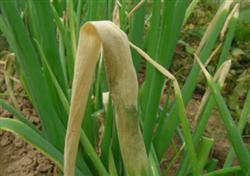
Welsh onion dry tips fall into two types: physiological dry tips and pathological dry tips, and among the latter, "white dry" and "green dry" often leave onion farmers unable to tell them apart, making it hard to target the right treatment, which leads to missing the best window for control. Here is a brief explanation of the causes and control measures for the two symptoms.
White dry is caused by late blight, which occurs easily under high temperature and high humidity conditions, and strikes when there is cloudy weather and rain; it is also the main cause of dry tips on Welsh onions at present. In the early stage of the disease, the lesions are dark green and water-soaked; after expanding, they become grayish-white lesions with indistinct margins, and the leaves wither; when the disease is severe, the field turns a dull white. For control agents, propamocarb (Previcur) or metalaxyl-mancozeb can be used. Note, however, that because the onion leaf surface has a layer of wax, an organosilicone adjuvant should be added when spraying to improve the adhesion of the agent.
Green dry is damage caused by gray mold. This disease is severe when nighttime temperatures are low and humidity is high, and it has now gradually become a minor disease. In the early stage of the disease, there are white spots on the leaves, nearly round or oval, 1-3 mm in diameter, developing from the leaf tip downward and gradually merging into patches, causing the onion leaves to curl and die. For control agents, iprodione, procymidone, or boscalid can be used, and an organosilicone adjuvant should likewise be added to improve control efficacy.
In addition, onion maggots can also cause dry tips on Welsh onions. The onion maggot larvae bore into the onion roots to cause damage; after pulling up the onion, the roots can be seen to have turned brown, thereby causing the leaf tips above ground to dry up, and in severe cases the roots rot or die. The pancake falls apart at a touch when it comes out of the pot.