How should green onions be fertilized for high quality and high yield?
Cause: Green onion root rot has symptoms similar to waterlogging root rot and is a fungal disease. It is a disease caused by infection with multiple pathogens such as Pythium, Fusarium, and Phytophthora. The pathogen overwinters in the soil or on diseased residues and becomes the main primary infection source the following year. The pathogen invades through wounds on the root crown or roots, and enters through rainwater or irrigation water...
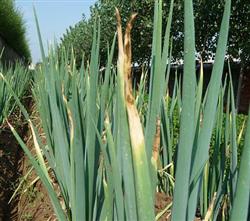 For green onion cultivation to achieve good quality and high yield, reducing nitrogen and increasing potassium in fertilization is key. The specific fertilization methods are introduced as follows:
1. Green onion is a crop of the Liliaceae family with a relatively long growth period. In the Huang-Huai River basin, the planting pattern generally adopted is sowing in September to October, transplanting in February to March of the following year, and harvesting head onions or small onions in May to June, or sowing in March to April, transplanting in June, and harvesting large white onions in autumn and winter. Green onion has a relatively high yield, generally 3000 to 6000 kg per 667 sq m (1 mu), and the ratio of nitrogen, phosphorus, and potassium nutrient uptake is about 1:0.4:1.3. It requires more potassium and nitrogen and less phosphorus, so the fertilization ratio should pay attention to the balanced supply of potassium fertilizer, especially in high-yield cultivation and when no organic fertilizer has been applied. The specific application ratio of nitrogen, phosphorus, and potassium fertilizers mainly depends on the following three aspects: first, the soil's own potassium supply capacity. For example, sandy soil has low potassium supply capacity, so the amount of potassium fertilizer used should be appropriately increased. Second, what the target yield of green onion is. Under high-yield cultivation conditions, the amount of potassium removed from the soil by each green onion crop is also greater, so the amount of potassium fertilizer applied should be increased accordingly. Third, the application amounts of other fertilizers, such as the amount of straw returned to the field and the amount of nitrogen fertilizer applied. If a large amount of organic fertilizer is put in, less potassium fertilizer can be applied. In particular, the amount of chemical nitrogen fertilizer should be appropriate and should be applied in balance with the corresponding potassium fertilizer to achieve a good yield-increasing effect. Otherwise, blindly applying chemical nitrogen fertilizer is not only unhelpful for high green onion yield, but will also cause a decline in green onion quality, such as a small proportion of white stalk, many leaves, weak onion flavor, and even a bitter taste.
2. Generally, at a relatively high yield level, the recommended nitrogen fertilizer rate for green onion is about 20 to 26 kg of pure nitrogen per 667 sq m. Applying too much nitrogen fertilizer alone, plus a large amount of irrigation water, not only wastes nitrogen fertilizer and increases costs, but also produces green onions that do not store well, have reduced quality, and cause negative environmental effects due to nitrogen loss. Therefore, the amount of nitrogen fertilizer applied should be appropriate. In terms of nitrogen fertilizer variety selection, the most common is urea, but the most suitable nitrogen fertilizer variety is ammonium sulfate, because green onion is a sulfur-loving crop.
3. Fertilization methods matter. The whole-process fertilization of green onion is divided into two parts: base fertilizer and topdressing. For the base fertilizer, it is best to apply 4000 to 5000 kg of thoroughly decomposed high-quality organic fertilizer per 667 sq m, broadcast it during land preparation, and plow it into the soil; for the chemical base fertilizer, all phosphate fertilizer, 40% of the nitrogen fertilizer, and 60% of the potassium sulfate fertilizer should be applied, and the variety can be compound fertilizer or single-element fertilizer. When choosing compound fertilizer, a sulfur-based general-purpose type or special-purpose type can be selected, and high-nitrogen compound fertilizer should not be applied. The application depth of the base fertilizer must be about 15 cm. Topdressing for green onion can be carried out 2 to 3 times, applying the remaining 60% of the nitrogen fertilizer and 40% of the potassium fertilizer from the base fertilization as topdressing during the full leaf stage and the early to middle stage of white stalk formation. Topdressing method: good integration of water and fertilizer is required, and flooding with large amounts of water and nitrogen must be avoided. Otherwise, it will not only cause low fertilizer use efficiency, but in summer, broadcasting urea on the soil surface will also cause leaf scorching and seedling burning due to nitrogen volatilization.