What are the main diseases of Welsh onion? A complete guide to identifying common types
Once the white pseudostem enters its vigorous growth period, the threat of pests and diseases also enters a high-incidence stage. The main pests and diseases are: purple blotch, downy mildew, soft rot, onion maggot, onion thrips, onion leaf miner, and beet armyworm. 1. Purple blotch: in the early stage of the disease, spray 75% chlorothalonil wettable powder at 500-600 times dilution, 58% metalaxyl-mancozeb...
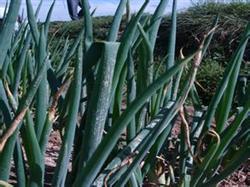 Welsh onion purple blotch
1. Symptoms: it mainly damages leaves and flower stalks. Initially, small water-soaked white spots appear, later turning light brown, net-like or spindle-shaped, slightly sunken lesions, which continue to expand into light brown or dark purple spots, often with a yellow halo around them. On the diseased areas, dark brown or blackish-gray mold-like growth appears in concentric ring patterns. The diseased areas continue to expand, causing the whole leaf to turn yellow, wither and die or break off.
Control methods
In the early stage of the disease, spray 75% chlorothalonil, or 64% oxadixyl, 40% dafudan, 58% metalaxyl, mancozeb wettable powder at 500 times dilution, or 50% iprodione wettable powder at 15000 times dilution, once every 7-10 days, for 3-4 consecutive treatments.
2. Welsh onion downy mildew
Symptoms: Welsh onion downy mildew mainly damages leaves and flower stalks. On the flower stalks, relatively large yellowish-white or creamy-yellow infection spots first appear, spindle-shaped or oval, on which white mold develops, later turning pale yellow or dark purple.
Control methods
In the early stage of the disease, spray 90% fosetyl-aluminum wettable powder at 500 times dilution, or 75% chlorothalonil wettable powder at 600 times dilution, 50% metalaxyl-copper wettable powder at 800 times dilution, 64% oxadixyl wettable powder at 500 times dilution, 72.2% propamocarb aqueous solution at 800 times dilution, 70% ethyl-manganese wettable powder at 500 times dilution, 60% hu. fosetyl-aluminum wettable powder at 500 times dilution, once every 7-10 days, for 2-3 consecutive treatments.
3. Welsh onion and onion gray mold
Symptoms: white spots first appear on the leaves, oval or nearly round, 1-3 mm in diameter, mostly developing downward from the leaf tip, gradually merging into patches, causing the onion leaves to curl and wither. When humidity is high, a large amount of gray mold grows on the dead leaves.
Control methods
In the early stage of the disease, spray 50% carbendazim or 70% thiophanate-methyl wettable powder at 500 times dilution. Alternatively, 50% procymidone or 50% iprodione and 50% vinclozolin wettable powder at 1000-1500 times solution, or 80% carbendazim wettable powder at 600 times dilution gives good results.
4. Welsh onion rust
Symptoms: it mainly damages leaves, flower stalks and green stems. In the early stage of the disease, oval, slightly raised orange-yellow blister spots appear on the epidermis, later the epidermis ruptures and turns outward, releasing orange-yellow powder, which is the pathogen's uredinia and urediniospores. After autumn, the blister spots turn dark brown, and when they rupture, dark brown powder is released, which is the telia and teliospores.
Control methods
In the early stage of the disease, spray 15% triadimefon wettable powder at 2000-2500 times dilution, or 50% carboxin emulsifiable concentrate at 700-800 times dilution, 25% diniconazole emulsifiable concentrate at 3000 times dilution, 70% mancozeb wettable powder at 1000 times dilution plus 1.5% triadimefon wettable powder at 2000 times dilution, once every 10 days or so, for 2-3 consecutive treatments.
Welsh onion Phytophthora blight
Symptoms: when leaves and flower stalks are infected, inconspicuous bluish-white spots first appear, which after expanding become grayish-white patches, causing the leaves to wither. During continuous rain or high humidity, white cottony mold grows on the diseased areas; in dry weather, the white mold disappears, and tearing open the epidermis reveals cottony white mycelium.
Control methods
In the early stage of the disease, spray 60% hu. fosetyl-aluminum wettable powder at 500 times dilution, or 70% ethyl. manganese wettable powder at 500 times dilution, 58% metalaxyl. mancozeb at 500 times dilution, 64% oxadixyl M8 wettable powder at 500 times dilution, 72.2% propamocarb aqueous solution at 800 times dilution, once every 7-10 days, for 2-3 consecutive treatments.
Pest stages: onion fly, onion maggot
Occurrence pattern: the onion fly occurs 2-3 generations per year. It lays eggs on the white pseudostem near the ground, or under clods near Welsh onion plants. The onion fly likes warmth and sunlight, but in the morning and evening it mostly hides in soil cracks. The onion fly larvae damage the base of the root-white of Welsh onion; in mild cases the plants wither, in severe cases they die, causing gaps and broken rows in the field. They mainly damage the white pseudostem, stem disc and roots underground, causing the upper leaves to turn yellow and dry up. Use 40% isofenphos-methyl emulsifiable concentrate at 500 times dilution or 50% phoxim at 400 times dilution to drench the roots; open a furrow beside the damaged area, pour in the pesticide and seal it with soil.
Onion thrips (Figure 18)
It damages leaves, sucking the leaf mesophyll and forming white spots; in severe cases, the whole field takes on a grayish-white appearance due to loss of chlorophyll. For the above two pests, use the systemic insecticide 40% omethoate emulsifiable concentrate at 800 times dilution, spraying 100 jin per mu, once every 7 days, for 2-3 consecutive sprays.
Welsh onion and onion soft rot
Symptoms: in the field during the bulb swelling stage, semi-transparent grayish-white spots appear on the lower part of 1-2 outer leaves, the leaf sheath base softens and rots, causing the outer leaves to fall over, and the lesions expand downward; when the bulb is infected, it is initially water-soaked, then the interior begins to rot, giving off a foul odor.
Control methods
In the early stage of the disease, spray 50% copper diammonium diacetate wettable powder at 500 times dilution, or 77% copper hydroxide wettable micropowder at 500 times dilution, 14% copper ammoniacal complex aqueous solution at 300 times dilution, 72% agricultural streptomycin sulfate soluble powder at 4000 times dilution, or new streptomycin at 4000-5000 times dilution, depending on the disease severity once every 7-10 days, for 1 or 2 treatments.
Welsh onion and onion yellow dwarf disease
Symptoms: when Welsh onion is infected, leaf growth is inhibited, leaves become twisted and narrowed, making the leaf surface uneven, and the leaf tips gradually turn yellow. Sometimes yellow-green mottling of varying lengths or long yellow streaks appear, the onion tube becomes twisted, growth stops, waxiness decreases, leaves droop and turn yellow, and in severe cases the whole plant becomes dwarfed or wilted.
Control methods
Starting in the early stage of the disease, spray 1.5% zhibingling emulsifiable concentrate at 1000 times dilution, or 20% virus A wettable powder at 500 times dilution, or 83 resistance inducer at 100 times dilution, once every 10 days or so, for 1 or 2 treatments.
Garlic leaf blight
Symptoms: it mainly damages leaves or flower stalks. Leaf infection mostly starts at the leaf tip or other parts of the leaf, initially appearing as small off-white net-like spots, which after expanding become irregular or oval grayish-white or grayish-brown lesions, on which black mold-like growth appears; in severe cases the diseased leaves wither and die.
Control methods
Starting in the early stage of the disease, spray 75% chlorothalonil wettable powder at 600 times dilution, or 50% iprodione wettable powder at 1500 times dilution, 64% oxadixyl wettable powder at 500 times dilution, 50% copper diammonium diacetate wettable powder at 500 times dilution, 60% hu. fosetyl-aluminum wettable powder at 500 times dilution, 14% copper ammoniacal complex aqueous solution at 300 times dilution, or 1:1:100 Bordeaux mixture, once every 7-10 days, for 3-4 consecutive treatments.
Welsh onion and onion small sclerotium disease
Symptoms: it mainly damages leaves and flower stalks. Initially only the tips of leaves or flower stalks change color, gradually expanding downward, causing parts or all of the onion plant to wither and die, leaving only new leaves. Peeling open the diseased leaves reveals white cottony aerial mycelium inside, and yellowish-brown or black small sclerotia are scattered beneath the epidermis of the diseased areas, 0.5-7 mm in size:
Control methods
Starting in the early stage of the disease, spray 40% carbendazim. sulfur suspension concentrate at 500 times dilution, or 50% thiophanate-methyl wettable powder at 400-500 times dilution, 50% iprodione wettable powder at 100-1500 times dilution, 50% vinclozolin (vinclozolin) wettable powder at 1000 times dilution, 20% tolclofos-methyl emulsifiable concentrate at 1000 times dilution, once every 7-10 days, for 2-3 consecutive treatments.
Welsh onion and onion white rot
Symptoms: leaves turn yellow starting from the tip and then wither and die. Infected young plants usually wither, and mature plants weaken and wither after several weeks. When humidity is high, many fuzzy-colored fungal bodies grow on the bulb and adventitious roots, after which the mycelium diminishes and black spherical sclerotia are exposed. Roots or bulbs rot in the field, becoming water-soaked. During storage, the bulbs may continue to rot.
Control methods
(1) Practice 3-4 year crop rotation, and avoid continuous cropping in diseased fields. (2) Strengthen field inspection, and promptly dig out and deeply bury diseased plants when found. (3) Before sowing, treat seeds with 50% iprodione wettable powder at 0.3% of seed weight. (4) In diseased fields, about 5 weeks after sowing, spray 50% carbendazim wettable powder at 500 times dilution, or 50% thiophanate-methyl wettable powder at 600 times dilution, or 50% iprodione wettable powder at 1000-1500 times dilution to drench the roots and stems. During storage, the above fungicides can also be sprayed, among which 50% iprodione wettable powder has the best effect. In addition, 20% tolclofos-methyl emulsifiable concentrate at 1000 times dilution can also be sprayed, once every 10 days or so, for 1 or 2 treatments.