How to manage autumn-planted scallions? Keep this management guide handy
Scallion is a biennial, cold-tolerant and highly adaptable vegetable of the Liliaceae family. Scallion leaves release propyl sulfide with a pungent odor, and its root system secretes bactericidal substances; together they can effectively inhibit the spread of various pathogens in the air and soil, prevent infection, or kill pathogens, significantly reducing the incidence of disease in vegetable plants...
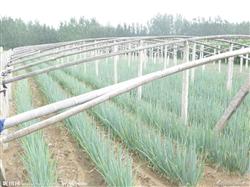 After the Start of Autumn (Liqiu) solar term, temperatures drop noticeably and air humidity decreases. The suitable temperature and humidity bring scallions into a period of rapid growth. During this time, field management should be strengthened, focusing on promoting roots, strengthening plants and earthing up for blanching, and scientifically managing fertilizer and water to create a suitable growing environment for the formation of the white pseudostem, thereby improving the yield and quality of scallions. In production, the following 4 points should be specifically grasped:
1. Topdressing and watering. After the Start of Autumn, temperatures gradually decrease, the root absorption function enters its vigorous phase, and the plants enter the peak leafing period, increasing the demand for water and fertilizer. From the Start of Autumn to White Dew, the watering principle is "light watering, water in the morning and evening," combined with watering and topdressing with "leaf-promoting fertilizer": apply 1500 kg of decomposed farmyard manure, 20-25 kg of superphosphate, and 10 kg of potassium sulfate per mu to promote rapid leaf development.
After White Dew, the weather is cool and the temperature difference between day and night increases. Scallions enter the pseudostem formation period, which is also the key period for fertilizer and water management. From White Dew to Autumn Equinox, topdressing should mainly be quick-acting nitrogen fertilizer, preferably urea, with about 20 kg per mu, plus 15 kg of potassium sulfate.
The watering principle is "frequent watering, heavy watering," keeping the soil moist regularly to meet the growth needs of the pseudostem.
After Frost's Descent, the weather becomes increasingly cold, leaf growth gradually slows, and leaf surface transpiration decreases. Watering should be gradually reduced, and watering should stop 7-8 days before harvest to improve the storage tolerance of scallions.
2. Earthing up for blanching. As the farming proverb says: "If you want scallions to stand tall, earth must be piled up to the heart of the scallion." Production practice shows that the deeper the scallions are earthed up, the longer the pseudostem.
Earthing up is an important measure for blanching the leaf sheaths, preventing lodging, and improving the yield and quality of the pseudostem. From the Start of Autumn to before harvest, earthing up should be done 4 times (Start of Autumn, End of Heat, White Dew and Autumn Equinox). Each time, the thickness of the earth should be just up to the leaf exit of the uppermost leaf, and the heart leaf must never be buried, so as not to affect the growth of scallions.
3. Pest and disease control. Timely control the damage of leafminers. After seedling recovery, spray 1.8% abamectin emulsifiable concentrate at 1500 times, or 75% cyromazine wettable powder at 3500 times, or 72% cymoxanil wettable powder at 600-800 times; from the peak egg-laying period to the early larval hatching stage, spray 20% fenvalerate emulsifiable concentrate at 2000-3000 times, or 2.5% deltamethrin emulsifiable concentrate at 2000 times, once every 7-8 days, for 2-3 consecutive sprays.
When black spot or purple blotch appears on scallion leaves, use 50% carbendazim wettable powder at 500 times, or 70% mancozeb wettable powder at 600 times, etc., spraying once every 7-10 days for 2-3 consecutive times. Pesticides should be used alternately to prevent resistance.
4. Timely harvest. As the farming proverb says: "If you don't harvest scallions by Cold Dew, the longer they grow, the more hollow the heart." Scallions should be harvested at the right time. Harvesting too early means the pseudostem has not fully expanded, leading to reduced yield; harvesting too late means the upper part of the pseudostem loses water and becomes soft, affecting the commercial value of scallions. In the central and southern regions of our province, harvesting is generally done before the Start of Winter.