Detailed Introduction to Onion Varieties and Classification
1 Main Types The types of onion can be classified morphologically as: ① Common onion (Allium epa L.), each plant usually forms only one bulb. Propagated by seed; a few varieties form aerial bulbs on the inflorescence under special environmental conditions. Common onions can generally be divided by bulb shape into flat-globular...
1 Main Types
Onion types can be classified morphologically as:
① Common onion (Allium epa L.). Each plant usually forms only one bulb. Propagated by seed; a few varieties form aerial bulbs on the inflorescence under special environmental conditions.
Common onions can generally be divided by bulb shape into flat-globular, round-globular, oval and spindle-shaped. They can also be divided by maturity into early-maturing, mid-maturing and late-maturing. South of the Yangtze River, mid- and early-maturing varieties are mostly used. They can also be divided by geographic latitude into three types:
"Short-day" type: adapted to the area south of the Yangtze River in China, at latitudes of 32° to 35°N. These varieties are mostly sown in autumn and harvested in spring and summer.
"Long-day" type: adapted to various parts of Northeast China, at latitudes north of 35° to 40°N. These varieties are sown or transplanted in early spring (using small bulbs) and harvested in autumn.
Intermediate type: adapted to the Yangtze River and Yellow River basins, between 32° and 40°N. These varieties are sown in autumn and harvested in late spring and early summer of the following year.
② Tillering onion (A. Cepa var. Agrogatum Don). It can tiller and usually does not set seed. Each tiller base can form a bulb, and it is propagated by the small tiller bulbs.
③ Top onion (A. Cepa var. viviparum Merg). Many aerial bulbs are borne on the inflorescence. The aerial bulbs can be used for propagation, and it does not set seed. It is mainly used for pickling. Like the tillering onion, the top onion has low economic value except for special purposes and is rarely cultivated.
2 Main Cultivated Varieties
Within each type, varieties can be divided by bulb skin color into red-skinned, yellow-skinned and white-skinned types.
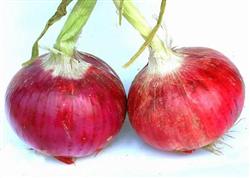
① Red-skinned onion. The onion head is purplish-red on the outside, and the fleshy scales are slightly reddish. It is flat-globular or round-globular, 8 to 10 cm in diameter. It tolerates storage and transport, has a relatively short dormancy period, and sprouts earlier, showing early to mid maturity, and is harvested from late May to early June. It is widely cultivated throughout East China. Representative varieties include Shanghai Red Skin and others.
② Yellow-skinned onion. The onion head is brass-colored to light yellow, and the fleshy scales are slightly yellow and soft, with fine, dense tissue and a relatively strong pungency. It is flat-round, 6 to 8 cm in diameter. It tolerates storage and transport relatively well, and is early to mid maturing. The yield is lower than that of red-skinned varieties, but the quality is better, and it can be used for dehydration processing. It is round or tall-round and suitable for export. Representative varieties include Lianyungang 84-1, DK Yellow, OP Yellow, Dabao, Laixuan 13 and others.
③ White-skinned onion. The onion head is white, and the fleshy scales are white. It is flat-round-globular, and some are tall-round and spindle-shaped, 5 to 6 cm in diameter. It has excellent quality and is suitable as a raw material for dehydration processing or as an ingredient in canned foods. However, the yield is relatively low and disease resistance is relatively weak. If sown too early in autumn in the Yangtze River basin, it is prone to premature bolting. Representative varieties include Hami White Skin and others.