What are the key techniques for growing onion seedlings? Master the essentials to grow strong seedlings
Onion is a common vegetable that tolerates transport and stores well. Onions are easy to grow and manage, and the economic return is between 1000 and 2000 yuan per mu. Experiments have shown that growing strong seedlings is a key measure for increasing yield. 1. Reasonable fertilization. In terms of fertilization, apply enough base fertilizer to ensure that the seedlings do not need topdressing in the early stage,...
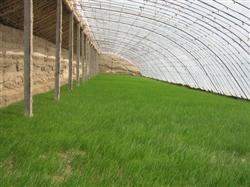 1. Reasonable fertilization. Onion seeds are small, the seedlings grow slowly, the string-like roots are relatively short, the root mass is small, and the absorption and utilization rate of fertilizer and water is not high. The seedbed should be selected as a plot with fertile, loose soil that can remain moist and has not grown alliums in the past 3-5 years. While deep plowing, apply about 10 kg/sq m of decomposed organic fertilizer and 60-80 g/sq m of nitrogen-phosphorus compound fertilizer. Mix evenly, level, and firm the soil.
Experiments have shown that reasonable fertilization and growing strong seedlings are one of the key measures for increasing yield. Seedlings that receive nitrogen and phosphorus fertilizer and a fertilizer combining the three elements nitrogen, phosphorus, and potassium during the seedling stage can increase the average weight per plant and root weight by 1 times compared with seedlings that receive no base fertilizer.
2. Water enough before sowing. According to vegetable growers' many years of experience, wet sowing of onion seedlings works better than dry sowing. Water the base water thoroughly, with a watering depth of no less than 6 cm, to meet the needs of onion emergence. Watering midway causes the seedbed to crust, which is unfavorable for full emergence and the healthy growth of onions.
3. Sow at the right time. The specific sowing date varies with local climatic conditions, and a graphing method can be used to determine the local sowing date. That is, use temperature as the vertical axis and months as the horizontal axis, draw a curve using the values of monthly average temperatures, find the 15°C point on it, draw a vertical line from this point to the horizontal axis, and then move 40 days earlier from the intersection point with the horizontal axis; this is the local suitable sowing date. Every place has a suitable sowing date. This has been obtained from long-term production practice and should be followed and not changed at will. If autumn-sown seedlings are sown too early, early bolting may occur the next year; if sown too late, the seedlings' vegetative body is too small, making overwintering difficult, which will also bring adverse consequences to production, and the loss may outweigh the gain.
4. Moderate soil covering. After sowing onion seeds in water, cover with soil promptly. Use decomposed farmyard manure mixed with soil and sifted, with a covering thickness of 0.8-1.50 cm. If the soil cover is too thin, it is easy to produce "capped seedlings," causing onions to root too shallowly and die, or, although not dying, to grow weakly and easily lodge. If the soil cover is too thick, it will also affect full emergence.
5. Shade promptly. Onion germination does not require light, nor does it have excessively high oxygen requirements. After sowing onions, film or straw should be covered promptly to keep the soil moist and prevent damage from heavy rain. Where conditions permit, shade film should be used. If conditions do not allow, use local materials and cover with straw. According to vegetable growers' experience, covering with yellow sweet wormwood has better air permeability and less seedbed contamination than covering with wheat straw.
6. Foliar fertilizer spraying. Spraying phosphorus on onion leaves can promote root development. This is because the process by which onions absorb and transport phosphorus from the soil is very slow. According to relevant data, it takes about 3-4 days to transport from absorption at the root tip to the leaf tip, while foliar phosphorus spraying can be absorbed and transported within one or two hours. To help seedling recovery and root development, spray onion seedlings with 0.2%-0.4% monopotassium phosphate 10-15 days before planting, which can improve the rooting ability of onions after planting. This is an inexpensive and beneficial method and is worth promoting.