Control Methods and Technical Key Points for Gray Mold in Greenhouse Chinese Chives
When humidity inside a greenhouse for Chinese chives is high, gray mold is likely to occur. After the disease develops, pale grayish-brown to white spots gradually appear on the leaves from the tip downward, on both the upper and lower surfaces; after expanding, they become elliptical or spindle-shaped lesions and merge with each other into large dead patches. When air humidity is above 85% and the temperature is 15°C~20°C, warm and humid conditions favor the occurrence of this disease.
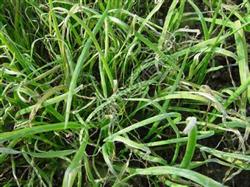
When humidity inside a greenhouse for Chinese chives is high, gray mold is likely to occur. After the disease develops, pale grayish-brown to white spots gradually appear on the leaves from the tip downward, on both the upper and lower surfaces; after expanding, they become elliptical or spindle-shaped lesions and merge with each other into large dead patches. When air humidity is above 85% and the temperature is 15°C~20°C, warm and humid conditions favor the occurrence of this disease.
Control measures: 1. Select disease-resistant varieties. Broad-leaf disease-resistant varieties such as Xuejiu, 791, and Jiaxing Baigen; narrow-leaf cold-resistant disease-resistant varieties such as Gong, Huangmiao, and Zhongjiu No. 2.
2. Strengthen field management. Using small amounts of water and frequent watering helps raise soil temperature. After each harvest, carry out 2~3 shallow intertillage and hilling operations to reduce humidity inside the greenhouse. Ventilate at the proper time to remove moisture. Master the harvest time, and harvest under conditions of low humidity and no dew; after cutting, dry the roots first before hilling. Promptly remove diseased plants and residual leaves, and increase fertilizer application to enhance the disease resistance of Chinese chives.
3. Chemical control. Per mu, use 250 g of 10% Speedling smoke agent for fumigation, or per mu use 1000 g of 10% Meiling powder for spraying; alternatively, use 50% Speedling wettable powder at 1000~1500 times dilution, 50% Thiophanate-methyl wettable powder at 500 times dilution, or 70% Mancozeb wettable powder at 500 times dilution for spray control. At the early stage of disease onset, apply once every 7 days until the disease is brought under control.