How to treat gray mold in Chinese chives? Key points of pollution-free control techniques
(1) Symptoms and epidemic patterns The disease mainly affects the leaves and shows 3 types: the white-spot type, in which water-soaked grayish-white spots form on both the front and back of the leaves, oval or spindle-shaped, with pale yellow margins; later the lesions enlarge into large dead patches, causing half a leaf or the whole leaf to die. In humid conditions, a sparse gray mold layer forms. The dry-tip type occurs...
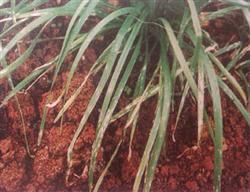
(1) Symptoms and epidemic patterns
The disease mainly affects the leaves and shows 3 types: the white-spot type, in which water-soaked grayish-white spots form on both the front and back of the leaves, oval or spindle-shaped, with pale yellow margins; later the lesions enlarge into large dead patches, causing half a leaf or the whole leaf to die. In humid conditions, a sparse gray mold layer forms. The dry-tip type develops downward from the cut stubble edge, initially water-soaked, then turning light green, and later expanding into streak-like lesions with brown margins or "V"-shaped lesions, causing the whole leaf to dry up, with gray mold layer forming on diseased leaves near the soil surface. The wet-rot type occurs under high humidity, when all leaves near the soil surface form dark green water-soaked soft rot, with a foul odor and dense gray mold layer. The pathogenic fungus spreads through airflow, irrigation water and farming operations, causing healthy leaves to become diseased. In winter and spring, Chinese chives are densely planted, the shed is warm, water drips from the shed film, and a water film adheres to the leaf surface, which is suitable for disease occurrence and spread. Once perennial Chinese chives become diseased, the inoculum accumulates, and the disease tends to worsen in subsequent years. Especially in early spring, under conditions of low minimum temperature in the shed, high humidity, insufficient sunlight and poor ventilation, gray mold can become epidemic and cause disaster.
(2) Control methods
① Agricultural control Timely ventilation to reduce humidity is an important measure for disease prevention. To control humidity, water thoroughly before covering the shed, and control water after covering the shed; especially do not water after each harvest. Do not allow bottom draft in the shed; cultivate and earth up carefully to avoid damaging leaves; harvest Chinese chives in time, then thoroughly remove diseased and residual leaves to reduce inoculum; apply more organic fertilizer and avoid excessive nitrogen fertilizer, which makes leaves tender and susceptible to disease; in summer, Chinese chives should be weeded, topdressed and watered to maintain good roots.
② Chemical control In winter and spring, when the first-cut Chinese chives are 4-7 cm tall, and for the second-cut Chinese chives 6-8 d after the first cut is harvested, chemical control should be applied in time. On cloudy and rainy days, use 10% procymidone smoke agent, or 45% chlorothalonil smoke agent, at 250 g per 667 sq m, divided into 6-8 points, ignited with a smoldering fire, close the shed, and fumigate for 3-4 h. It can also be dusted in the evening with 10% procymidone dust, or 6.5% carbendazim·diethofencarb dust, at 1000 g per 667 sq m; on sunny days, use 40% dimethirimol suspension concentrate at 1200 times dilution, or 65% thiophanate-methyl·diethofencarb wettable powder at 1000 times dilution, or 50% iprodione wettable powder at 1000-1600 times dilution for spraying, focusing on new leaves and the surrounding soil, and apply 2-3 times consecutively depending on disease severity. After spraying, ventilate on sunny days to dissipate moisture. Spray once every 7 d, and use alternately with other control methods for 2-3 times consecutively.