Detailed Explanation of the Multi-Bud Scion Harvesting Technique from a Single Seedling for Eggplant in Protected Cultivation
Grafting cultivation of eggplant has become the most important disease-resistant and yield-increasing cultivation method in current protected eggplant production. When raising grafted eggplant seedlings, the one-seedling-one-bud scion harvesting technique is generally used, but this method involves high seed costs and high production costs. For this reason, based on the principle of apical dominance in plant growth and combined with the characteristic of strong lateral bud sprouting in eggplant seedlings...
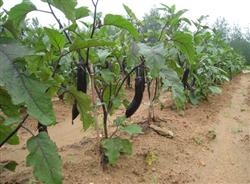
Grafting cultivation of eggplant has become the most important disease-resistant and yield-increasing cultivation method in current protected eggplant production. When raising grafted eggplant seedlings, the one-seedling-one-bud scion harvesting technique is generally used, but this method involves high seed costs and high production costs. For this reason, based on the principle of apical dominance in plant growth and combined with the characteristic of strong lateral bud sprouting in eggplant seedlings, the author tested and summarized three multi-bud scion harvesting techniques from a single seedling:
The first method uses lateral buds from robust mature plants of the previous crop as scions. One plant can provide ten to several dozen lateral buds. This method can save on scion seed costs, but it has the following drawbacks: first, mother plants must be reserved, making thorough disinfection of the entire greenhouse difficult; second, the lateral buds may carry viruses or other pathogens, causing grafted seedlings to develop disease early and severely, affecting yield; third, because the scions vary in size, the surviving grafted seedlings may differ in height, increasing the difficulty of field management and the workload of pruning and shoot removal.
The second method is the stem-segment scion harvesting method. The scions and rootstocks can be raised at the same time, or the scions can be raised earlier. Because scion seedlings grow faster than rootstock seedlings, stem segments can be cut separately according to the height and leaf number of the scion seedlings, with each segment retaining 1 to 2 true leaves. Generally, one scion plant can be cut into 2 to 3 stem segments, and the terminal bud and the cut stem segments are used directly as scions. After the stem-segment grafts survive, the axillary scions of the stem-segment scions and the seedlings grown from stem segments as scions grow at inconsistent rates, so they should be planted in separate zones and managed separately; after the grafted seedlings reach a uniform height, they can be managed uniformly. This method is mainly suitable for factory seedling production.
The third method is the multi-lateral-bud scion harvesting method. The scions and rootstocks can be raised at the same time, or the scions can be raised earlier. According to the required number of harvested scions, an appropriate leaf-age stage is chosen to remove the terminal bud. Local vegetable growers in Shouguang or seedling factories generally remove the terminal bud when the 3rd to 4th true leaf of the scion is showing its heart leaf; the lateral buds then grow rapidly, and when the lateral buds reach 4 to 5 leaves, they are removed with a blade and used as scions for grafting. Generally, one scion plant can provide 2 to 3 lateral buds. Grafting should be carried out at an appropriate time according to the principle of matching the stem thickness of the rootstock and scion. This method is convenient for vegetable growers and even more suitable for factory seedling production. In factory seedling production, when the scion has 4 to 5 true leaves, the terminal bud can be taken to graft one batch first, and when the lateral buds grow to 4 to 5 leaves, another batch can be grafted, adopting a batch-by-batch grafting approach that can effectively reduce seedling production costs.
Using the multi-bud scion harvesting technique from a single seedling for eggplant in protected cultivation can greatly reduce seedling production costs and produce considerable economic benefits.