Key Points of High-Yield Cultivation Techniques for Eggplant in Early Spring Open-Field Cultivation
1. Variety selection: Choose varieties with good marketability, strong cold and disease resistance, high and stable yield, tolerance to low light, suitability for dense planting and excellent quality, such as Hangqie No. 1, Yinqie No. 1, etc. 2. Seedling raising and cultivation methods: Open-field eggplant generally adopts improved solar hotbed with electric heating wire for seedling raising, sowing and raising seedlings in mid to late January, planting in April...
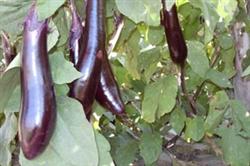
1. Variety selection
Choose varieties with good marketability, strong cold and disease resistance, high and stable yield, tolerance to low light, suitability for dense planting and excellent quality, such as Hangqie No. 1, Yinqie No. 1, etc.
2. Seedling raising and cultivation methods
Open-field eggplant generally adopts improved solar hotbed with electric heating wire for seedling raising, sowing and raising seedlings in mid to late January, planting in late April, and harvesting begins in late June.
3. Sowing and seedling raising
3.1 Seed treatment: Sun the seeds for 1-2 days before soaking, then soak in 1% potassium permanganate solution for 30 minutes, remove and rinse clean. Then soak in warm water at 50°C-55°C with 5-6 times the seed volume for 10-15 minutes, stirring constantly, and when the temperature drops to about 30°C, soak for 8-10 hours, remove and rub off the mucus on the seed surface with fine sand, wrap the treated seeds in a wet cloth, and place under conditions of about 30°C for germination. During germination, rinse with clean water once a day, and generally germination occurs in 5-7 days. Sow when more than 70% of the seeds have sprouted.
3.2 Preparation before sowing: Mix 60% fertile paddy soil that has never grown solanaceous vegetables and 40% pig manure evenly as culture soil, then add an appropriate amount of ternary compound fertilizer and 25% Want to know more vegetable experts and friends?
Carbendazim 1 liang. Then make a seedbed, bed width 1.2 m, lay electric heating wire at 80-100 watts per mu when needed, then spread 10 cm thick nutrient soil on top, and water thoroughly in preparation for sowing.
3.3 Sowing: Sow on a sunny morning, evenly scatter the germinated seeds on the bed surface, cover with 1 cm thick nutrient soil, then cover with plastic film. Before emergence, maintain the daytime temperature at 25°C-30°C, nighttime at 16°C-20°C, and soil temperature at about 20°C. Generally, full emergence occurs in 5-6 days. After 70% emergence, remove the plastic film.
3.4 Seedling stage management: After full emergence, appropriately lower the room temperature to 20°C-25°C during the day and 15°C at night, and scatter dry nutrient soil over the seedbed once to prevent seed coats from being carried out of the soil. After the two cotyledons fully unfold, scatter once more, with each application 0.3-0.5 cm thick. When the seedlings grow to the two-leaf-one-heart stage, carry out seedling transplanting by opening small furrows at 10-15 cm row spacing, watering in the furrows, setting the seedlings at 10 cm plant spacing, then covering with nutrient soil. After transplanting, strengthen heat preservation, 28°C-30°C during the day and 16°C-20°C at night. When the heart leaves of the seedlings begin to grow, control the daytime temperature at 20°C-25°C and nighttime at 13°C-15°C to prevent excessive growth. About 10 days before planting, harden the seedlings at about 20°C during the day and about 12°C at night.
4. Planting:
Before planting, apply 5000 kg of decomposed organic fertilizer and 50 kg of multi-element compound fertilizer per mu in combination with land preparation. Plant on a sunny day, water thoroughly in the furrows, and plant the seedlings after the water seeps in. Plant spacing 30-35 cm, 2500-3000 plants per mu, then cover with soil.
5. Field management
5.1 Intertillage: Carry out a shallow intertillage 3 days after planting to increase soil temperature and promote seedling recovery.
5.2 Fertilizer and water management: Generally do not water from seedling recovery to before flowering; if drought occurs, water lightly once. At the "staring eye" stage of the first fruit, topdress and water, applying 10-15 kg urea and 10 kg potassium sulfate per mu along with watering. After the eggplant sets fruit, water every 5-7 days, and topdress every 3 days, applying 10-15 kg urea per mu each time.
5.3 Pruning and shoot removal: After the sixth eggplant has set, retain the two-forked branching and remove the axillary buds below the first fruit.
6. Pest and disease control
The main disease is gray mold, which can be controlled with 5% procymidone wettable powder at 1500 times dilution; or 75% chlorothalonil wettable powder at 600 times dilution, once every 7-10 days, for 2-3 consecutive applications. At the same time, attention should also be paid to controlling viral diseases. The main pests are aphids and thrips, which can be controlled with 10% Haonian Dong at 1000 times dilution or 20% Yakexing emulsifiable concentrate at 800 times dilution; for red spider mites, 73% propargite emulsifiable concentrate at about 2000 times dilution can be used.