Key Technical Points for Pollution-Free High-Efficiency Cultivation of Bitter Melon in Greenhouses
I. Grafting Seedling Cultivation 1. Seedling Raising Methods The rootstock is raised in nutrient pots, and the scion is raised in sterile soil to strictly prevent soil-borne disease infection. Soak bitter melon seeds in a 75% thiophanate-methyl 800-fold solution for 12 hours, then soak in clean water for 16 hours, remove and air-dry, bury in sand for 2 days of warm germination; disinfect the nutrient soil with quintozene...
 Bitter melon, also known as balsam pear, is not only rich in protein and various vitamins essential to the human body, but also has medicinal effects such as aiding digestion and clearing heat and toxins, making it very popular among consumers. In recent years, with the continuous improvement of people's living standards, production has fallen far short of market demand. Implementing pollution-free greenhouse cultivation technology can both increase yield and supply the market during the Spring Festival, generating very high economic returns. The main cultivation technical points are as follows:
Select Superior Varieties
Bitter melon prefers warmth, tolerates heat, likes moisture, and fears waterlogging, with wide adaptability. For greenhouse cultivation, it is advisable to choose medium- and early-maturing varieties with moderate branching ability, strong growth vigor, good stress resistance, and high quality and yield, such as Long Bitter Melon, Xiafeng Bitter Melon, and Penang Bitter Melon.
Sow at the Right Time
Bitter melon takes about 100 days from sowing to harvest. Based on the production conditions of the greenhouse and to ensure harvesting and marketing around the Spring Festival as much as possible, the sowing period is generally determined to be late September to early October as the most suitable.
Cultivating Strong Seedlings and Pre-Sowing Preparation
15-20 days before sowing, apply 4000-5000 kg of decomposed farmyard manure per 667 sq m as base fertilizer, spread evenly, then deep-plow and sun-dry the soil for 7-10 days, then close the greenhouse tightly for 5- days. Through sun exposure and high-temperature greenhouse sealing, fully sterilize and disinfect the soil. Then, on one side inside the greenhouse, along the north-south direction, build ridges and make beds according to specifications of 6-7 m long and 1.1-1.3 m wide to set up the seedbed.
Seed Soaking and Germination
Bitter melon seeds have thick, hard seed coats. Before sowing, seed soaking and germination must be carried out. Place the seeds in 60°C hot water for 20-30 min, then rub and wash off the mucus on the seed coat surface, then place in 30°C warm water to soak for 6-8 h, remove and place in a 10% trisodium phosphate solution, soak and disinfect for 15-20 min, then place under 30-35°C temperature conditions with moisture maintained for germination. Generally, 750-1000 g of seed is used per 667 sq m. Arch Shed Seedling Raising
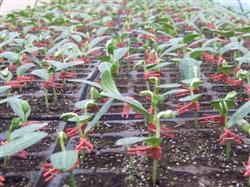
When more than 50% of seeds have cracked and show white, sowing can begin. Water thoroughly before sowing, and after the water has completely infiltrated, sow the germinated seeds in the seedbed at a density of 10 cm × 10 cm, and cover evenly with 1.5-2 cm of fine soil. Then build a small arch shed, maintaining the temperature inside the arch shed at around 25°C. When the seedlings grow to the two-leaf-one-heart stage, gradually lift the film on the arch shed for ventilation and hardening. During the seedling stage, water as little as possible or not at all to prevent leggy growth. If aphids or whiteflies are found causing damage, spray with 10% imidacloprid wettable powder 2500-fold solution to kill pests, cultivating virus-free strong seedlings.
Transplant in Time
When the seedlings grow 4-5 leaves, they can be transplanted. Before transplanting, cover the ridges with plastic film, and punch holes in the film at a row spacing of 70-80 cm and plant spacing of 30-35 cm for planting. When taking seedlings, try to keep the soil ball intact and avoid damaging the roots as much as possible. The planting depth should be such that the cotyledons are level with the soil surface. After planting, irrigate along the film, press the film openings firmly with wet soil, then seal the greenhouse tightly to raise temperature and help seedlings recover.
Pruning and Vine Training
After transplanting and seedling recovery, begin ventilation, keeping the greenhouse temperature at 20-25°C during the day and 15-18°C at night. After the plants extend their vines, use the crossbeams at the north and south ends of the greenhouse, directly above the seedling ridges, to fix old telephone wires or iron wires along the rows, tie nylon ropes on the wires at plant spacing, and timely train the vines onto the trellis. Bitter melon has strong branching ability, and lateral vines grow luxuriantly. If left to grow freely, it not only wastes nutrients and hinders the normal growth, flowering, and fruiting of the main vine, but also causes canopy closure, affecting ventilation and light penetration in the greenhouse. Therefore, during vine training, timely remove lateral vines of the plants and pick off overly dense old leaves and yellow leaves to enhance photosynthesis. Concentrate nutrient supply to benefit main vine growth and fruit coloring.
Temperature and Light Regulation
The suitable temperature for bitter melon flowering and fruiting is around 25°C. When the greenhouse temperature exceeds 25°C during the day, the film can be opened for ventilation. At night, the greenhouse temperature should be maintained at around 15°C, and the minimum early morning temperature should not be lower than 12°C. On sunny days, uncover the straw mats at 9 AM and put them down after 4 PM. When the outside temperature drops, a layer of paper quilt or old film can be added over the straw mats for cold protection and insulation, and the time for uncovering mats and ventilating should be appropriately shortened. In cold, rainy, or snowy weather, besides extending the mat-covering time, promptly clear residual snow and debris from the greenhouse film, and add reflective curtains and supplemental lights to increase greenhouse lighting and raise greenhouse temperature to meet the growth needs of bitter melon.
Fertilizer and Water Management
From transplanting to flowering, bitter melon plants are relatively small and require little water and fertilizer. Entering the flowering and fruiting stage, fertilizer demand increases rapidly. Additional fertilizer can be applied in stages at bud emergence, fruit setting, and the start of harvesting. When applying additional fertilizer, it can be combined with watering, appropriately applying decomposed chicken manure or humic acid compound fertilizer. When watering, water frequently and lightly, and never flood-irrigate. Generally, watering is done in the morning on sunny days, and no watering on cold, overcast days.
Hand Pollination
Bitter melon is a cross-pollinated crop. In the greenhouse cultivation environment, pollinating insects are very few. Hand pollination can effectively improve the fruit-setting rate and fruit quality. Pollination is generally carried out from 6-10 AM, and at the same time, applying 2,4-D to female flowers can effectively reduce flower drop and significantly increase the fruit-setting rate.
Pest and Disease Control
Bitter melon has strong stress resistance, and in greenhouse cultivation, it is rarely attacked by pests and diseases. If aphids, whiteflies, melon fruit flies, or infections of anthracnose or leaf spot are found, and the control threshold is reached, the naturally closed environment of the greenhouse can be utilized, and high-efficiency, low-toxicity, low-residue pollution-free pesticides such as imidacloprid, abamectin, aphid-killing smoke agents, and chlorothalonil smoke agents can be selected for targeted treatment.
Harvest at the Right Time
Bitter melon is mainly eaten as a tender gourd, and the harvest period is relatively strict. Generally, 10-12 days after flowering, when the corolla at the tip has dried and fallen off, the fruit has fully grown, the strip-like and tumor-like granules on the peel have rapidly expanded and are clearly protruding, plump and full, bright in color, and the variety characteristics are fully expressed, it can be harvested. When harvesting, use fruit scissors to cut the fruit stalk to prevent tearing and pulling that may damage the fruit and affect the storage and commercial value of bitter melon.