How to grow and manage yardlong beans so they set more pods
Many vegetable growers know that yardlong beans are hard to manage: they tend to grow leggy and set pods poorly, and flower and pod drop even happens from time to time. So what exactly causes the difficulty in setting pods? 1. Planting density must be reasonable. The best seedling age for transplanting yardlong beans is when the young leaves of the heart just unfold. A reasonable row spacing for yardlong beans is generally 60 cm for the narrow row...
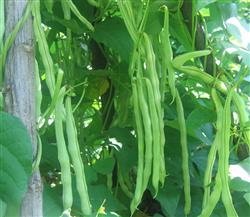
Many vegetable growers know that yardlong beans are hard to manage: they tend to grow leggy and set pods poorly, and flower and pod drop even happens from time to time. So what exactly causes the difficulty in setting pods?
1. Planting density must be reasonable. The best seedling age for transplanting yardlong beans is when the young leaves of the heart just unfold. A reasonable row spacing for yardlong beans is generally 60 cm for the narrow row and 80 cm for the wide row, with the trellis 1.8-2 m high; the taller the trellis, the greater the row spacing should be, and the plant spacing is about 45 cm, generally with two plants per planting site. If the planting density is too high, the yardlong bean plants will grow leggy and set pods poorly.
2. Day-night temperature difference must be controlled. Yardlong beans are highly heat-tolerant but not tolerant of freezing, and the suitable growing temperature is 20°C-25°C. During the flowering and pod-setting period of yardlong beans, day temperature, night temperature and the day-night temperature difference should be well controlled. The more suitable growing temperature during the flowering period of yardlong beans is no more than 30°C during the day and no more than 18°C at night. Therefore, yardlong bean growers are reminded to manage the time of closing the greenhouse well, delaying the closing time as the temperature rises. The standard for closing the greenhouse during the flowering and pod-setting period of yardlong beans is when the greenhouse temperature reaches 17°C.
3. Light conditions must be suitable. Although yardlong bean varieties suitable for greenhouse cultivation do not have strict requirements for photoperiod, they have relatively high requirements for light intensity, especially during the flowering and pod-setting period; if light is insufficient, it will cause flower and pod drop in yardlong beans.
4. Soil moisture and nutrients must be appropriate. Watering time and amount should be flexibly controlled according to local soil moisture conditions. Throughout the entire growth period of yardlong beans, the most basic practice is to water three times: after transplanting, water the first time, and it must be watered thoroughly, otherwise the plants will be uneven; when the vines grow to 0.6 m high, water the second time; the most critical point in yardlong bean production is to water at the pod-setting stage, not at the pod-filling stage, and watering is not suitable during the full flowering period of yardlong beans, so the third watering should be done before the initial flowering stage, and combined with watering, spray a flower-promoting and fruit-setting agent, which is more conducive to flowering and pod setting in yardlong beans. After pod setting, water once more lightly to promote the expansion and elongation of the yardlong beans. In addition, nitrogen fertilizer should not be applied in a one-sided way, otherwise it will cause leggy growth of vines and leaves in yardlong beans and delay flowering and pod setting. Phosphate fertilizer should be applied more to promote the formation of root nodules and enhance their nitrogen-fixing ability.