Detailed Explanation of Key Points for High-Yield Cultivation Techniques of Yardlong Beans
Yardlong beans are also called cowpeas, and their habits and cultivation techniques are similar to those of common beans. Although yardlong beans have root nodule bacteria that can fix nitrogen, they are harvested for their tender pods and tender seeds, so nitrogen supply is indispensable, especially in the early stage. Nitrogen:phosphorus:potassium = 1:0.6:1.3. The trace element molybdenum can promote vigorous development of root nodules. Legumes are also very sensitive to trace elements such as boron and zinc, so on the basis of reasonable application of N, P, and K fertilizers, spraying boron fertilizer, molybdenum fertilizer, and zinc fertilizer has a certain effect on increasing the pod-setting rate of legumes, promoting full seeds, and improving yield. Below is a discussion of high-yield cultivation techniques for yardlong beans. Because the root system has aerobic root nodule bacteria, this is also one of the reasons why common beans can tolerate short-term soil drought and have poor moisture tolerance.
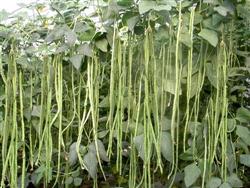
Yardlong beans are also called cowpeas, and their habits and cultivation techniques are similar to those of common beans. Although yardlong beans have root nodule bacteria that can fix nitrogen, they are harvested for their tender pods and tender seeds, so nitrogen supply is indispensable, especially in the early stage. Nitrogen:phosphorus:potassium = 1:0.6:1.3. The trace element molybdenum can promote vigorous development of root nodules. Legumes are also very sensitive to trace elements such as boron and zinc, so on the basis of reasonable application of N, P, and K fertilizers, spraying boron fertilizer, molybdenum fertilizer, and zinc fertilizer has a certain effect on increasing the pod-setting rate of legumes, promoting full seeds, and improving yield. Below is a discussion of high-yield cultivation techniques for yardlong beans. Because the root system has aerobic root nodule bacteria, this is also one of the reasons why common beans can tolerate short-term soil drought and have poor moisture tolerance.
I. Land Preparation and Sowing
It is best to choose fields that have not previously grown legumes. Continuous cropping fields must be disinfected, because continuous cropping fields are very prone to root rot and Fusarium wilt, causing yardlong bean vines to wither and die, which is very difficult to control.
1. Disinfection. ① Apply 60-80 kg of quicklime per mu to soak the field, then drain and sun-bleach after 7-10 days; ② Before planting, drench the soil with 500 times diluted potassium permanganate solution, or yardlong bean bacterial disease control agent (moxa or Junzhenqing No. 2 may also be used) + Beilin (Jiajiai) 500 times solution to a depth of more than 3 cm.
2. Choose ridge-making according to soil fertility. The ridge surface should be about 40 cm wide and 30 cm high. Open a small ditch 10 cm deep on the ridge surface, and pour 1000 kg of decomposed manure water per mu into the ditch. After sun-bleaching, loosen the soil, select suitable varieties, dry the seeds in the sun for 4 hours, then soak them in water, mix the seeds with chlorothalonil original powder at 25 g of powder per 500 g of seeds, sow in the small ditch in a single row, sowing two seeds every 20 cm. After sowing, cover with soil-manure fertilizer or burned soil, and water.
II. Seedling Stage Management
Two days after sowing, lightly water according to the dryness and wetness of the ridge surface to ensure the moisture needed for emergence. After 5-6 days, when the bean seedlings have two leaves and one heart, drench once with 800 times diluted Xunduqing plus 300 times diluted Jinggangmycin, using 750 kg of solution per mu, to control root rot, Phytophthora blight, and other diseases. Thin seedlings in time to ensure one plant every 20 cm. When applying chemicals, be careful that the granules do not contact the plants. Fertilize appropriately according to the growth of the bean seedlings: use 3-5 kg of urea per mu plus an equal amount of potassium fertilizer, mixed with 1000-1500 kg of water, and water lightly after application. Controlling bean thrips is a key point at the seedling stage. Bean thrips damage the young growing tips, which is commonly seen as no shoot emerging and only two leaves visible, commonly known as "blind heart." To control bean thrips, use 600 times diluted isocarbophos plus 600 times diluted Yisaoli, or 1500 times diluted abamectin plus 1500 times diluted imidacloprid, or 500 times diluted Haoniandong plus 5% fipronil 1500 times. Spray once every 6 days. At the seedling stage, spray Yunda 120 once or twice.
III. Vine-Extending Stage Management
When the bean seedlings begin to send out vines, carry out heavy hilling combined with fertilization. Apply 30 kg of phosphate fertilizer per mu plus 10 kg of urea evenly on both sides of the ridge, then cover the fertilizer and weeds with soil from the ridge ditch. Be careful that the fertilizer and soil do not contact the bean stems. If conditions permit, apply 2000 kg of barnyard manure per mu and hill up soil along the ridge sides. After hilling, drench once with sulfur-amine mixture: 1 kg of copper sulfate and 2 kg of ammonium bicarbonate per mu mixed with 1000 kg of water. At the same time, guide the vines onto trellises, generally using A-frame trellises. If the seedlings grow vigorously, conical trellises can be used, that is, every 40 cm, insert three bamboo poles into an equilateral triangle, tie them into a cone with rope above the ridge surface, and place horizontal bamboo on top. To facilitate operation, the trellis height should be controlled within 2 m. Conical trellises can increase yield by more than 10% compared with A-frame trellises. Control moisture: on sunny days, irrigate with running water once every 3 days, and also wet the ridge surface; on rainy days, pay attention to drainage. The main diseases and pests at the vine-extending stage are rust, powdery mildew, bean thrips, and bean pod borer. Use triadimefon (800-500 times) plus 500 times diluted isocarbophos plus 800 times diluted Anlubao, or 600 times diluted Xiansheng plus 600 times diluted Wannengfen plus 800 times diluted Yisaoli. Note that the concentration of triadimefon should go from dilute to concentrated (800-500 times). Spray once every 7 days, and add Yunda 120 every 14 days.
IV. Harvest Stage Management
About 60 days after sowing, the plants enter reproductive growth and the harvest stage begins. Fertilize once every 7 days, each time using 10 kg of compound fertilizer per mu plus 5 kg of urea, mixed with 100 kg of manure fertilizer and composted for 3 days, then mixed with 1500 kg of water and applied to the ridge surface, followed by light watering; or apply in holes along the ridge sides, using 20 kg of compound fertilizer per mu plus 10 kg of potassium fertilizer plus 10 kg of urea, opening small holes every 35 cm along the ridge side and applying, fertilizing one side of each ridge, then after 10 days applying the same amount of fertilizer on the other side. Before hole application, water sufficiently. Within two days after application, do not water the ridge surface, and do not fertilize on rainy days. During the harvest stage, maintain 1-2 cm of water in the ridge ditch. For disease and pest control, the following agents can be selected. To control spot blight and Phytophthora blight: 75% chlorothalonil 600 times plus 70% mancozeb 600 times; for rust and powdery mildew: 50% colloidal sulfur 300 times, drenching 1000 kg of solution per mu, but the premise is that symptoms have not yet appeared, as prevention is better than cure. The main insect pest is bean pod borer, and the following can be used: ① Caixi 1000 times plus imidacloprid 1500 times; ② abamectin 1500 times plus Anlubao 600 times; ③ Bacillus thuringiensis 1000 times plus Xiaochongdi 800 times. The above three agents should not be mixed with fungicides. Because bean pod borer control is very difficult, spraying should be done once every 3-4 days, and spraying before 10 a.m. when the bean flowers are open gives better results. Add Yunda 120 every 7 days. Harvesting is best done in the morning when the dew has not yet dried.