How to prevent and control diseases of yardlong beans? A detailed guide to practical methods
I. Main symptoms The yardlong bean can be infected by pathogens throughout its entire growing season, but its resistance weakens and susceptibility increases from the beginning of flowering to the fruiting period. The disease mainly attacks the leaves; in the early stage of the disease, chlorotic yellow-white spots appear on the leaves, and the spots gradually increase until they densely cover the entire leaf. The plant is short and stunted, with few and small pods, and its growth...
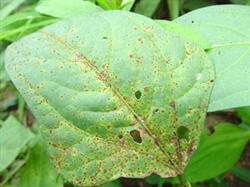 Diseases of yardlong beans include yardlong bean rust, yardlong bean phytophthora blight, yardlong bean fusarium wilt, yardlong bean leaf mold, yardlong bean viral disease, and so on.
1. Yardlong bean rust
Main symptoms of yardlong bean rust: The disease mainly attacks the leaves, and in severe cases also damages the petioles and pods. The pathogen belongs to Basidiomycota, genus Uromyces. In the early stage of the disease, scattered chlorotic yellow-white spots appear on the underside of the leaves, and the spots gradually increase until they densely cover the entire leaf. On the corresponding upper surface of the lesions, slightly raised yellow-brown spots form, and after the epidermis ruptures, red-brown powder is released. The leaves turn yellow, wither and fall off, the plant is short and stunted, with few and small pods, the growth period is shortened, and finally the plant withers and dies. The yardlong bean can be infected by pathogens throughout its entire growing season, and its resistance weakens and susceptibility increases from the beginning of flowering to the fruiting period, reducing sources of infection.
Control methods: Comprehensive control measures based on strengthening the management of soil, seed, fertilizer and water, supplemented by timely spraying of pesticides. Clean the field. After harvest, remove diseased plant residues from the field and burn them in a centralized manner. Choose fields whose previous crop was a grass-family crop; do not choose fields whose previous crop was a legume or peanut crop for planting. Choose disease-resistant varieties such as Yuexia No. 2, Tiexian Green Yardlong Bean, and Suifeng No. 8. Apply pesticide promptly for control in the early stage of the disease. For the pesticide, you may choose 50% sulfur suspension concentrate at 150 times dilution, or 75% thiophanate-methyl wettable powder at 1000 times dilution, or 50% carbendazim wettable powder at 800--1000 times dilution, or 20% triadimefon emulsifiable concentrate at 800--1000 times dilution. Spray once every 8--10 days, for 2--3 consecutive sprays.
2. Yardlong bean phytophthora blight
Symptoms: It mainly damages stems, leaves and pods, and mostly occurs at or near the stem nodes, especially near the ground. The diseased part is initially water-soaked, then becomes wet-rotted and constricted around the stem, and the leaves and vines above the diseased part wither and die. When humidity is high, the cortex rots and white mold appears on the surface. When leaves are infected, dark green water-soaked spots initially appear, then expand into round light brown spots with white mold on the surface. When pods are damaged, the diseased part also develops white mold and rots.
Control measures: Choose disease-resistant varieties. Practice crop rotation. Choose well-drained sandy loam soil for planting, use high ridges and deep furrows, and plant at a reasonable density so as to allow ventilation and light penetration, and pay attention to timely drainage after rain. For chemical control, spray pesticide promptly for protection in the early stage of the disease. You may choose 58% metalaxyl-mancozeb soluble powder at 500--800 times dilution, or 64% oxadixyl-mancozeb wettable powder at 500 times dilution, or 72.2% propamocarb aqueous solution at 800 times dilution, and spray once every 7--10 days, for 2--3 consecutive sprays.
3. Yardlong bean fusarium wilt
When the plant develops the disease, it first starts from the lower leaves. Irregular water-soaked lesions appear at the leaf margins, especially at the leaf tips; afterward the leaves turn yellow and die, and the disease gradually spreads to the upper leaves, and finally the entire plant wilts and dies. The cortex at the root-collar of diseased plants often cracks, and its vascular bundle tissue turns brown. When humidity is high, a pink mold layer appears on the surface of the diseased part.
Control measures: It is best to rotate with grass-family crops in paddy-upland rotation, and increase the application of lime to improve the soil and reduce the occurrence of the disease. Chemical control: In the early stage of the disease, you may use 50% carbendazim wettable powder at 1000 times dilution, or 10% shuangxiaoling aqueous solution at 400 times dilution, or 75% thiophanate-methyl wettable powder at 1000 times dilution, pouring 50--150 grams per plant, once every 7--10 days, for 2--3 consecutive times; you may also mix 500 grams of 50% carbendazim wettable powder with 200 kilograms of dry soil and apply it in furrows in the sowing row, applying 200 kilograms per mu.
4. Yardlong bean root rot
Root rot causes yardlong bean vines to wither and die. The pathogen of root rot, called Fusarium solani f. sp. phaseoli, can infect yardlong beans and common beans. Generally, early symptoms are not obvious; only when flowering and podding does the plant appear relatively short and stunted, and the lower leaves of diseased plants begin to turn yellow from the leaf margins and slowly wither, usually without falling off, and diseased plants are easy to pull out. The underground part of the stem and the main root turn red-brown, and the diseased part is slightly sunken; some crack deeply to the cortex, the lateral roots fall off and rot, and even the entire main root rots. The pathogen overwinters in the soil with diseased residues as mycelium, chlamydospores, and so on, has strong saprophytic ability, and can survive saprophytically in soil and manure for many years. It is mainly spread through rainwater, irrigation water, tools and contaminated fertilizer, and invades through root wounds, causing cortex rot. Generally, the disease is more severe on continuous cropping land with heavy clay texture, excessive moisture, acidity, insufficient fertility and extensive management.
Control measures: Try to avoid continuous cropping of yardlong beans and common beans; it is better if 2--3 years of crop rotation can be practiced, and pay attention to choosing relatively disease-resistant and disease-tolerant varieties. Promptly pull out and burn diseased and residual plants. Compost and manure must be fermented, rotted and thoroughly decomposed. Using enzyme bacterial fertilizer also helps suppress and eliminate soil pathogens. Choose plots with higher terrain and better water permeability, prepare the land with deep furrows and high ridges, and apply an appropriate amount of lime to prevent flooding and ensure timely drainage after rain. When sowing, use Aijuntuo or thiophanate-methyl, or 50% carbendazim wettable powder mixed with soil at 1:50 for hole application or furrow application. In the early stage of the disease, you may choose Pujunke, Aijuntuo at 1200 times dilution, or Genfuning at 800--1000 times, or Kuweiling at 500 times, or dexon at 1000 times for root drenching, about once every 10 days, for 2--3 drenchings.
5. Yardlong bean leaf mold
Leaf mold (leaf mildew) mainly damages leaves, stems and vines, and pods. In the early stage of the disease, purple-brown spots appear on both sides of the leaves; after expansion, they become nearly round dark brown lesions with a diameter of 1-2 cm and indistinct margins. When moist, gray-black mold can be seen on the underside of the leaves; when moist, gray-black mold can be seen on the underside of the leaves.
Control measures: After harvest, promptly remove diseased residues, burn them in a centralized manner or bury them deeply, and clean the field; keep the field well ventilated and light-transmitting, and prevent excessive humidity. Increasing the application of phosphorus and potassium fertilizer can improve the plant's disease resistance; in the early stage of the disease, promptly remove diseased leaves and spray pesticide promptly for control. You may use 50% carbendazim wettable powder at 500 times dilution, or 75% thiophanate-methyl wettable powder at 800 times dilution, or 65% zineb wettable powder at 600 times dilution, or 14% copper ammonia complex aqueous solution at 400 times dilution, spraying once every 7--10 days, for 2--3 consecutive sprays.
6. Yardlong bean viral disease
Symptoms: Mosaic patterns of alternating dark and light green appear on the leaves; the green parts of the mosaic bulge or sink to form pouch shapes, and the leaves usually bend downward. Some varieties develop deformed leaves after infection. Infected plants may be stunted or not stunted, flowering is delayed, and in severe cases yield loss or total crop failure results.
Control measures: Choose disease-resistant varieties, strengthen fertilizer and water management, improve the plant's disease resistance, pay attention to controlling aphids, and cut off the transmission route of aphids.