Key Technical Points for Spring Open-Field Cultivation of Ground-Trailing Winter Melon
Ground-trailing winter melon has the advantages of saving trellis materials, reducing labor for building trellises and tying vines, lower costs, being convenient for intercropping and relay cropping, and relatively extensive cultivation management. During spring open-field cultivation in the early spring low-temperature season, intercropping pak choi, small radish, garland chrysanthemum and other vegetables in the vine-running beds can improve land utilization and increase vegetable yield. Our local farmers...
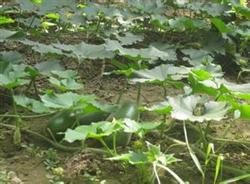
Ground-trailing winter melon has the advantages of saving trellis materials, reducing labor for building trellises and tying vines, lower costs, being convenient for intercropping and relay cropping, and relatively extensive cultivation management. During spring open-field cultivation in the early spring low-temperature season, intercropping pak choi, small radish, garland chrysanthemum and other vegetables in the vine-running beds can improve land utilization and increase vegetable yield. After practice in recent years, our local farmers have summarized the techniques for spring open-field cultivation of ground-trailing winter melon.
I. Variety Selection
Choose mid- and late-maturing varieties with good plant vigor, relatively weak branching ability, strong resistance to sunscald, large fruit type, and a waxy bloom, such as Beijing Ground Winter Melon and Pink-Skin Winter Melon. Generally do not choose green-skinned winter melon, because its resistance to sunscald is poor and it is not suitable for ground-trailing cultivation.
II. Land Selection and Bed Making
Choose a plot with relatively high terrain, good drainage, and loose soil. The cultivation bed is generally composed of two parts, the planting bed and the vine-running bed, arranged alternately. There are usually the following two methods of bed making:
1. Single-direction bed method. The bed width is 83 cm. Two beds, north and south, are arranged side by side as one group. The north bed is the planting bed, and the south bed is the vine-running bed. The north bed is higher and gradually slopes toward the south bed, which can block the north wind and prevent cold. Open a furrow along the center line of the planting bed and apply base fertilizer in a band, then plant 1 row of winter melon on the base fertilizer, with the winter melon vines extending southward.
2. Double-direction bed method. Make a planting bed 1.3-1.5 m wide in the east-west extended direction, and make 1 parallel vine-running bed on each of its north and south sides, with a bed width of 83 cm. Open a furrow along the center line of the planting bed and apply base fertilizer in a band, then plant 2 rows of winter melon on the base fertilizer. The south row of winter melon extends southward, and the north row extends northward.
III. Planting
The planting time is after the local spring late frost. The planting depth should be such that the soil ball of the melon seedling is buried. The methods are divided into two types: the ordinary planting method and the water-settled seedling method.
1. Ordinary planting method. In the planting bed, dig planting holes 60-66 cm in both length and width, gently place the seedling into the hole, cover with soil to bury the soil ball, and then water for settling.
2. Water-settled seedling method. First open a shallow furrow 13-16 cm deep and 20 cm wide in the planting bed, pour water into the furrow, and when half of the water has seeped down, place the seedlings into the furrow; after the water has completely seeped down, seal the furrow with soil.
IV. Fertilizer and Water Management
The focus of fertilizer and water management for ground-trailing winter melon is on the planting bed, and watering and fertilizing can be carried out together; the vine-running bed generally does not receive special watering and topdressing, and can be managed according to the requirements of the intercropped and relay-cropped crops. In the early stage of vine growth, open a furrow 20 cm deep in front of the seedlings, broadcast farmyard manure in the furrow, 10 kg per furrow, then irrigate; after the water seeps down, apply chemical fertilizer, 1 kg per furrow; after the stems and vines cover the planting bed, no longer open furrows for watering and fertilizing, and water according to soil moisture, applying chemical fertilizer and dilute manure with the water. In the dry season, generally water once every 5-10 days; in the rainy season, do not water, and pay attention to drainage to prevent waterlogging.
V. Other Field Management
1. Cultivation and weeding. After watering for settling, carry out cultivation. The principle of cultivation is not to loosen the roots of the seedlings. During cultivation, appropriately build a semicircular mound of soil at the base of the seedlings. When soil moisture is good, cultivate 2-3 times before watering again.
2. Vine coiling and vine pressing. When the stems and vines extend to 60-70 cm long, coil the vines and press them. The method is: open a semicircular shallow furrow along the north side of the root of each plant, with a furrow depth of 6-7 cm, coil the vine northward into the furrow, cover with soil and press firmly. When pressing the vine, be careful to let the 2-3 small leaves at the tip of the stem remain exposed above the ground, and do not bury the growing point in the soil. When the stems and vines extend another 60-70 cm forward, use the same method to open a shallow furrow on the south side and carry out a second vine coiling and vine pressing. Press the vine once every 4-5 leaf nodes; the whole growth period can have three or four pressings. Be careful to remove excess lateral vines, tendrils, and male flowers completely. For plants with vigorous growth, the vine can be pressed deeper, and the stem can be twisted and split and pressed into the soil; for plants with weak growth, it can be shallower, and the node spacing should be farther, and it should not be close to the fruit (best to leave one or two nodes between it and the fruit), and even more, the node of the female flower should not be pressed into the soil. For the lateral branches that emerge, the principle in production is to keep them if there is space and pinch them off if there is no space.
3. Fruit selection and fruit setting. The fruit set from the second to fifth female flowers is preferable. Select and keep young melons with good varietal characteristics, normal shape, fast development, large fruit type, and abundant fine hairs. When the young melon has set and "bends its neck," and the single melon weighs 0.3-0.5 kg, the fruit can be set. Keep 1 or 2 fruits that develop fastest, are largest, and are most robust, and remove all the other fruits.
4. Turning and cushioning the melon. Be careful when turning the melon, gently turning about 1/4 each time. When turning, the melon should coordinate with the melon stalk and vine, and do not break the stems and leaves. Generally turn once every 5-8 days, and it is best to do so on a sunny day. To prevent the melon from rotting, place 1 straw cushion under each melon, and cushions made of wheat straw, rice straw, etc. are preferable.
VI. Control of Common Diseases and Pests
1. Common diseases. Common diseases include damping-off, Phytophthora blight, Fusarium wilt, anthracnose, downy mildew, viral disease, powdery mildew, etc.
① Control of damping-off. Choose a plot where cucurbit crops have not been previously planted as the seedling bed. The bed soil should be turned and sun-dried as early as possible. The organic fertilizer applied must be thoroughly decomposed. The bed surface should be level and free of large soil clods. Cover early before sowing to raise the bed temperature above 20°C. When seedlings show disease, use copper-ammonium mixture for control (that is, use 1 part copper sulfate and 2 parts ammonium bicarbonate, grind them into powder and mix, and store in a sealed container for 24 hours). Each time take out 50 g of copper-ammonium mixture and dilute with 12.5 L of clean water, then spray the bed surface.
② Control of Phytophthora blight and other diseases. For Phytophthora blight, spray 72% DuPont Curzate, or 69% Anke Mancozeb wettable powder at 900 times dilution; for Fusarium wilt, spray 50% Huntsman sulfur suspension concentrate at 500 times dilution, or 70% mancozeb wettable powder at 500 times dilution; for anthracnose, spray 50% carbendazim wettable powder at 800 times dilution, or 2% antimycin at 200 times dilution; for downy mildew, spray 58% metalaxyl-mancozeb at 500 times dilution, or 40% phosethyl-Al wettable powder at 200 times dilution, or 25% ridomil at 1500 times dilution, spraying once every 6-7 days, with 2-3 consecutive treatments; for viral disease, use Virus A, Zhibingling, 83 Zeng Kangji, etc.; for powdery mildew, spray 15% triadimefon wettable powder, or 20% triadimefon emulsifiable concentrate at 2000-3000 times dilution, spraying once every 7-10 days, for 2-3 consecutive times.
2. Common pests. Common pests are melon aphid and whitefly, and low-toxicity pesticides should be sprayed early for control.
VII. Harvest
When the fruit has fully developed and grown to a certain size, it can be harvested at any time according to market conditions. Harvesting too early results in lower yield, but fruit intended for storage must reach the standard of physiological maturity.