How to plant winter melon seeds for high yield? All the technical points are here
1. Sow at the right time and grow strong seedlings. The sowing period should be arranged according to local climate conditions, aiming to set fruit before the rainy season arrives. Generally sow from late February to mid-March, use a heat-retaining seedbed and nutritional pots for seedling raising, with about 100g of seed per mu. Before sowing, soak the seeds in hot water at about 70 degrees, let them cool naturally, soak for 1...
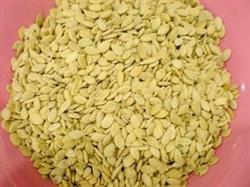 1. Sow at the right time and grow strong seedlings. The sowing period should be arranged according to local climate conditions, aiming to set fruit before the rainy season arrives. Generally sow from late February to mid-March, use a heat-retaining seedbed and nutritional pots for seedling raising, with about 100g of seed per mu. Before sowing, soak the seeds in hot water at about 70 degrees, let them cool naturally, soak for 1 hour, then place them under 25-30 degrees to promote germination. After the seeds begin to sprout, check the germination bed frequently, pick out the sprouted seeds and sow them in the prepared nutritional pots. During the seedling stage, do a good job of cold protection and heat preservation. When a cold wave comes, use a heating wire or incandescent lamp in the seedbed to raise the temperature. The principle for humidity control is to let it dry and wet alternately. Harden the seedlings 10 days before transplanting.
2. Isolation. In order to maintain variety purity, different varieties should be isolated when saving seed. Generally, it is required that within a range of more than 500m around the seed production field, there should be no production of other winter melon varieties or wax gourd.
3. Land preparation and transplanting. Avoid continuous cropping. Choose a plot where winter melon has not been planted for more than 2 years. The site should be high in elevation, with loose, fertile soil, convenient drainage and irrigation, and ditches that dry after rain stops. Generally, make beds at 4.5m, with bed ditches 0.2m deep and 0.5m wide. The bed shape should be turtle-backed, with a smooth bed surface and fine clods. The bed length should be about 30m, with a middle ditch 0.3m deep and a surrounding ditch 0.35m deep. Apply base fertilizer on both sides of the bed about 0.35m from the ditch edge, applying 3000kg of decomposed barnyard manure and 60kg of compound fertilizer per mu, and finally cover the transplanting row with 1m-wide plastic film. In early to mid-April, when the melon seedlings have 2 or 3 true leaves, transplant them at a plant spacing of 0.45m, with 600 plants per mu.
4. Field management. 1) Water and fertilizer management. After transplanting and survival, use clear manure water to promote seedling growth. When there are 2-3 true leaves, apply vine-laying fertilizer through holes in the plastic film on the bed surface for each plant, applying 15kg of urea and 30kg of compound mixed fertilizer per mu. Note that after this fertilization and until fruit set, no fertilizer should be applied. After fruit set, when the melon weighs about 500g, topdress and water promptly, applying 20kg of urea per mu in holes. On rainy days, pay attention to preventing waterlogging. When the melon leaves wilt during high temperature and drought, irrigate with "running horse water", once every 5-7 days. 2) Vine training. After the plants lay their vines, carry out vine training. Before fruit set, keep one thick side vine on the main vine. After fruit set, let the side vines grow freely. When the vines are 0.5m long, press the vines once. At the same time, let the vines of the two rows in the same bed crawl toward each other so that the vines are arranged neatly and do not cross. When saving seed, generally adopt two vines with one melon, and it is best to set fruit on the 2nd-4th female flower of the main vine. If nutritional conditions are good, try to keep another melon on a side vine. 3) Assisted pollination. In order to increase the fruit-setting rate and seed yield, assisted pollination should be carried out during the flowering period. Winter melon flowers open at about 7 a.m. At this time, collect newly opened male flowers, use a writing brush or the like to dip up pollen, or use the male flower directly to fully apply pollen to the stigma of the female flower. Artificial pollination should be completed before 10 a.m.; bees can also be released during the flowering period to let them assist pollination. 4) Melon protection. After the melon is firmly set, use dry grass as a cushion underneath to prevent rot; during high temperature and strong sunlight, cover the melon with grass to avoid sunscald, and at the same time do a good job of disease and pest control.
5. Selection of seed plants. The selection of winter melon seed plants is carried out in two steps. Generally, first, when the young fruit weighs about 500g, select healthy plants with the typical traits of this variety as seed plants, and promptly remove mixed plants, variant plants and diseased plants. Make another selection when harvesting the fully mature melons. Guangdong green-skinned winter melon generally matures about 40 days after fruit set. During production, when 50%-60% of the plants' female flowers are open, mark the female flowers that have opened. From the time of marking, 40 days later, harvest this batch of melons according to their degree of maturity. It is best to harvest before most of the plant's leaves remain green and have not yet withered. After the seed melons are harvested, place them in a cool, dry place to after-ripen for 15 days, and take the seeds after the seeds have completed physiological maturity.
6. Seed extraction, drying and storage. Extract seeds on a sunny day. When extracting seeds, generally select seeds from the middle part of the fruit, which has thick flesh and a small cavity. After rubbing and separating the seed pulp, rinse away the pulp with water, and rub and wash the seeds until there is no mucus, then dry them in the sun. During the operation, do not use iron containers to hold them, to prevent the seed color from darkening. Seeds cannot be spread directly on concrete ground to dry; it is best to place them on bamboo ware, and the thinner the spread, the better. Try to dry the seed coat on the first day, but do not expose them to strong sunlight, to prevent the seed coat from cracking due to too-rapid dehydration. Before they are fully dried, they must not be piled up. After the seeds are fully dried, store them in a cool, dry place. Through several years of production practice, using this method for seed production, the average seed yield per mu has increased to 25kg, and the highest yield can reach 40kg.