Detailed Guide to Cultivation Techniques for Guangdong Black-Skin Wax Gourd
I. Wax gourd belongs to the Cucurbitaceae family and the genus Benincasa, an annual climbing herbaceous plant. Its root system is strong, with well-developed fibrous roots, reaching a depth of 50-100 cm and a width of 150-200 cm; the root system has strong absorption capacity and readily produces adventitious roots; the leaves are alternate, broad and large, palmate, with 5-7 shallow lobes, green, with hairs on both the upper and lower surfaces, 30-35 cm wide...
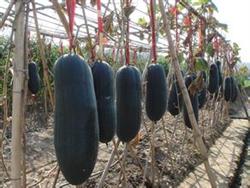
I. Wax gourd belongs to the Cucurbitaceae family and the genus Benincasa, an annual climbing herbaceous plant. Its root system is strong, with well-developed fibrous roots, reaching a depth of 50-100 cm and a width of 150-200 cm; the root system has strong absorption capacity and readily produces adventitious roots; the leaves are alternate, broad and large, palmate, with 5-7 shallow lobes, green, with hairs on both the upper and lower surfaces, 30-35 cm wide and 24-28 cm long, with reticulate veins that protrude on the underside. The petiole is distinct, 14-18 cm long, 0.5-0.7 cm in diameter, covered with hairs; the stem is vining, pentagonal-angular, green, densely covered with hairs. The stem has strong branching ability; the axillary buds at each node can produce lateral vines, and the axillary buds at each node of the lateral vines can also produce secondary lateral vines. If allowed to grow freely, the stems and vines become extremely luxuriant. Therefore, in cultivation, pinching and pruning of side shoots should be carried out promptly to prevent rampant vine growth. A newly formed stem node has only one axillary bud; as vine growth begins, each stem node produces a branching tendril, and subsequent stem nodes also bear male or female flowers. Under moist conditions, the basal stem nodes also readily produce adventitious roots for absorbing nutrients and water. Therefore, in cultivation, the method of layering the vines can be adopted to expand the absorption area.
II. Wax gourd flowers are mostly unisexual; generally, they are monoecious with separate male and female flowers, though a few varieties have bisexual flowers. Male flowers generally appear first, followed by female flowers, and there is a certain pattern in the emergence of male and female flowers. The male flower has 5 sepals, nearly hastate, green, and 5 petals, elliptical, yellow. There are 3 stamens, arranged in a triangle in the center of the flower, with terminal anthers that dehisce through several bends. The female flower's petals are the same as those of the male. The ovary is inferior, and its shape varies by variety, including long elliptical and short elliptical, green, densely covered with hairs; the flower stalk is shorter and thicker than that of the male flower and covered with hairs. The style is short, and the stigma is lobed and three-cleft, pale yellow. The node position at which the first female flower appears on the main vine varies with variety and environmental conditions. For early-maturing varieties, the first female flower generally forms in the leaf axil at nodes 6-9 of the main vine; for mid- and late-maturing varieties, it forms in the leaf axil at nodes 12-15 or 15-20. After the first female flower, generally one female flower is differentiated every 5-7 nodes, and sometimes two or even three female flowers are differentiated consecutively. Suitable environmental conditions can lower the node position at which female flowers appear on the main vine. Lateral vines differentiate female flowers earlier, mostly producing female flowers at the first or second node. Wax gourd generally sets fruit mainly on the main vine, and fruit setting on lateral vines is less reliable. Wax gourd flowers generally begin to open around 10 p.m. and are fully open by 7 a.m. the next morning. The petals wither after about 2 days. According to the experience of melon growers, the more slowly the petals wither and the longer they remain on the fruit, the stronger the fruit and the larger the fruit produced. This is because vigorously growing plants have sufficient nutrients to supply fruit development.
III. Cultivation Methods Wax gourd cultivation methods can be divided into three types: ground wax gourd, shed wax gourd, and trellis wax gourd.
1. Ground wax gourd: The plants grow creeping on the ground, with relatively wide spacing between plants and rows, generally about 300 plants per mu. Management is relatively extensive; the stems and vines are basically allowed to grow freely, or lateral vines are removed before fruit set and allowed to grow at will after fruit set. Its advantages are less labor and lower cost. Its disadvantages are poor fruit shape, requiring frequent fruit support; otherwise, the rate of deformed fruit is high; the rind is easily damaged by external environmental influences, affecting storability; light energy utilization is low, fruit size is uneven, and yield per unit area is relatively low. This method is only suitable for gray-skin wax gourd varieties sold within the island, and is not suitable for varieties with higher commercial requirements for northward transport or export, such as "Green Skin Winter" and "Black Skin Winter."
2. Shed wax gourd: After the plants begin to vine, a shed made of bamboo and wood is used to guide the vines. There are tall sheds and low sheds. Tall sheds are generally 150-200 cm high, while low sheds are generally 60-80 cm high, with a shed width of 250-300 cm. Hainan melon growers mostly use the low-shed method. Lateral vines are removed before the plants reach the shed, and after reaching the shed the stems and vines grow freely. Shed wax gourd sets fruit better than ground wax gourd, the fruit size is relatively uniform, and the yield per unit area is generally higher than that of ground wax gourd.
3. Trellis wax gourd: Generally about 550 plants are planted per mu, and there are many forms of trellising. There is the "single-row" type: that is, one stake per plant, with horizontal bamboos at a height of 130-150 cm connected and fixed; there is the "A-frame" type; there are the "single-star drum trellis longan" and "four-star drum trellis longan" types: that is, three or four bamboo poles are used to build a drum trellis, and the drum trellises are connected and fixed with horizontal bamboos, one drum trellis per plant. Although trellis wax gourd has many forms, they all combine plant training, make better use of space, increase the fruit-setting rate and make fruit size uniform, which helps increase both yield and quality; it also facilitates intercropping and relay cropping, increasing the number of multiple cropping cycles; and it saves trellis materials and reduces costs compared with shed wax gourd. Under current conditions, trellis wax gourd is the more reasonable and more scientific of the three cultivation methods.
IV. Cultivation Season, Sowing and Seedling Raising, and Planting Density
1. Cultivation season: Wax gourd likes warmth and tolerates heat. To obtain a high yield, planting should be timed to coincide with suitable climatic conditions for fruit set and fruit development. Climatic conditions have the greatest influence on the fruit-setting rate of wax gourd, so special attention must be paid to seasonal arrangement. Clear weather, relatively high temperatures, and relatively high humidity are favorable for fruit set; dry air, low temperatures, and rainy days mean fewer insects are active, which is unfavorable for pollination; it also reduces the pollination capacity of the stigma, resulting in poor fruit set. According to the characteristics of wax gourd's requirements for light and temperature conditions, because temperatures in southern Hainan are mostly above 20°C in winter and spring and sunlight is abundant, sowing can be carried out throughout the winter and spring seasons, and normal flowering and fruiting can occur. In sowing wax gourd, in addition to considering climatic factors, market factors should also be considered. Only in this way can cultivated wax gourd achieve the goals of high yield and high efficiency.
2. Sowing and seedling raising: For spring cultivation of wax gourd, because it is often affected by low temperatures, nutrient-pot seedling raising should be adopted. The required nutrient soil should be prepared in advance; screened fertile garden soil that has been baked and sun-dried, decomposed pig and cattle manure residue, and rice husk ash or coconut coir can be selected and mixed. The volume ratio of the three is about 6:2:2, and a small amount of nitrogen-phosphorus-potassium compound fertilizer may also be added. The amount added is generally controlled at 0.2%-0.3%, and it must be finely crushed and evenly mixed to prevent damage to seeds and roots. For sprouting wax gourd seeds, generally first soak in warm water at 50-55°C for 10-15 minutes (stirring while soaking), then continue soaking at room temperature for 10-12 hours, and preferably place at about 30°C for sprouting. A longer soaking time results in faster and more uniform germination; most seeds germinate in one and a half to two days. A shorter soaking time results in poorer germination vigor. Seeds with smooth seed coats and no edges, because the seed coat has poor permeability, are prone to oxygen-deficiency and seed rot during sprouting, with a low germination rate. Therefore, for sprouting such seeds, the seed coat must first be rubbed and washed with fine sand to remove adhering matter, and then placed under constant temperature conditions of 28-30°C for sprouting. Before germination, rinse the seeds once with clean water each morning and evening every day, drain the water promptly, and continue sprouting. If constant-temperature equipment is not available, it is safer to soak the seeds and then sow directly into seedling bags or seedling beds.
3. One day before sowing, water the nutrient soil in the pots thoroughly. The sowing depth is 2-3 cm, and 1-2 germinated seeds are sown per nutrient pot. The seeds should be placed flat or with the sprout tip facing up, and immediately after sowing cover with shading net, straw, or other mulch; if a cold wave or cloudy and rainy weather occurs, plastic film should be used for covering. After sowing and before emergence, pay attention to watering, but do not overwater, to prevent seed rot and root rot; merely keep the soil moist. When about 70% of seedlings have emerged, remove the covering promptly. Before the seedlings break heart, appropriately control moisture to promote root growth; after breaking heart, keep the nutrient soil in a semi-dry, semi-moist state to promote steady growth of the melon seedlings. After about 25-30 days, they can be transplanted to the field. Two to three days before planting, the seedlings can be drenched with 10% dilute human manure water and 800 times 80% zineb or 600 times 75% chlorothalonil solution, so as to transplant with fertilizer and pesticide.
4. Planting density: The planting density of wax gourd varies with variety, cultivation method, and cultivation season. The yield per unit area of small-fruited wax gourd is composed of three factors: the number of plants per mu, the number of fruits per plant, and the weight of a single fruit. Proper close planting can increase yield. Most large-fruited wax gourd varieties bear one fruit per plant, and their yield per unit area is composed of two factors: the number of plants per mu and the weight of a single fruit. Therefore, on the basis of ensuring single-fruit weight, proper close planting should be carried out. Ground wax gourd plants grow vines and leaves on the ground, making plant training inconvenient, so close planting is not suitable; shed wax gourd basically also grows on a flat plane, so it is also not conducive to close planting; trellis wax gourd can use space for growth, and combined with plant training and vine guiding, it is conducive to close planting. At present, most wax gourd varieties cultivated in Hainan production are large-fruited varieties. For flat-shed trellis cultivation, the bed width is generally about 350 cm (including ditches), with double-row planting, plant spacing of 70-80 cm, and about 500 plants per mu; for trellis wax gourd cultivation, the row and plant spacing is generally 150 x (70-80) cm, with about 550-600 plants per mu; for ground wax gourd, the bed width is generally about 400-500 cm (including ditches), with double-row planting, plant spacing of about 80-100 cm, and about 300 plants per mu. The planting density of wax gourd is also related to the level of fertilizer and water management. Where fertilizer is sufficient, drainage and irrigation are convenient, and management level is high, the focus should be on growing large fruits to strive for high yield and high quality, and it should not be too dense. On the basis of removing all lateral vines, pinching the main vine allows denser planting than not pinching.
V. Land Selection and Preparation, Applying Sufficient Base Fertilizer
1. The root system of wax gourd is very well developed, and the growth period is long. In order to obtain a relatively high yield, it is necessary to select sandy loam to clay loam with deep soil layers, rich organic matter, and a pH of 6-6.5 for planting; at the same time, in order to avoid cold waves during the seedling stage and early spring drought in winter-spring cultivation, as well as summer rains later, it is advisable to choose fields facing south with the back to the north and convenient drainage and irrigation; autumn-winter wax gourd often encounters typhoon rain, so land selection should preferably be sloping dry land with convenient irrigation and drainage. After the melon field is selected, deep plowing and harrowing should be carried out as early as possible, preferably to a depth of about 30 cm. For winter-spring cultivation of wax gourd, late rice fields with convenient drainage and irrigation are preferable.
2. After the late rice is harvested, the field should be plowed early and sun-dried until white, and before planting it should be plowed and harrowed again and finely leveled. After land preparation, the planting layout should be planned and the bed surface made; then ridges should be made on the bed surface, with a ridge width of 80-100 cm and a ridge height of about 30 cm, leaving half a bed on each side of the ridge, with a shallow ditch between the ridge and the half-bed, for use in hilling and topdressing during the vine-running stage. Planting holes are arranged along the ridge according to plant spacing, with holes about 30 cm deep and about 40 cm wide.
3. The growth period of wax gourd is relatively long, and the root system has strong absorption capacity. Therefore, sufficient base fertilizer should be applied. The base fertilizer is generally mainly high-quality farmyard manure, more than 2000 kg per mu, 30-50 kg of soybean cake, and 40-50 kg of superphosphate. After composting, mix evenly and apply in furrows or holes, and mix thoroughly with the soil before sowing or transplanting.
4. For loamy soil or clayey soil, when conditions permit, 30-40 kg of ternary compound fertilizer and 15-20 kg of urea per mu can also be applied by full-layer mixing to meet balanced nutrient supply. For soil with a relatively high sand content, however, the amount should be reduced to prevent fertilizer damage.
5. Plastic film mulching to ensure high and stable yield. Because plastic film mulching cultivation of wax gourd can create superior environmental conditions for cultivation such as temperature, light, water, fertilizer, and soil, it promotes the growth and development of the wax gourd root system and plants and reduces the harm from certain diseases and pests as well as cold, drought, and heavy rain. Therefore, it can achieve obvious yield-increasing effects. Tests have shown that spring plastic film mulching cultivation of wax gourd generally increases yield by 30%-50% compared with open-field cultivation; under severe weather conditions, the increase can sometimes even reach more than 1 times.
6. For plastic film mulching cultivation of wax gourd, generally it is sufficient to cover only the melon ridge. The film width selected is 80-120 cm, and colors include white, black, and silver-gray, among others. White film has a good warming effect, but weeds tend to grow, so before mulching a pre-emergence herbicide must first be sprayed once, such as butachlor or acetochlor, at 75-100 ml per mu, diluted with about 30 kg of water and sprayed on the soil surface, and then the film is applied; black film has a slightly poorer warming effect but can prevent and control weed occurrence; silver-gray film can repel aphids and reduce the occurrence and spread of viral diseases.
7. Before mulching, be sure to level and finely prepare the land, apply sufficient base fertilizer, and keep the soil moist. When mulching, be sure to stretch the film flat and press the film edges tightly. When planting melons after mulching, be sure to water thoroughly to settle the roots and seal the openings well with fine soil. Afterward, be careful not to let humidity inside the film become too high, to avoid root rot. As long as the soil is moist when the film is applied, generally no further watering is needed for about 20 days after transplanting. If water is lacking later, the furrow irrigation method should be used, and it is sufficient to fill only half the furrow with water.
VI. Pest and Disease Control
1. Damping-off: The main stem that has just emerged rots slowly, with constriction and seedling lodging being the fundamental conditions for root disease.
2. Rhizoctonia rot: The root becomes constricted and withered, diseased but not lodged. The commonly used agents for controlling damping-off and Rhizoctonia rot are: hymexazol and propamocarb; the excellent agent and formula are: Kuke + "Sanju" strong-seedling root-promoting agent.
3. Anthracnose: Black spots appear between the stems; the lesions are round or elliptical, with small black dots in the center of the lesions.
The commonly used agents for controlling anthracnose are: prochloraz and prochloraz-manganese; the excellent agent and formula are: Jinshineng + effervescent tablets (agricultural streptomycin) + Youshengsu.
4. Downy mildew: The lesions are yellowish-brown and spread continuously from old leaves toward the growing point; the leaf surface shows chlorosis, and there is mold growth (white and black) on the underside of the leaves.
The commonly used agents for controlling downy mildew are: metalaxyl-mancozeb and cymoxanil; the excellent agent and formula are: Kemeiqing + Miaoge + Jinsanbao.
5. Phytophthora blight: The vine area becomes dark green and water-soaked; the leaves are easily broken, and in severe cases the upper part dies.
The commonly used agents for controlling Phytophthora blight are: dimethomorph and metalaxyl-mancozeb; the excellent agent and formula are: Putalin + effervescent tablets (agricultural streptomycin) + Dasanbao.
6. Fusarium wilt: The plant appears normal in the morning, and at noon and in the afternoon the leaves and vine area contract (brown). It is a soil-borne disease and often occurs at the flowering stage.
The commonly used agents for controlling Fusarium wilt are: Kuwei Like and Junduqing; the excellent agent and formula are: Kuke + Duokang Root Disease Doctor + "Sanju" strong-seedling root-promoting agent.
7. Green worms: Mainly include inchworms, noctuid moths, Aulacophora beetles, and melon fruit flies and other pests. The excellent agent and formula for controlling green worms are: Huang'ehuang + Gaolübao + Gaojin.
8. Leafminer: The excellent agent and formula for controlling this pest are: abamectin + Legaote + Gaojin.
9. Thrips, aphids, whiteflies: The excellent agents and formulas for controlling these pests are: fipronil, 20% Yashaling, Yashibao, and 3% acetamiprid.
VII. Black-skin wax gourd has a relatively high yield. During the autumn harvest peak, because it is marketed at the same time as various vegetables, prices fall sharply. If farming households can use their existing conditions for delayed storage and fresh-keeping of wax gourd, they can not only extend the sales and supply period of wax gourd but also greatly increase economic benefits, and this is worth vigorously promoting and utilizing.
1. Preparation before storage
Wax gourd has a relatively high water content, and neither young melons nor overripe melons are suitable for storage. The criteria for wax gourd suitable for storage are thick rind, thick flesh, dense texture, relatively good quality, bright green skin on the surface, covered with waxy bloom, and late-maturing large-fruited varieties. Harvest when 90% mature. 7-10 d before harvest, irrigation should be stopped in the growing field, and in cool weather the fruit should be cut with scissors (preferably in the morning), leaving a 3-5 cm fruit stalk. When handling, it should be lifted and placed gently, strictly preventing scratches and bruises, and strictly preventing throwing, dropping, and rolling (excessive vibration will cause internal damage to the wax gourd), which would create major hidden dangers for storage in the warehouse.
2. Preparation of the storage kiln warehouse
The size of the storage kiln warehouse is determined by the quantity of wax gourd to be stored. Farmhouse-owned kiln warehouses are mostly about 30 sq m and can store 5000 kg of wax gourd. They are mostly built in a semi-underground manner, that is, the kiln chamber is about 3.5 m high, with 1.8 m above and below ground level, and kiln windows are set on all four sides, opening opposite each other front and back and left and right, to facilitate ventilation and air exchange. This kind of kiln warehouse structure has the advantages of high temperature stability, coolness, simple ventilation, and easy control of dryness and humidity. 2-3 d before the wax gourd is put into the warehouse, comprehensive disinfection and sterilization treatment should be carried out. The method is: after sealing and fumigating the kiln warehouse with potassium permanganate smoke, then put the wax gourd into the warehouse.
3. Storage methods and precautions
Select mature wax gourds that have been strictly selected, uniform in size, and unbroken for stacked storage or rack storage in the warehouse. For stacked storage, dry grass or straw curtains should first be laid on the warehouse floor, and then the wax gourds placed on top, generally no more than 3 layers, to avoid compression damage. Rack storage of wax gourd, because ventilation is better, is correspondingly better than stacked storage. When storing wax gourd on racks, soft ventilation materials such as dry grass should also first be laid on the storage racks, and then the wax gourds placed on them. During placement, the wax gourds should be positioned according to their state when growing in the field, and must never be placed incorrectly. Be sure to do it as follows: however it grew in the field, so it is placed in the kiln warehouse, because the flesh has already adapted to the direction of gravity; maintaining the original direction of gravity during storage makes the flesh less likely to crack, and the storage time can then be longer. Wax gourd is a cold-sensitive vegetable; it likes warmth and tolerates heat, and is not tolerant of low temperatures. Below 10°C, chilling injury will occur. The suitable temperature for storing wax gourd is 10-15°C, and the relative humidity is 70%-75%. Therefore, during storage, especially when the wax gourd has just been put into the warehouse, attention should be paid to strengthening ventilation. When the temperature is relatively high at noon, be sure to open the warehouse windows for ventilation and air exchange, which not only helps dissipate heat and lower temperature, but also removes moisture, reduces environmental humidity, and maintains a dry state in the warehouse. During the storage period of wax gourd, as long as the temperature and humidity environmental conditions are properly controlled, it can generally be stored for 3-4 months or longer.