What are the key points for cultivating winter melon in small arched tunnels in early spring?
Winter melon has a well-developed root system, luxuriant branches and leaves, and bears huge fruits; it is a high-yielding crop with strong adaptability. The entire growth period of winter melon is about 100-150 days, and its life is divided into 4 stages: from seed germination to the cotyledons flattening out and the first true leaf appearing is the germination stage; from the first true leaf emerging to the beginning of vine growth is the seedling stage; from the seedling...
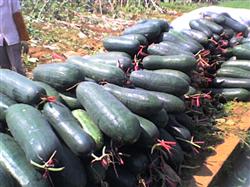 Winter melon is a major heat-relieving soup vegetable in summer and autumn. In the Xingtai area, winter melon is mostly cultivated in small arched tunnels in early spring, coming to market in mid-to-late June and continuing until mid-to-late September, with a long supply period and high yield. Its key cultivation points are described below:
I. Variety selection
Generally, the disease-resistant, high-yielding, heat-tolerant Guangdong Black Skin winter melon is used.
II. Sowing and seedling raising
In the Xingtai area, seedlings are mostly raised in nutrient pots in solar greenhouses or small warm sheds, with nutrient pots measuring 10 cm x 10 cm. Nutrient soil mixing ratio: 70% fully decomposed organic fertilizer, 30% field soil that has never grown vegetables; mix thoroughly, fill into the nutrient pots, then water thoroughly and wait for sowing.
In the Xingtai area, winter melon sowing time is generally set at February 10-15, with the daytime temperature controlled at 23°C-25°C and the nighttime temperature kept above 15°C. When the seedling age is about 40 days and the seedlings have 4 leaves and 1 heart, transplanting begins.
III. Transplanting and covering with a tunnel
1. Fertilization. Apply 2000 kg of fully decomposed chicken manure and 30 kg of 54% ternary compound fertilizer per mu; after application, plow and turn evenly, then water, and after 3-4 days cover with plastic film and wait for transplanting.
2. Reasonable transplanting. In the Xingtai area, generally from late March to early April, when the seedlings have 4 leaves and 1 heart, punch holes at a plant spacing of 60 cm and transplant one plant per hole, with 300-350 plants per mu. Then use a watering can to spot-water, insert 1 bamboo strip every 1.3 m, and promptly cover with film, pressing it down firmly and tightly. The tunnel film specifications are 0.025 mm thick and 200 cm wide.
IV. Field management
1. Management during the tunnel-covered period. Do not ventilate in the early stage after transplanting, to promote seedling recovery and root growth. After seedling recovery, ventilate according to weather conditions, and as the outside temperature rises, the ventilation openings should become larger and larger, and the ventilation time should become longer and longer. In the Xingtai area, the tunnel film is generally removed after May 1, changing to open-field production.
2. Fertilizer and water management. Generally no watering during the tunnel-covered period; after the film is removed, in conjunction with guiding and pressing the vines, water once thoroughly. Generally no watering during the flowering and fruit-setting period, to avoid fruit abortion. After the fruit is set, when the fruit stalk naturally droops in a "bent neck," attack with both fertilizer and water, applying 20 kg of 40% compound fertilizer per mu in holes. After that, water every 7-10 days and topdress about once every 15 days, with the topdressing amount determined according to the growth of the winter melon.
3. Plant adjustment. Before fruit setting, guide and press the vines and remove all side branches; after fruit setting, let them grow naturally, without pruning or removing branches.
4. Pest and disease control. The main pests and diseases of winter melon are viral disease, powdery mildew, aphids, etc. Use a 500-fold spray of 20% moroxydine hydrochloride-copper to control viral disease, a 500-fold spray of 15% triadimefon to control powdery mildew, and a 1000-fold spray of 20% imidacloprid to control aphids.
5. Harvest: Small arched tunnel winter melon is generally harvested and marketed after June 15 when a single fruit weighs more than 5 kg, continuing until mid-to-late September, with a yield of up to 5000 kg per mu.