Identification and Control Methods for Green Peach Aphid on Cilantro
Description of Characteristics and Control Methods The green peach aphid, Myzus persicae (Sulzer), belongs to the order Hemiptera (formerly Homoptera; however, Homoptera has now been moved within Hemiptera), family Aphididae. Also known as the greasy bug, tobacco aphid, peach red aphid, and oil bug. The green peach aphid is a polyphagous pest, with host plants numbering approximately 74 families and 28...
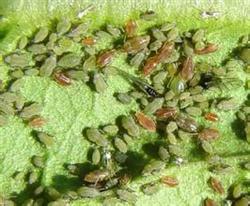
Description of Characteristics and Control Methods
The green peach aphid, Myzus persicae (Sulzer), belongs to the order Hemiptera (formerly Homoptera; however, Homoptera has now been moved within Hemiptera), family Aphididae. Also known as the greasy bug, tobacco aphid, peach red aphid, and oil bug. The green peach aphid is a polyphagous pest, with host plants numbering approximately 74 families and 285 species. The green peach aphid has a heteroecious (host-alternating) life cycle, in which the winter hosts (primary hosts) are mainly Rosaceae fruit trees such as pear, peach, plum, Japanese apricot, and cherry; the summer hosts (secondary hosts) are mainly various crops such as Chinese cabbage, cabbage, radish, mustard, rapeseed, turnip, sweet pepper, chili pepper, spinach, and cilantro. The green peach aphid is a major pest in sweet pepper cultivation and is also a major vector of various plant viruses.
The green peach aphid generally has a full life cycle. In early spring, overwintering eggs hatch into fundatrices (stem mothers), which reproduce by parthenogenetic viviparity on the winter host, and several generations of fundatrigeniae are produced. After the last frost, winged parthenogenetic viviparous females are produced, which migrate to secondary hosts such as cruciferous and solanaceous crops to cause damage, and continuously reproduce wingless parthenogenetic viviparous females through parthenogenetic viviparity, continuing the damage. It is not until late autumn, when the summer hosts senesce and become unfavorable for the green peach aphid's survival, that winged sexuparae are produced, which migrate to the winter host and give birth to wingless oviparous females and winged males; after mating, the males and females lay eggs on the winter host plant to overwinter. The overwintering eggs have strong cold resistance and can safely overwinter even in the cold high-latitude regions of the north. The green peach aphid can also live an anholocyclic (incomplete-cycle) life of continuous parthenogenesis; for example, in winter in northern regions, it can still continue to reproduce and cause damage on solanaceous fruit vegetables in greenhouses.
①Eliminate pest source plants. Before sowing, clean the seedling-raising site, pull up weeds and various crop residues; before transplanting, remove weeds around the garden as early as possible, and burn them together with the residual plants and fallen leaves in the field.
②Strengthen field management to create a moist field microclimate that is unfavorable for aphid breeding.
③Yellow board trapping of aphids. Set up yellow boards around the sweet pepper field. That is, coat a 66 cm square plastic film entirely with orange-yellow color, then from the top of a 66 cm long, 33 cm wide rectangular frame, wrap and clamp it with the yellow-coated side facing inward. Insert it around the sweet pepper field, 0.5 m above the ground, one board every 3-5 m, and then apply machine oil to the uncolored outer side. This can trap and kill large numbers of winged aphids.
④Silver film to repel aphids. Aphids are the main vector of cucumber mosaic virus; cover the bed surface with silver-gray plastic film.
⑤Intercropping with corn. Between the two rows of sweet pepper in a 1 m wide bed, sow corn by dibbling at a plant spacing of 2 m 6-7 days before transplanting the sweet pepper, so that the corn grows taller than the sweet pepper as quickly as possible, playing a role in appropriate shading, cooling, and preventing aphid virus transmission.
⑥Chemical control is currently the most effective measure for controlling aphids. Practice has proven that as long as aphids are controlled, viral diseases can be effectively prevented. Therefore, try to eliminate winged aphids before they migrate to sweet pepper, or eliminate wingless aphids in sweet pepper fields during the scattered-spot stage. When spraying, focus on the undersides of leaves. You can spray a 1500-fold water solution of 80% dichlorvos emulsifiable concentrate, or spray a 1000-fold water solution of 40% dimethoate emulsifiable concentrate, or spray a 1500-fold water solution of 50% malathion emulsifiable concentrate, or spray a 1000-fold water solution of 50% diazinon emulsifiable concentrate, or spray a 1500-fold water solution of 50% phoxim emulsifiable concentrate, or spray a 1000-fold water solution of 50% fenitrothion emulsifiable concentrate, or spray a 1000-fold water solution of 40% acephate emulsifiable concentrate, or spray a 1000-fold water solution of 25% quinalphos emulsifiable concentrate, or spray an 800-fold water solution of 25% phosmet emulsifiable concentrate, or spray a 1500-fold water solution of 50% fenthion emulsifiable concentrate, or spray a 2000-fold water solution of 50% pirimicarb soluble powder, or spray a 3000-fold water solution of 2.5% deltamethrin emulsifiable concentrate, or spray a 4000-fold water solution of 20% fenvalerate emulsifiable concentrate, or spray a 5000-fold water solution of 10% difenoconazole emulsifiable concentrate, or spray a 4000-fold water solution of 10% cypermethrin emulsifiable concentrate, or spray a 2500-fold water solution of 10% duolaihao suspension concentrate, or spray a 1500-fold water solution of 50% menazon emulsifiable concentrate, or spray a 4000-fold water solution of 21% juma mixture emulsifiable concentrate, etc.