How to plant ginger in early warm spring? The four-improvement technique is key
In recent years, the outlook for earning foreign exchange through exporting high-quality ginger has been promising, but quality requirements have also become increasingly high. Our department guided 20 large-scale growers in promoting and applying the "four improvements" new technique, which made the ginger produced large and plump with shiny skin color, increased the average yield per mu by 64% compared with traditional planting, and achieved doubled income growth for ginger farmers. When spring warms and flowers bloom in March to April...
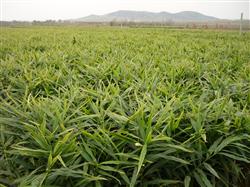
In recent years, the outlook for earning foreign exchange through exporting high-quality ginger has been promising, but quality requirements have also become increasingly high. Our department guided 20 large-scale growers in promoting and applying the "four improvements" new technique, which made the ginger produced large and plump with shiny skin color, increased the average yield per mu by 64% compared with traditional planting, and achieved doubled income growth for ginger farmers. When spring warms and flowers bloom in March to April, it is the golden season for sowing ginger. The "four improvements" measures are hereby introduced as follows for ginger farmers' reference.
1. Change traditional furrow sowing to ridge planting. Based on the characteristics of ginger's short and shallow roots and its fear of both waterlogging and early drought, change traditional furrow sowing to ridge planting, control the ridge spacing at 65-70 cm and the clump spacing at 20-25 cm, with 4000-5000 clumps per mu being better. Through ridging, the active soil layer is greatly increased, making the soil looser, preventing compaction under irrigation, and allowing smooth drainage of accumulated water. The ginger grows in a soil layer where water, fertilizer, air, and heat are all relatively balanced, which is very conducive to ginger block expansion and short, thick ginger bulbs. This measure alone can increase ginger yield by more than 30% compared with traditional furrow sowing.
2. Change planting in lean soil to cultivating fertile soil. Based on the characteristics that ginger forms yield through rhizomes and likes loose, fertile, active soil, the amount of fertilizer applied must be increased during planting, and the active soil layer must be deepened. Therefore, before sowing, the plot must be deeply plowed and leveled. Before plowing, apply more than 500 kg of organic fertilizer per ku, and when ridging, apply 50 kg each of soybean cake and compound fertilizer. Afterward, more than 100 kg of fertilizer must also be applied in a timely manner to promote seedlings, boost plant growth, and boost block growth, so as to meet the needs of ginger growth and development and greatly improve its yield and quality.
3. Change small ginger seed pieces to large ginger seed pieces. Ginger is propagated asexually, and growth during the seedling stage mainly depends on nutrients supplied by the "ginger mother." When planting, selecting large, plump ginger seed pieces is a simple and easy measure to increase yield. Experiments have shown that ginger yield increases as ginger seed weight increases, and 150 g ginger seed pieces can increase yield by more than 15% compared with 100 g ginger seed pieces. At the same time, whether the ginger seed is plump or thin also has a relatively large impact on yield. For ginger seed pieces of the same 150 g weight, plump ones increase yield by nearly 20% compared with thin ones. The reason for the yield increase is simple: "a big mother makes fat children." The seedlings are thick and strong, branch more and faster, and have a large photosynthetic area. Therefore, ginger seed pieces should preferably be selected from those with shiny skin color, plumpness, and large blocks, with each piece weighing more than 100 g. Absolutely avoid using small, thin ginger pieces as seed.
4. Change extensive planting to careful management. To achieve high yield in ginger, properly regulating "water, fertilizer, air, and heat" is crucial. First, maintain water. During the seedling stage, frequently spray water to protect seedlings; in hot summer, frequently spray cooling water; in the later stage, spray water well for block expansion. Second, apply supplemental fertilizer. In addition to applying enough base fertilizer to the field, according to its different growth stages, promptly apply fertilizer to promote seedlings, boost plant growth, and boost block growth. Third, provide aeration. Frequently hoe the soil and earth up shallowly to help the soil become loose and aerated and promote growth. Fourth, control heat. In the hot summer season, not only should shading measures be taken, but cooling water should also be applied frequently to avoid high temperatures burning the sprouts. In addition, in the prevention and control of diseases and insect pests, special attention should be paid to selecting low-toxicity and low-residue pesticides such as chlorfluazuron, agricultural streptomycin, and pyrethroids to ensure the healthy growth of ginger.