How to control ginger stem base rot with good results
In recent years, as the area of continuous ginger cropping has continued to expand, combined with extensive field management, ginger diseases have also shown a worsening trend, especially since June, when high temperatures and frequent rain make ginger stem base rot most likely to occur. Recently, Li Hualiang and Lu Changlei of Renzhao Town, Pingdu City, Shandong Province, and Yu Wanquan of Ju County, among others, reported that in their area...
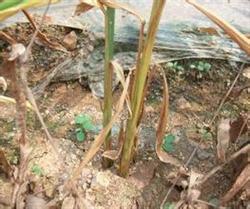
In recent years, as the area of continuous ginger cropping has continued to expand, combined with extensive field management, ginger diseases have also shown a worsening trend, especially since June, when high temperatures and frequent rain make ginger stem base rot most likely to occur. Recently, Li Hualiang and Lu Changlei of Renzhao Town, Pingdu City, Shandong Province, and Yu Wanquan of Ju County, among others, reported that the ginger they planted has already begun to show stem base rot, and they are seeking good control methods. They are introduced as follows:
I. Disease symptoms
In the early stage of ginger stem base rot, water-soaked spots of varying sizes appear at the stem base and gradually expand, and the leaves turn yellow. In the late stage of the disease, the lesions encircle the stem base for one full circle, causing the tissue at the stem base to gradually rot. Because the transport of water and nutrients is blocked, the aboveground main stem dries up and dies from top to bottom, the leaves blacken and fall off, and the plant appears withered. When humidity is high, if the soil is pushed aside, white cotton-like material can be seen on the diseased parts and in the soil. In severe cases, plants begin to die, causing extremely great harm.
II. Transmission routes
The pathogen overwinters as mycelium latent on diseased ginger and diseased residues, or overwinters in the soil as mycelium and chlamydospores, and can cause disease when conditions are suitable. It generally begins to occur in May, and after harvest the seed ginger carrying the pathogen can continue to cause disease, continuing until sowing in March of the following year.
III. Conditions for disease occurrence
High temperature and high humidity favor the occurrence of ginger stem base rot, and the suitable temperature for disease occurrence is 20°C-25°C. Ginger is a light-loving and drought-tolerant plant, and plots with poor ventilation and poor light penetration are prone to the disease. Yellow clay loam and heavily clayey soil have severe occurrence. It is advisable to choose sandy loam with deep soil layers, good drainage, loose texture and rich organic matter, and the soil pH value should preferably be 6-7. Phosphate and potassium fertilizers can effectively promote ginger growth and improve disease resistance. The pathogen can survive in the soil for a long time, and in continuous cropping plots the amount of inoculum in the field accumulates, resulting in more severe occurrence.
IV. Control methods
1. Select disease- and insect-free, non-moldy seed ginger to prevent the spread of diseases and insects and ensure full stands and strong seedlings. When sowing, soak the seed with 40% Fuxing emulsifiable concentrate at 8000 times dilution, or use 200 g of 50% carbendazim per 100 kg of seed mixed with 100 kg of water, soak for 4-5 minutes, and sow after drying.
2. Soil disinfection treatment. In plots where the disease occurs severely, when preparing the land, apply 1-1.5 kg per mu of 70% thiophanate-methyl, 50% carbendazim, 50% dexon or thiram mixed with 30 kg of fine soil and broadcast it into the soil. Applying lime for disinfection in acidic soil can prevent soilborne diseases.
3. Reasonable crop rotation. Rotate for more than 2 years with gramineous crops to prevent disasters and avoid harm.
4. Scientific fertilizer use and soil improvement. Ginger prefers soil with good aeration. Per mu, use 100 kg of potassium sulfate type no-till fertilizer and 2500 kg of well-decomposed farmyard manure, 1 kg of Boron Jiajia, and 1.5 kg of Zinc Jiajia.
5. Ridge cultivation with trellis support improves soil aeration and promotes underground stem growth. Make ridges 1 m wide and 20 cm high. When the seedlings are 30 cm high, set up A-shaped trellises with 4 bamboo poles per sq m to promote ventilation, light penetration and moisture flow, promote leaf photosynthesis, and prevent and control disease.
6. In the early stage of disease occurrence, drench the roots or spray the leaves with 250 times dilution of Duoyongtu plus natural brassinolide - Shuofeng 481, or drench the roots at the diseased parts with 40% Fuxing emulsifiable concentrate at 8000 times dilution or 75% chlorothalonil at 1000 times dilution, applying 50-100 ml per plant, once every 10 days, for 2 consecutive applications.