Detailed Explanation of Key Techniques for Softening Cultivation of Ginger
Softening cultivation of ginger is based on normal cultivation; first, increase the planting density and strengthen measures for shading and cooling, thereby achieving the goal of harvesting tender ginger. In this way, tender ginger not only has a long harvest period and high yield, but is also fresh, tender and crisp, with thin skin and sparse nodes, and has a fragrant ginger flavor when eaten. 1. Site selection: Choose...
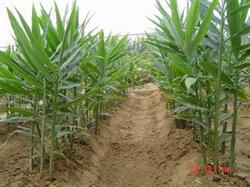
Softening cultivation of ginger is based on normal cultivation; first, increase the planting density and strengthen measures for shading and cooling, thereby achieving the goal of harvesting tender ginger. In this way, tender ginger not only has a long harvest period and high yield, but is also fresh, tender and crisp, with thin skin and sparse nodes, and has a fragrant ginger flavor when eaten.
1. Site selection: Choose fertile soil where ginger has not been planted for 3 consecutive years.
2. Seed selection: Choose fresh ginger rhizomes that are large, have many buds and are free of pests and diseases. Each 667 sq m requires 300 kg of ginger seed.
3. Ginger seed treatment: First soak the ginger seed in a 100-fold solution of 40% formalin for 30 minutes for disinfection, then cover and seal it in gunny sacks for 3-6 hours, then sun-dry it for 2 days, turning it once each morning and evening every day, then pile it indoors for 4 days with the temperature kept at 15°C. Repeat this drying and piling 3 times, which is beneficial for ginger seed sprouting.
4. Sprout promotion: Spray air-dried wheat husks, rice husks, etc. with 1% limewater to moisten them (a humidity of 70% is suitable), and spread them 10 cm thick on the ground inside a shed as bedding. After the last sun-drying of the ginger seed, while the ginger seed is still warm, place the ginger seed on the bedding, arranging it layer by layer, with a pile height of 1 m. Cover the top layer with 5 cm of clean rice straw, then cover with plastic film or plastic sheeting, keep the temperature at 20°C and the humidity at 75%, and carry out light-shielded sprout promotion. When the ginger sprouts grow to 1 cm, they can be sown and planted.
5. Preparation before planting: First cut the sprouted seed ginger into pieces, leaving 2-3 buds per piece. After cutting, dip the cut surfaces in fresh plant ash. First, this disinfects, and second, it can supplement potassium nutrition. Then prepare the land and make beds. Apply 5000 kg of high-quality coarse manure per 667 sq m. After broadcast application of the fertilizer, deep plow 30 cm. After leveling the land, make beds 1 m wide, then cover with plastic film to warm the soil. Plant when the soil temperature is stable above 15°C.
6. Planting: Open furrows and plant at a row spacing of 50 cm and a plant spacing of 15 cm, with 2 rows per bed. When planting, point the bud tips south, with the depth such that the bud tips are level with the soil surface, then spray warm water just enough to moisten the ginger rhizomes, then cover with a thin layer of fine sand just enough to fully cover the ginger bud tips, and then cover with plastic film to preserve heat and moisture to promote bud growth.
7. Field management: Before emergence, control the bed temperature above 15°C. After emergence, provide appropriate shading to prevent strong light. When the ginger seedlings grow 3 side branches, topdress and water. Apply 1000 kg of 50% manure water and 10 kg of urea per 667 sq m. During the peak period of stem and leaf growth, topdress once every 20 days.
8. Pest and disease control: The main disease of ginger is ginger blast. To control ginger blast, use a 200-fold solution of compound ginger blast cleaner to disinfect the ginger rhizomes. In the early stage of the disease, use a 200-fold solution of compound ginger blast cleaner to drench the roots every 10 days, using 300 kg of liquid per 667 sq m. The main pests harming ginger are ginger stem borers and cutworms, which can be controlled by spraying 800-fold solution of 90% trichlorfon once every 10 days.
9. Softening measures: First, hilling for softening. Generally, after each topdressing and watering, hill up the soil around the ginger roots to prevent lodging and promote ginger softening. After 3-4 hillings, the ginger beds gradually become ginger ridges, which can further promote ginger softening. Second, shading for softening. Before the high-temperature season arrives, set up shade frames over the ginger ridge beds and cover them with shade nets to prevent strong light from directly shining on the ginger seedlings. This can lower temperature and preserve moisture, and also plays a role in shading and softening.
Ginger that has undergone softening cultivation should not be harvested as mother ginger, and only tender ginger can be harvested. Generally sown in April, tender ginger can be harvested in August and can be harvested until the end of October. The yield of tender ginger is 3000 kg per 667 sq m.